Table of Contents
Fifty thin city pages that swap the town name and nothing else rank nowhere useful and convert less. They add crawl noise, train distrust, and create compliance risk — while Ads still needs a landing that matches geo and job intent. Multi-area service businesses need location pages that earn calls with proof, not find-and-replace doorway farms. This guide sets a quality bar, a conversion blueprint, information architecture that does not become a spider trap, and content ops that scale without spam.
It is for appointment-led firms — home services, trades, clinics, professional practices — across the US, UK, AU, CA and NZ. Not legal advice; policy notes are high-level. Soft next steps: a Growth Diagnostic when local SEO and Ads landings disagree, or the 90-Day Lead Engine when local architecture needs a time-boxed rebuild. Soft proof posture: Results. Soft cluster: local SEO and Google Ads and Google Business Profile for calls.
Soft service homes: SEO for service businesses, Google Ads for service businesses, Analytics & tracking, and the services hub.
Doorway pages vs useful location pages
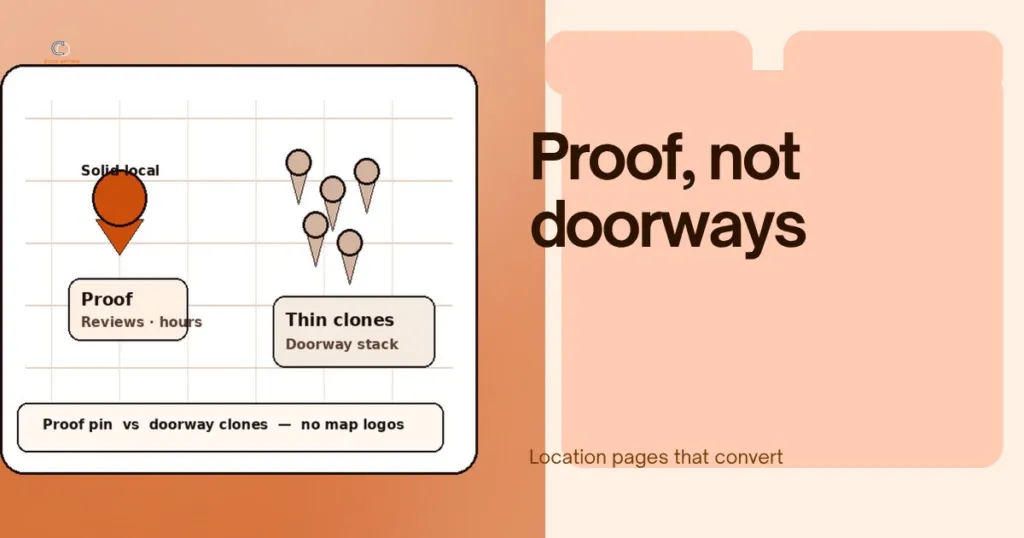
A doorway page is built mainly to rank for a location query with little unique value — thin copy, duplicated paragraphs, stock urgency, no real proof you serve that area well. A useful location page helps a human decide: clear service-area fit, local proof, fast enquiry paths, honest exclusions, and message match with how Ads or organic queries speak.
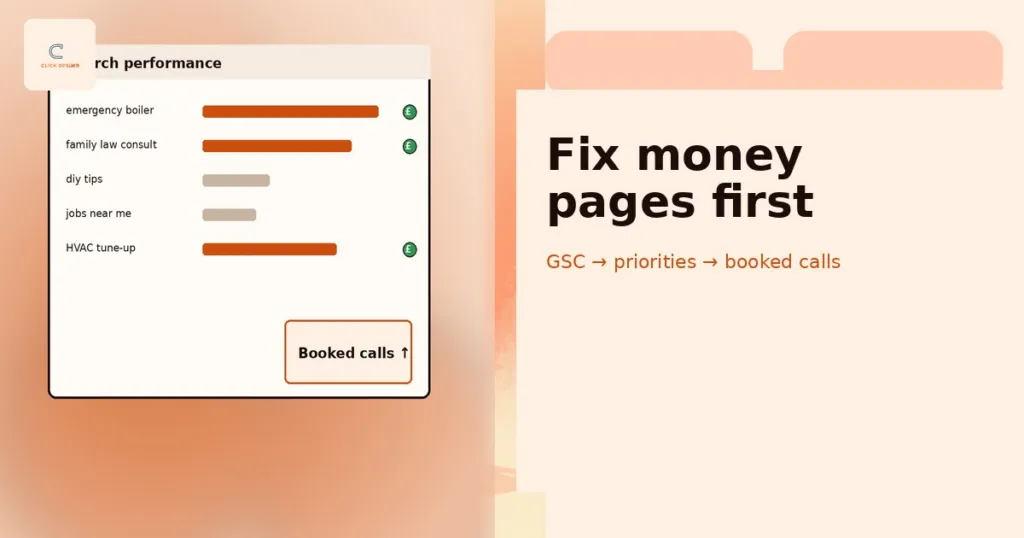
Doorways fail users and often fail SEO over time. Useful pages can support both organic discovery and paid landings when geo targeting matches. Soft money-page discipline from Search Console for service money pages applies: strengthen what deserves to rank; consolidate thin clones. Soft seasonal warning: do not mass-publish spun “summer special [suburb]” pages — see seasonal demand planning.
Useful does not mean a novel per postcode. It means enough unique, accurate substance that a resident or referral partner would recognise you as present — crews, clinics, case proof, travel policy — not a paragraph factory.
A practical test: read the page aloud with the town name muted. If nothing concrete remains — no proof, no access notes, no real FAQs — you are holding a doorway. If substance remains, you likely have a page worth refining. Soft money-page mindset from the wider cluster still applies: invest where demand and capacity meet.
Policy and trust risks (high level, not legal advice)
Search systems and users punish scaled thinness — Google’s spam policies name both doorway abuse and scaled content abuse. Risks include soft ranking suppression, manual actions in severe cases, wasted crawl, brand distrust when every city page reads identical, and Ads experience issues when landings feel spammy. This is not legal advice and not a prediction of enforcement on your site. The commercial rule is simpler: if you would be embarrassed to show the page to a customer in that area, do not publish it. Soft ethics parallel on paid re-engagement: ethical remarketing. Soft agency honesty: brief or fire a Google Ads agency if a vendor’s “local SEO” is doorway volume.
Quality bar: If only the town name changed, it is not ready to publish.
The conversion blueprint for a location page
A converting location page typically includes:
- Unique service proof for that area or cluster — jobs completed, photos, clinician coverage, travel times, neighbourhoods you truly serve.
- Area clarity — who you help, radius or list, and what you refuse (out of area, DIY, wrong job types).
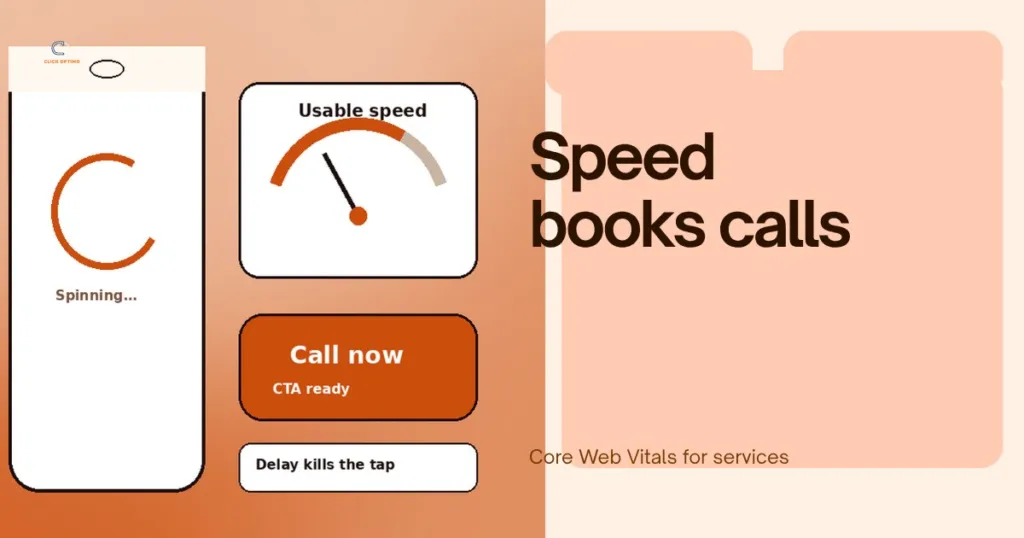
- Fast call and form paths — visible click-to-call, short forms, mobile-first; speed matters — Core Web Vitals and page speed.
- FAQs that match how locals ask — access, parking, after-hours, insurance, emergency vs elective.
- GBP consistency — NAP and service claims aligned with Google Business Profile for calls.
- Message match for Ads — if the ad says boiler repair in a named town, the page must not be generic “welcome.”
Soft landing craft pairs with landing pages that book calls. Soft trust and tracking: track booked calls, not clicks and cost per booked call. Soft spam defence when forms flood: lead quality scoring.
Blueprint beats template theatre. A shared layout is fine; shared emptiness is not. Modular blocks (proof, FAQs, CTAs) should still be filled with genuine local differentiators — not lorem with a city token.
Proof can be proportional. A newer area may start with crew base, travel policy, and honest “we are expanding coverage” language plus strong service links — still better than fake case studies. Never invent reviews or jobs. Soft Results posture for the firm overall stays method-honest on Results; location pages inherit the same rule.
When not to build another city page
Do not build another city page when: you cannot add unique proof; you do not actually serve there this quarter; the query is better served by one strong service page with a clear areas list; Ads would convert better landing all geos on one high-quality URL; or you are cloning to hit a vanity page-count KPI. Prefer fewer strong pages over dozens of near-duplicates. Soft local + paid alignment: local SEO and Google Ads. Soft year-one budget honesty: Ads vs SEO budget in year one — doorway farms are a poor use of SEO budget.
Information architecture and internal links
Architecture should help humans and crawlers: service hubs ↔ location pages without orphan URLs or endless identical siblings. Link from service money pages to the locations you truly support; link locations back to the jobs you sell; avoid reciprocal spam footers with fifty city names and no substance. Soft Search Console ops: search console money pages. Soft SEO system: SEO for service businesses.
Spider traps look like infinite filtered city × service combinations with thin copy. Cap the graph to areas you can staff and prove. Use breadcrumbs and clear nav. Soft measurement of which URLs assist bookings: attribution for assisted conversions and analytics & tracking.
Internal links should carry intent: “boiler repair in [area]” points to a page that books that job, not a blog tag. Soft GBP and site story must stay coherent — one NAP, honest hours, matching services.
Aligning Ads geo and landing choices
Ads geo targeting and landing choice must agree. Sending all geos to one strong page can beat dozens of weak city URLs — especially early. Use specific location landings when proof and offer differ enough to change conversion, and when geo targeting matches capacity (conversion-based Smart Bidding ignores location bid adjustments, so use targeting and budgets). Soft Ads system: Google Ads for service businesses. Soft waste and negatives: wasted Ads checklist, negative keywords. Soft LSA vs Search when product mix matters: LSA vs Search Ads. Soft measurement stack: GA4 + call tracking + Ads.
Never point a town-specific ad at a doorway clone. Soft landing QA belongs in weekly cadence — same discipline as creative tests.
Content ops: how to scale quality
Scale with modular blocks + genuine local differentiators, not a script that spins paragraphs. Process ideas: research what is truly different (access, regulations, common job types, crew base); interview reception for local FAQs; pull real proof with permission; schedule publishing to capacity (do not dump forty pages in a week); review quarterly for accuracy. Soft seasonal content should still qualify — seasonal demand. Soft integrated delivery when SEO and Ads must share one vocabulary: integrated Ads + SEO vs specialists and lead engine rebuild walkthrough.
Ops also means saying no. A salesperson’s request for “every suburb” is not a content brief. Require proof assets before a URL goes live. Soft remarketing should not amplify thin pages either.
Editorial calendar tips that stay anti-spam: batch research interviews by region, publish only when proof packs are complete, and retire or merge pages that never earn enquiries after a fair window. Soft speed check on templates before you clone them across cities — Core Web Vitals. Soft year-one allocation when choosing craft versus media: Ads vs SEO budget.
Measuring location-page contribution to booked calls
Judge location pages on enquiries and booked calls attributable to those URLs — calls, forms, assisted paths — not only rankings or impressions. Use consistent definitions. If ten city pages produce noise and one hub produces diary events, consolidate. Soft tools: analytics & tracking, track booked calls, cost per booked call. Soft commercial rebuild: 90-Day Lead Engine and day-by-day. Soft SEO home: SEO for service businesses.
Search Console helps you see which queries and pages deserve investment; Ads search terms tell you whether geo landings match intent. Soft GBP insights complement site analytics when Maps is a major path. Soft proof of method only on Results — no fabricated local pack lifts in this article.
FAQs
What is a doorway page?
A thin page built mainly to rank for a location query with little unique value—often harmful to users and risky for SEO.
Do service businesses need location pages?
Often yes when you genuinely serve distinct areas and can add unique proof. Not every suburb deserves a near-duplicate page.
What makes a location page convert?
Clear service-area fit, fast enquiry paths, local trust signals, and message match with Ads or organic queries.
Should every location page target Google Ads?
Only when geo targeting and offer match. Sending all geos to one strong page can beat dozens of weak ones.
How do location pages relate to Google Business Profile?
Keep NAP and service claims consistent. GBP and site pages should tell one coherent story.
How can ClickOptimo help?
SEO and Lead Engine work prioritises converting local architecture over doorway volume. Book via /book/.
Next step: fewer pages, more proof
Do not scale local presence with find-and-replace spam. Know doorway risk, ship a conversion blueprint, design IA that humans can use, run content ops that require genuine differentiators, and measure contribution to booked calls. Soft cluster stays local SEO + Ads and GBP for calls. When you want a guided pass, book a short diagnostic.
Book a Growth Diagnostic — twenty minutes, gaps ranked by diary impact.
More context: Growth Diagnostic · services · SEO for service businesses · Google Ads for service businesses
growth@clickoptimo.com · +91-8497982579