
Table of Contents
Google Search Console is useful until it is not: fifty charts, a blog post with impressions, a thin location URL with “coverage” drama — and the money pages that should fill the diary sit ignored. Owners drown in data while service, location and high-intent hub pages stay under-tuned. Google Search Console for service money pages is not a beginner tour of every report. It is a prioritisation guide: fix the pages that can book work first.
This blueprint is for appointment-led firms — home services, trades, clinics, professional practices — across the US, UK, AU, CA and NZ. No fake ranking guarantees. Soft next steps: a Growth Diagnostic when SEO, Ads and tracking disagree on which pages matter, or the 90-Day Lead Engine when money pages need a time-boxed rebuild with SEO for service businesses.
Money pages are the URLs designed to generate enquiries or calls: core services, genuine location pages and high-intent hubs — not every blog post that earned a vanity spike. Soft proof of method sits on Results; logos do not replace diary outcomes. Use GSC as a filter for those pages, then act.
Owners who open GSC without a money-page filter waste mornings on tag archives and dated blog posts that never book a job. Decide the URL set first — write it down — then every chart answers one question: does this help those pages earn enquiries? If a report cannot answer that, close it. Agency decks that lead with “overall impressions up” without a money-page cut are entertainment, not SEO management.
Identify money pages in GSC
Start in Performance → Pages. Export or filter to URLs that sell the job: `/services/…`, location or area pages that actually convert, and hub pages that route intent to a call or form. Exclude archive, tag, author and thin blog URLs from your first pass. If a “money” page has almost no impressions after months live, that is a demand or indexing signal — not a reason to polish a blog instead.
Build a simple priority matrix: High intent × High impressions (protect and improve CTR), High intent × Striking distance (content and title fixes), Low intent × High impressions (demote, noindex carefully, or stop chasing), Technical blockers on money URLs (fix first). Owners who “optimise whatever ranks” reward the wrong scoreboard. Tie page priority to booked calls, not clicks and cost per booked call so SEO work has a commercial filter.
Label each money URL with one owner job: emergency boiler, family consult, HVAC install. If two jobs share one URL, GSC will mix intents and your titles will stay vague. Split or clarify before you rewrite meta en masse. Soft method proof can point to Results; never invent traffic lift percentages.
Brand vs non-brand filters that matter
Brand queries tell you whether people who already know you find the right page. Non-brand queries tell you whether strangers find the offer. Use the built-in branded queries filter in Search Console where your property has it (added late 2025), or filter queries containing your brand names yourself; do not let brand CTR hide weak non-brand titles on service pages. For local services, also segment by city or suburb modifiers when volume allows. Brand comfort is not a substitute for job-intent visibility.
Query opportunities that map to jobs
Open Performance → Queries filtered to a money page (or page group). Look for three patterns:
- Striking distance — positions roughly 8–20 with real impressions: improve titles, first-screen clarity, proof and FAQs that match the query language.
- Intent mismatches — high impressions for DIY, jobs, wholesale or out-of-area themes: fix copy exclusions, consider canonical/index decisions, and feed negative keywords to Ads.
- Near-win job language — queries that name the service and area but land on a generic hub: create or strengthen the specific money page rather than stuffing one URL.
Do not chase every impression spike. Prioritise queries that can become booked work in your service area and offer. A spike for “salary” or “how to become” next to a trade brand is noise, not opportunity. Pair GSC themes with the wasted Google Ads spend checklist so organic and paid waste tell one story.
Write a one-line “job brief” per money page from the top converting query themes: who, where, what happens after they call, what you refuse. If GSC shows two incompatible briefs on one URL, you have a structure problem — not a meta-description problem. Landing pages that book calls need the same clarity whether traffic is organic or paid.
Feeding Ads and content from one query list
Export a shared monthly query list for SEO and Google Ads for service businesses. Mark each row: keep (message match), expand (new FAQ or page), negate (Ads + organic disambiguation), or ignore. When Ads finds a winning angle, SEO should inherit proof and FAQs. When GSC shows a durable non-brand theme with weak CTR, Ads can test headline language while SEO fixes the page. One list beats two silos arguing about “branded vs generic.” Soft next step when the rebuild needs to be time-boxed: the 90-Day Lead Engine.
When you share the query list with Ads, agree a 48-hour SLA for new negatives that are clearly DIY, employment or out-of-area. SEO can still publish a clarifying FAQ on the money page so organic visitors self-select. The goal is one commercial vocabulary: job language in titles, ads and thank-you paths. Without that shared list, SEO “wins” rankings Ads already marked as waste — and the diary never notices.
CTR fixes that stay honest
Titles and meta descriptions for services should name the job, the area where honest, and the next step (call, book, request). Avoid clickbait that raises bounce: “#1 miracle,” fake scarcity, or promises you cannot staff. Honest CTR lifts come from clarity — “Emergency plumber in [area] — call now” beats “Welcome to our plumbing family” on a money page.
Rewrite titles when position is decent but CTR is weak relative to peers on similar queries. AI Overviews and AI Mode appearances are counted in the same Performance report, so some queries now show impressions with fewer clicks — compare like with like. Keep one primary promise; do not cram five suburbs into a spam title. Meta descriptions support the click; they are not ranking magic. After changes, wait for meaningful impressions before judging — and reconcile with enquiry and booked-call trends via Analytics & tracking, not CTR alone.
After a title change, log the date in a simple sheet next to the URL and target query cluster (Search Console now supports custom chart annotations too). Judging CTR after forty impressions is superstition; judging after a few hundred in a stable season is fairer. If CTR rises but booked calls fall, you attracted the wrong click — revert and rewrite for qualification, not drama. Honest titles are a conversion tool as much as an SEO tool.
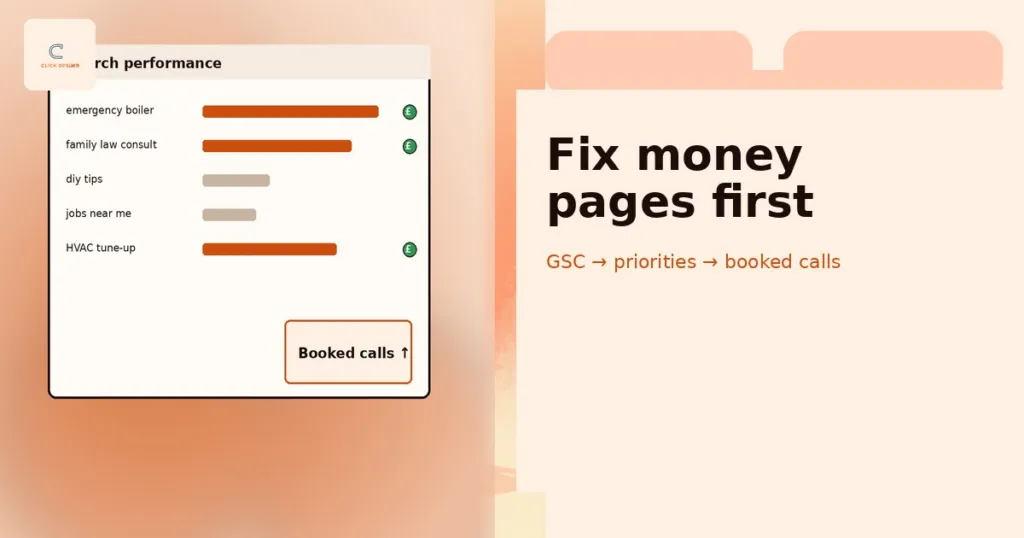
Priority matrix: Fix money-page titles and content gaps before polishing blog vanity CTR.
Local modifiers without doorway spam
Local modifiers belong when you truly serve and can convert that geography. Unique proof, NAP consistency and real coverage matter; doorway-thin suburb clones with spun paragraphs do not. Prefer genuine location or service-area pages that local SEO and Google Ads can share, reinforced by Google Business Profile hygiene for calls. If GSC shows many near-duplicate location URLs competing, consolidate and strengthen rather than multiplying thin variants.
Indexing and experience issues that block enquiries
Coverage and experience issues on money pages block enquiries before optimisation theatre matters. Check Indexing → Pages (the Page indexing report) for errors and exclusions on service and location URLs first. Soft Core Web Vitals: slow heroes, heavy chat stacks and blocking scripts that delay the call path deserve attention — treat speed as conversion, not only “SEO technical.” Mobile usability failures on forms and tap-to-call are enquiry killers — Search Console dropped its Mobile Usability report in 2023, so test on a real phone. Duplicate location thinness creates crawl noise and weak rankings; fix structure before buying more links.
When indexing, message and tracking still disagree with the diary, a short Growth Diagnostic ranks SEO and Ads gaps by booked-call impact.
Do not let “discovered – currently not indexed” on a random tag URL distract from a soft-404 money page. Validate that key service URLs return 200, appear in sitemaps and are not accidentally noindexed after a redesign. Experience issues that hide the phone or form are commercial problems wearing a technical badge — see also the GA4 + call tracking + Ads stack so organic wins are measurable as enquiries.
Treat coverage incidents on money pages like a broken phone line: same-day triage. Soft CWV work can wait a sprint if the URL is indexable and the call path works; a noindexed service page cannot. After migrations or theme changes, re-check the top twenty money URLs before you celebrate “Site Health green.” Experience blockers that delay tap-to-call on mobile deserve the same urgency as a 404.
A monthly GSC rhythm for owners
A focused monthly review plus quick checks after major site changes is enough for many service SMEs. Cadence:
- Money-page filter — impressions, clicks, CTR, position for the URL set that can book work.
- Query scan — striking distance, mismatches, Ads feedback list.
- Title/meta queue — three honest CTR fixes max; ship and measure.
- Coverage spot-check — errors on money URLs only first.
- Diary join — did enquiries and booked calls move, or only charts?
Owners should not live in GSC daily. Agencies and partners should bring a money-page scoreboard, not a screenshot dump — the same standard as briefing or firing a Google Ads agency. When SEO needs durable pages and Ads stress-tests them under spend, use SEO for service businesses as the system home; soft next step for a time-boxed rebuild: the 90-Day Lead Engine and the day-by-day Lead Engine walkthrough.
Handoff the monthly GSC pack in one page: money-page table, three query actions, three title fixes shipped, coverage exceptions, and diary join (enquiries and booked). That is enough for an owner meeting. Anything longer usually hides missing commercial filters. Keep the services and SEO owners aligned so content calendars serve money pages first, not blog volume quotas.
FAQs
What are money pages for a service business?
Pages designed to generate enquiries or calls—typically core services, high-intent hubs and genuine location pages—not every blog post.
How should I use Search Console first?
Filter performance to money pages, review queries and CTR, then fix titles, content gaps and technical blockers that stop enquiries.
Can Search Console insights improve Google Ads?
Yes—query themes inform keywords, negatives and landing message match when shared across teams.
Should I chase every impression spike?
No. Prioritise queries that can become booked work in your service area and offer.
How often should owners check GSC?
A focused monthly review plus quick checks after major site changes is enough for many service SMEs.
How can ClickOptimo help?
SEO and Diagnostic work prioritises money-page impact on booked calls. Book via /book/.
Next step: fix money pages before vanity charts
Do not award the next hour to a blog CTR tweak while service and location URLs underperform on intent, titles or indexing. Filter GSC to money pages, act on queries that map to jobs, keep CTR honest, clear blockers that stop enquiries, and join outcomes to the diary. When you want a guided pass across SEO, Ads and tracking, book a short diagnostic.
Book a Growth Diagnostic — twenty minutes, gaps ranked by diary impact.
More context: Growth Diagnostic · services · SEO for service businesses
growth@clickoptimo.com · +91-8497982579