
Table of Contents
Your cost per lead looks healthy. The agency screenshot is green. Someone is celebrating “cheap leads.” Yet the diary is thin, sales is frustrated, and you still cannot answer the only planning question that matters: what does it actually cost to book a qualified call?
That gap is expensive. Volume without bookings is just expensive noise. This guide is for owners and growth leads of service businesses — trades, clinics, professional services, home services, B2B firms across the US, UK, AU, CA and NZ — who already spend on Google and want a metric sales can verify. If you are still wiring the measurement chain, start with how to track booked calls, not clicks — then come back here to manage the money.
You will leave with a clear reason CPL misleads, a definition and formula for cost per booked call, illustrative maths (example only), when CPL still helps, and decision rules to pause, fix or scale. No #1 guarantees. No ROAS theatre. Operators first.
Volume without bookings is just expensive noise.
What CPL usually counts (and what it ignores)
Cost per lead (CPL) is usually total media spend divided by whatever the account labels a “lead.” In practice that label often includes form fills, chat starts, soft micro-conversions, and sometimes anyone who tapped Call — regardless of whether a human conversation followed.
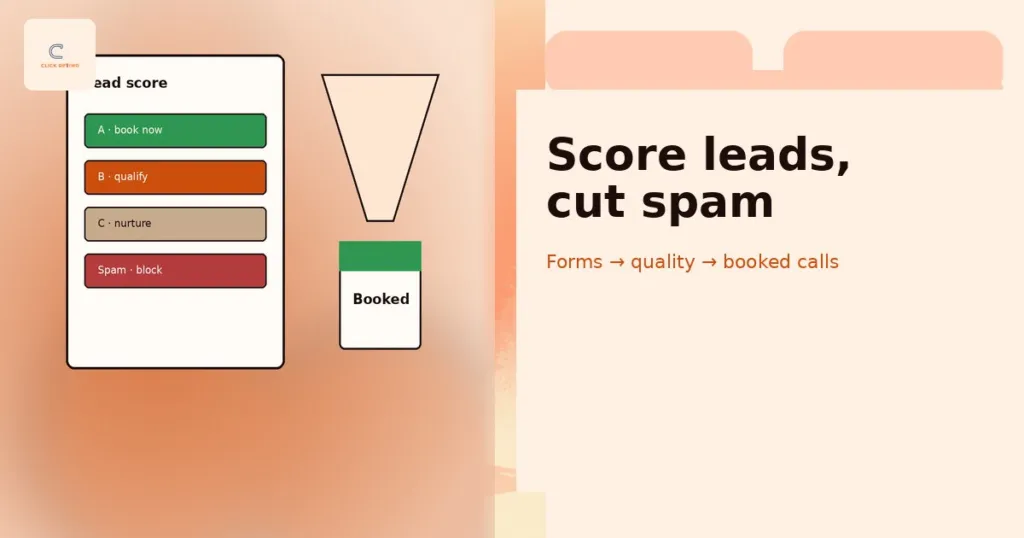
What CPL typically ignores is quality and outcome. Spam, duplicates, wrong-geography enquiries, tyre-kickers, and sales-rejected contacts all lower the headline number. The report looks efficient while capacity is wasted on people who will never book.
| Metric | What it usually counts | What it usually ignores |
|---|---|---|
| CPL | Form fills, chat starts, soft micros, rings | Spam, fit, geography, sales acceptance, diary slots |
| Cost per booked call (CPBC) | Qualified appointments on the calendar / CRM | Vanity volume; tyre-kickers that never schedule |
Leads ≠ conversations ≠ booked calls
Use one ladder; treat everything else as secondary signal.
A lead is an inbound signal — a form, a ring, a chat. A conversation is a real exchange with a prospect. A booked call is a scheduled appointment or confirmed diary slot tied to a real person, usually marked in CRM or calendar. Owners get paid from conversations that become work — not from thank-you pages. If your weekly report stops at “leads,” you are managing noise.
Why agencies love CPL (and owners shouldn’t)
CPL is easy to produce from the ad platform. It moves quickly, looks comparable week to week, and rewards volume. That makes it a comfortable agency scoreboard. Owners should not manage budget on that number alone. A cheap lead that sales rejects is expensive — it costs media *and* sales time. Prefer the diary metric for Scale / Fix / Pause decisions; keep CPL as a hygiene check upstream.
A cheap lead that sales rejects is expensive.
Cost per booked call: definition and formula
Cost per booked call is total relevant marketing spend in a period divided by the number of qualified appointments booked in that same period. In formula form:
CPBC = (media spend + essential tools [+ optional management]) ÷ booked qualified appointments
Include Google Ads (and other paid channels you attribute) as media. Add call tracking, analytics tools, and similar essentials for a fuller view. Include management fees only if you want a fully loaded planning figure — and say so in the report so weeks stay comparable.
What counts as “booked” must be written down with sales: a calendar event, a CRM stage such as “appointment booked,” or an equivalent sales-accepted diary slot — not a phone ring, not a form thank-you, not a missed after-hours voicemail.
Illustrative maths (label as example — no fake client proof)
Example only (not a client result): A service account spends £4,000 on Google Ads and £250 on call tracking and tools in a month. The CRM shows 16 qualified appointments sales accepts as real diary slots. Fully loaded cost per booked call ≈ (£4,000 + £250) ÷ 16 = £265.63.
In the same month Ads reported 40 “leads” at £100 CPL. The dashboard looked efficient. The real cost of a diary slot was more than double the lead metric. That gap is why CPL-only owners keep funding tyre-kickers.
Compare two campaigns with the same spend (illustrative only):
| Campaign | Spend | “Leads” | CPL | Booked calls | Cost per booked call |
|---|---|---|---|---|---|
| A | £2,000 | 40 | £50 | 4 | £500 |
| B | £2,000 | 20 | £100 | 10 | £200 |
Campaign A wins the vanity contest. Campaign B wins the diary. Scale B; fix or pause A until booked-call quality improves.
Cost per qualified enquiry as a bridge metric
Some teams cannot yet mark “booked” cleanly — the CRM is still an inbox, or calendar data is incomplete. Use cost per qualified enquiry as a bridge: spend divided by sales-accepted enquiries (not raw forms). It is stricter than CPL and softer than CPBC. Move to cost per booked call as soon as diary stages exist. Do not let the bridge become the permanent north-star.
How to wire reporting so the number is trustworthy
A formula is useless if systems disagree on the same human. Wire Ads, GA4, call tracking, and CRM or calendar so one prospect is not counted three ways — and so “booked” means the same thing everywhere. See Analytics & tracking for how ClickOptimo scopes that wiring, and Google Ads for service businesses for bidding only after the primary conversion is trustworthy.
Minimum alignment: a written definition of booked; a primary Ads conversion that matches it (or an imported CRM stage); GA4 key events for the same hero actions; call tracking that preserves campaign context where possible; and weekly deduplication when the same person both submits a form and calls.
Attribution windows that match your sales cycle
If your sales cycle is days or weeks, a one-day view will under-credit slow bookers and over-celebrate same-day tyre-kickers. Set reporting and conversion windows to match how long it realistically takes a prospect to book — then hold the definition steady week to week. Changing the window every time the number looks bad destroys trust.
Offline closes and assisted paths (high level)
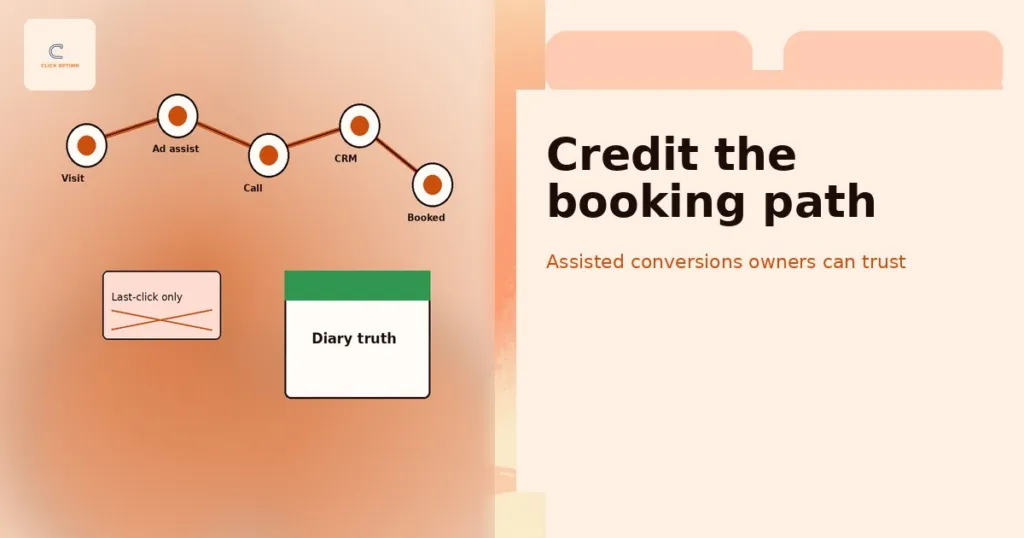
Many service sales close after the first click. Import offline or CRM stages — booked, showed, won — on a reliable schedule so Google Ads can learn what a real outcome looks like. Google’s recommended route is now enhanced conversions for leads, with new API uploads running through the Data Manager API since 15 June 2026. Assisted paths (organic then paid, or call then form) are normal; do not demand perfect multi-touch theatre before you act. Demand one honest diary reconciliation. When Ads, GA4 and the calendar diverge, fix tagging and deduplication before arguing about creative.
When CPL is still useful
CPL is not useless. Use it for early funnel hygiene: creative tests, geo experiments, landing-page variants, and spotting sudden spam spikes. A sharp rise in CPL can flag a broken form or a bad keyword cluster before the diary moves.
What CPL must not be is the sole north-star for a service owner. Manage budget and agency performance on cost per booked call — or cost per qualified enquiry while you bridge. Celebrate falling CPL only when booked calls move with it. Green report, empty calendar: that is a definition problem, not proof the channel is efficient.
Rule of thumb: CPL diagnoses volume and waste upstream. Cost per booked call decides Scale, Fix or Pause. Never let the softer number override the diary.
Decision rules: pause, fix, or scale
Use three plain rules.
Fix first when booked calls are flat (or unknown) while spend rises. Do not “test more budget” on a broken definition. Check conversion tags, call rules, CRM stages, and whether marketing and sales share one sentence for what counts.
Pause or cut segments that produce cheap leads sales consistently rejects — wrong geo, DIY intent, spam-heavy form paths — even if CPL looks attractive.
Scale carefully when cost per booked call is healthy *and* you have capacity to take the appointments. Scaling into a full diary only creates no-shows and angry sales. Capacity is part of the metric story.
If you want a structured read across Ads, SEO and tracking before you move spend, book a Growth Diagnostic.
Red flags in weekly reports
Treat these as Fix or Pause signals, not a cue to add budget:
- Ads “leads” up; booked slots flat or down
- CPL falling while sales rejection rate rises
- Cheap calls look good until you hear recordings
- Forms spike on shared thank-you URLs with no CRM stage
- Nobody can reconcile Spend | Ads conversions | GA4 | Booked calls after one honest week
- Attribution window or “lead” definition changed mid-month to make the chart look better
Green report. Empty calendar. That is a definition problem — not proof the channel is efficient.
How this feeds Ads, SEO and the Lead Engine
One booked-call definition should feed both paid and organic. Shared money pages, shared query lessons, shared negatives: Ads teaches SEO which themes book; SEO landing clarity improves paid conversion. When SEO owns rankings and Ads owns CPL — and neither owns the diary — the founder pays twice for disagreement. See SEO for service businesses and the wider services hub for how those pieces sit together.
Soft proof of method sits on Results. When metrics and the lead system need a rebuild — not a creative refresh — look at the 90-Day Lead Engine: Ads, SEO and tracking aligned to booked calls and qualified enquiries over a fixed runway.
FAQs
What is cost per booked call?
Total relevant marketing spend in a period divided by the number of qualified appointments booked. It focuses on diary outcomes, not raw form volume. Include media as a baseline; add tools (and management if you choose) for a fully loaded planning figure — and keep the definition consistent week to week.
Why is cost per lead misleading for service businesses?
Because many “leads” never become conversations or jobs. Cheap CPL can hide spam, wrong-area enquiries, and tyre-kickers while the calendar stays empty. Owners sell from booked calls and won work — not from thank-you page counts.
How do I calculate cost per booked call?
Add media spend plus essential tracking and tools (and management if you include it), then divide by booked qualified appointments from that period. Write down what “booked” means with sales. Keep the numerator and denominator rules identical every week so trends mean something.
Should I stop tracking CPL entirely?
No. Use CPL for early funnel hygiene, creative tests and geo experiments. Manage budget and agency performance on cost per booked call — or cost per qualified enquiry as a bridge until diary stages are reliable.
What counts as a booked call?
A scheduled appointment or confirmed diary slot tied to a real prospect — usually marked in CRM or calendar — not merely a phone ring or form thank-you page. Agree duration or disposition rules with sales so missed calls and voicemail are not counted as wins.
How does a Growth Diagnostic help with metrics?
It reviews whether Ads, SEO and tracking actually report booked-call outcomes, then ranks fixes by impact. You leave with a clearer Scale / Fix / Pause read before raising spend. Book via /book/.
Next step: manage the diary metric, then scale
Do not treat a falling CPL as progress while the calendar stays quiet. Redefine the scoreboard around booked calls and qualified enquiries, wire reporting so the number is trustworthy, then decide Pause, Fix or Scale with eyes open.
Book a Growth Diagnostic — twenty minutes, measurement-first.
growth@clickoptimo.com · +91-8497982579