Table of Contents
- What “clicks you can’t measure” actually means
- The service-business measurement chain
- The minimum viable tracking stack
- A 10-point wasted-measurement checklist
- Cost per booked call: the metric to manage
- How Ads, SEO and tracking share one story
- When to DIY vs book a Diagnostic
- FAQs
- Next step: measure booked calls, then scale
Your Google Ads dashboard can look healthy while the diary stays quiet. Spend is up. Cost-per-click is down. Someone is celebrating “leads.” Yet you still cannot answer the only question that matters for a service business: which campaigns create booked, qualified calls?
That gap is expensive. A cheap click that never becomes a booked call is still expensive. This guide is for owners and growth leads of service businesses — trades, clinics, professional services, home services, B2B firms — who already spend on Google and want measurement that sales can verify — not another vanity report.
You will leave with a clear definition of “measurable,” a map from click to booked call, a minimum tracking stack, a ten-point checklist, and a straight answer on when to DIY versus book help. No hustle. No guarantee theatre. Operators first.
A cheap click that never becomes a booked call is still expensive.
What “clicks you can’t measure” actually means
“Clicks you can’t measure” are paid or organic sessions without a trustworthy path to a sales-verifiable outcome. Soft conversions — page views, engaged sessions, button clicks — look useful in a report. They are not pipeline.
Three failure modes usually collide: spam or tyre-kicker “leads”; real calls and forms that never reach Ads, GA4, or the CRM; and a conversion definition marketing and sales do not share.
Clicks vs enquiries vs booked calls
Use one ladder; everything else is secondary signal.
| Stage | What it is | What it is not |
|---|---|---|
| Click | Someone opened your ad or organic result | Proof of demand or fit |
| Enquiry | A form submit or phone call that reaches your team | A booked slot or won job |
| Booked call | A scheduled appointment or estimate on the calendar / CRM | A missed call or incomplete form |
| Show / win | They attended — or became a paid job | A marketing vanity metric |
Working definition: A conversion you can manage is a booked discovery call, booked estimate, or sales-accepted enquiry — when it shows on the calendar or CRM and is not spam. Micro-conversions help debugging; they must not drive Smart Bidding.
Why CPL lies when the diary is empty
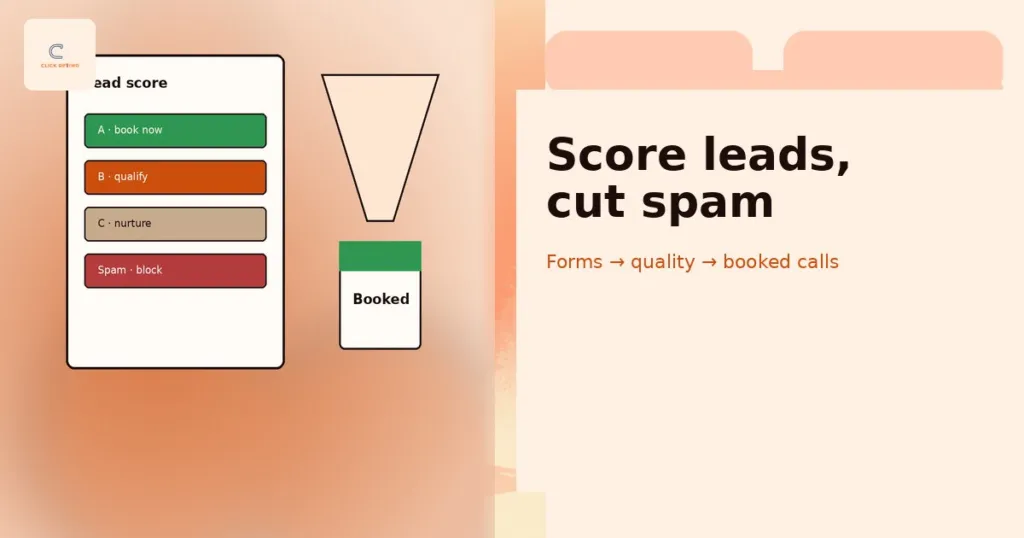
Cost per lead (CPL) helps only when “lead” means something sales accepts. Too often it counts low-quality forms, duplicates, wrong-geo tyre-kickers, or anyone who tapped Call. Service businesses sell from conversations and booked jobs — not raw lead volume. A falling CPL with a flat diary is a reporting fiction, not efficiency.
The service-business measurement chain
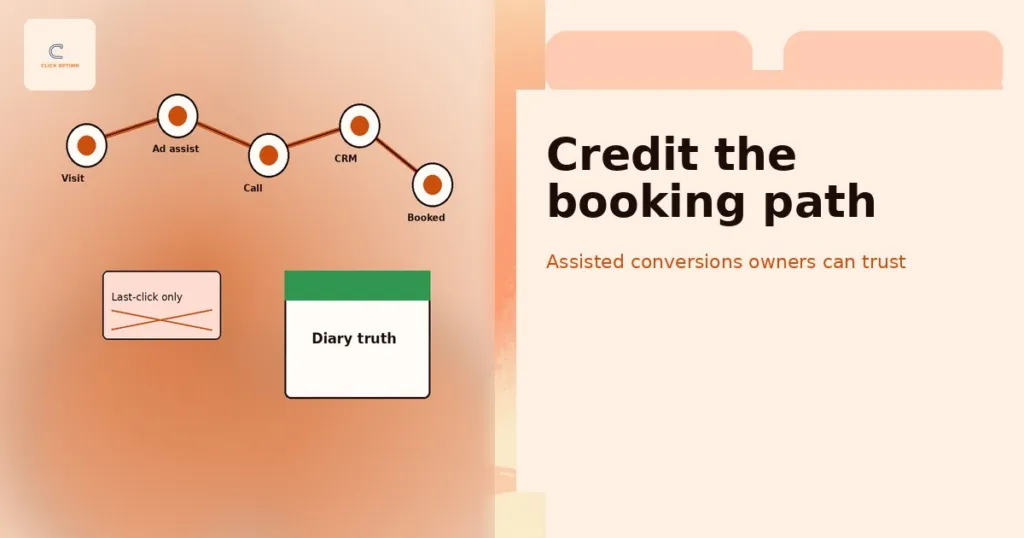
Think end-to-end: ad or keyword → landing page → form or call → CRM stage → calendar event. If any link is missing or defined differently in each system, optimisation becomes guesswork. Ads, analytics, and the phone must roughly agree on one human action.
Forms that create pipeline (not vanity)
A form is pipeline only when submit fires a real event, lands on an attributable thank-you, and creates a CRM record with a status sales can move. Shared thank-you URLs, tags that fire on page load, and inbox dumps without stages inflate “leads” while the diary stays empty. Prefer one sales-agreed hero form — and reconcile weekly against booked slots, not submit counts.
Calls as conversions (click-to-call, call assets, tracked numbers)
For many service businesses, the phone still carries the sale. Treat calls as first-class conversions: click-to-call, call assets on responsive search ads, and tracked numbers on your site. Google stopped new call-only ads in February 2026; existing ones stop serving in February 2027. Agree a duration or disposition rule with sales — a live conversation above a minimum length, not a missed ring or after-hours voicemail counted as a win. Spot-check recordings before celebrating a cheap call CPL.
Offline / CRM import when the sale closes later
Many service sales close days or weeks after the first click. If Google Ads only sees the form or first ring, Smart Bidding never learns what a real win looks like. Import offline conversions or CRM stages — booked, showed, won — on a reliable schedule. Google now recommends enhanced conversions for leads for this, and since 15 June 2026 new API uploads run through its Data Manager API. That is how you track booked calls Google Ads can optimise towards, not tyre-kickers who filled a form.
The minimum viable tracking stack
Keep the stack lean: Google Ads bidding against a trusted primary conversion; GA4 (often via GTM) for the same lead and booked events; call tracking that preserves campaign data where possible; a CRM or calendar that marks “booked.” See Analytics & tracking for how ClickOptimo scopes that wiring.
Google Ads conversion actions that matter
Set a primary conversion that matches the sales definition — a qualified form, qualified call, or imported booked/won stage. Keep micro-conversions secondary or observation-only. Duplicate tags inflate counts and teach bidding the wrong lesson. On Google Ads for service businesses, bid only after that primary action is trustworthy.
GA4 events for leads and booked actions
Mirror the same hero events in GA4 as key events: form submit (form ID, page path), qualified call start or duration threshold if available, and a booked action when calendar or CRM can emit it. When Ads and GA4 diverge, fix consent, tagging, and deduplication before arguing about creative.
Call tracking that doesn’t break attribution
Call tracking earns its keep when it passes campaign and keyword context into Ads and analytics without wrecking local SEO or swapping numbers mid-journey. Match pools to service-area pages. Do not count every missed call as a conversion. Align ad numbers with the same qualification rules as the site.
What “good enough” looks like before you scale spend
“Good enough” is not perfect multi-touch attribution. It is: one written conversion definition; primary Ads conversion and GA4 key event for the same action; calls counted with a sales-agreed rule; and a 14–30 day reconciliation of Ads, GA4, and booked slots within a tolerance you accept. Until that exists, more budget buys louder noise. See the services hub for the wider picture — then fix measurement before you scale.
A 10-point wasted-measurement checklist
Run this week — do not rebuild campaigns yet.
- Hero definition missing — Marketing and sales have not written one sentence for what counts.
- Tag fires on load — Conversion fires on page open, not on a real submit or qualified call.
- Duplicate events — GTM, hard-coded tags, and platform pixels all count the same action.
- Shared thank-you — One thank-you URL covers every form, so micro-actions look equal to real enquiries.
- Calls not counted — Click-to-call, call assets, or site numbers never hit Ads or GA4.
- Missed calls counted as wins — Voicemail and abandoned rings sit with live booked conversations.
- CRM is an inbox — Forms dump to email with no “booked” stage, so nobody reconciles the diary.
- No offline import — Later wins never return to Google Ads, so bidding never sees them.
- Wrong primary or window — The account optimises to a soft event while the diary metric is ignored.
- No weekly reconciliation — Nobody compares Spend | Ads conversions | GA4 key events | Booked calls.
Red flags that mean pause scale, not “add budget”
Pause or cut — do not “test more spend” — when Ads conversions are high and sales says the week was quiet; cheap calls look good until you hear recordings; forms spike but booked slots do not; SEO and Ads both claim credit with no owner of the leak; or you cannot reconcile Ads to the diary after one honest week. Those are Fix or Pause signals, not a cue to add budget.
Green report. Empty calendar. That is usually a definition problem, not a “Google is broken” problem.
Cost per booked call: the metric to manage
Cost per booked call is total relevant spend divided by qualified appointments booked. Include media; add tools (and optional management) for a fully loaded view. CPL helps diagnose volume — it misleads when many “leads” never become meetings. Manage the diary metric; treat CPL as a supporting check.
Sample maths (illustrative — label as example)
Example only (not a client result): A service account spends £4,000 on Google Ads, £200 on call tracking and tools, and books 16 qualified appointments sales accepts. Fully loaded cost per booked call ≈ (£4,000 + £200) ÷ 16 = £262.50. If Ads reported 40 “leads” at £100 CPL, the dashboard looked efficient — while the real diary-slot cost was more than double. That gap is why CPL-only owners keep funding tyre-kickers.
How Ads, SEO and tracking share one story
Organic and paid should land on the same measured money pages. Query themes and negatives from Ads should inform SEO for service businesses; landing lessons from paid tests should improve organic paths. When SEO owns rankings and Ads owns CPL — and neither owns booked calls — the founder pays twice for disagreement. One booked-call definition keeps the story coherent.
Fix tracking before you scale content or bids
More content and higher bids on a broken path amplify waste. Fix tracking first; then decide Scale, Fix, or Pause. Soft proof sits on Results; the method starts with measurement integrity, not vanity traffic.
Tracking before scaling spend. Fix the measurement path first; then decide Scale, Fix, or Pause with eyes open.
When to DIY vs book a Diagnostic
DIY if tags fire correctly, calls follow a sales-agreed rule, CRM or calendar maps to booked status, and you can reconcile Ads to the diary within tolerance. Book a Growth Diagnostic if spend is up while booked calls are flat or unknown, if Ads/GA4/phone disagree, or if nobody can prove which campaigns fill the diary. When the system needs a rebuild, see the 90-Day Lead Engine. Diagnosis first; creative refresh later.
FAQs
What does it mean to track booked calls from Google Ads?
It means capturing when a click leads to a scheduled appointment (calendar or CRM), not only a form fill or phone ring — and sending that signal back to Google Ads and analytics so optimisation targets diary outcomes. Soft events support debugging; the primary conversion should be the booked or sales-accepted action your team trusts.
What is cost per booked call?
Cost per booked call is total relevant spend divided by qualified appointments booked in the period. It differs from cost per lead when many “leads” never become meetings. Include media as a baseline; add tools and management for a fully loaded planning figure.
Why is cost per lead misleading for service businesses?
Because CPL often counts low-quality forms, duplicates, or tyre-kickers. Owners sell from conversations and booked jobs — not raw lead volume. A falling CPL with an empty diary is not efficiency; it is a definition problem that invites more spend on the wrong signal.
What is the minimum tracking stack for a service business?
Google Ads conversion actions for meaningful enquiries and calls, GA4 (often via GTM) for the same events, call tracking that preserves campaign data where possible, and a CRM or calendar stage that marks “booked.” Wire them so one human action is not counted three ways.
Should I fix tracking before increasing Google Ads budget?
Yes if you cannot see which campaigns produce booked calls. Scaling unmeasured spend usually raises cost without teaching the account what “good” looks like. Raise budget only on segments you can already prove; keep the rest in Fix until reconciliation holds.
How does ClickOptimo’s Growth Diagnostic help with measurement?
It is a short, measurement-first review of Ads, SEO and tracking gaps — so you leave with priorities ranked by impact on booked calls, not a vanity traffic report. You get a clearer Scale / Fix / Pause read before changing creative or raising spend. Book via /book/.
Next step: measure booked calls, then scale
Do not treat unmeasurable clicks as progress. Define the booked call, wire the minimum stack, run the checklist, and reconcile Ads to the diary — then scale what sales can verify.
Book a Growth Diagnostic — twenty minutes, measurement-first.
growth@clickoptimo.com · +91-8497982579