Table of Contents
- Why trust is the bottleneck for service businesses
- Which content answers which buyer question
- Seven types of content that build trust before the first call
- How to plan content from your sales calls
- How to get trust content seen
- How to measure content in booked calls
- Common mistakes with service business content
- FAQs
- Next step: turn this week’s calls into your first trust page
Most service businesses do not lose jobs because their ads are weak. They lose them in the gap between someone finding them and deciding to call. In that gap, the buyer asks questions you never hear: how much will this cost, what happens on the day, have you done this before? If your website does not answer them, a competitor’s will.
That is what content marketing is for in a service business. Not a weekly post to “stay active”, but pages that answer the questions buyers have before they pick up the phone. Done well, this content shows up while people are deciding, and makes the call itself shorter, warmer and more likely to end in a booking.
This guide is for owners and marketing leads of service businesses — trades, clinics, home services and professional firms — across the US, UK, AU, CA and NZ. It covers why trust is the real bottleneck, seven content types that build it, how to plan topics from your own sales calls, how to get the content seen, and how to measure it in booked calls rather than page views.
The best content for a service business is the answer your team already gives on the phone, written down before the buyer has to ask.
Why trust is the bottleneck for service businesses
Buying a service is a risk. A homeowner letting a stranger in, a patient choosing a clinic, a director picking an accountant: none of them can inspect the product first. They are buying a promise, so they hunt for signals that you are safe to call.
Ads and SEO put you in front of the right people. They cannot make those people trust you. When trust is missing, you see plenty of visits but few calls, calls that end with “I’ll think about it”, and quotes that go quiet. More traffic rarely fixes this, because the leak happens after the click.
Trust content plugs that leak. It matters more as AI overviews and chat assistants summarise answers, because clear, first-hand answers give those tools something worth citing. We cover that shift in why SEO still matters in 2026.
Which content answers which buyer question
Before writing anything, map each content type to the question it answers, where it lives and how you will know it works.
| Content type | Buyer question it answers | Where it lives | What to measure |
|---|---|---|---|
| Pricing explainers | “How much will this cost, and why?” | A dedicated guide linked from each service page | Calls and forms started after viewing it |
| “What to expect” pages | “What happens after I call?” | Service pages, booking page, confirmation emails | Clicks to book; fewer process questions on calls |
| Case examples and local proof | “Have you done this for someone like me, near me?” | Case study hub, service pages, area pages | Booked calls where the page was viewed first |
| Comparison pages | “Which option is right for me, and is it worth it?” | Guides section, linked from related services | Assisted conversions; branded searches |
| Expert FAQ answers | “Is my situation normal, and can you fix it?” | FAQ blocks on service pages, longer answer posts | Question-query impressions; calls |
| Team and credentials | “Who will turn up, and are they qualified?” | Team page, service pages, author boxes | Views in sessions that end in a booking |
Seven types of content that build trust before the first call
You do not need all seven at once. Start where your calls show the most doubt.
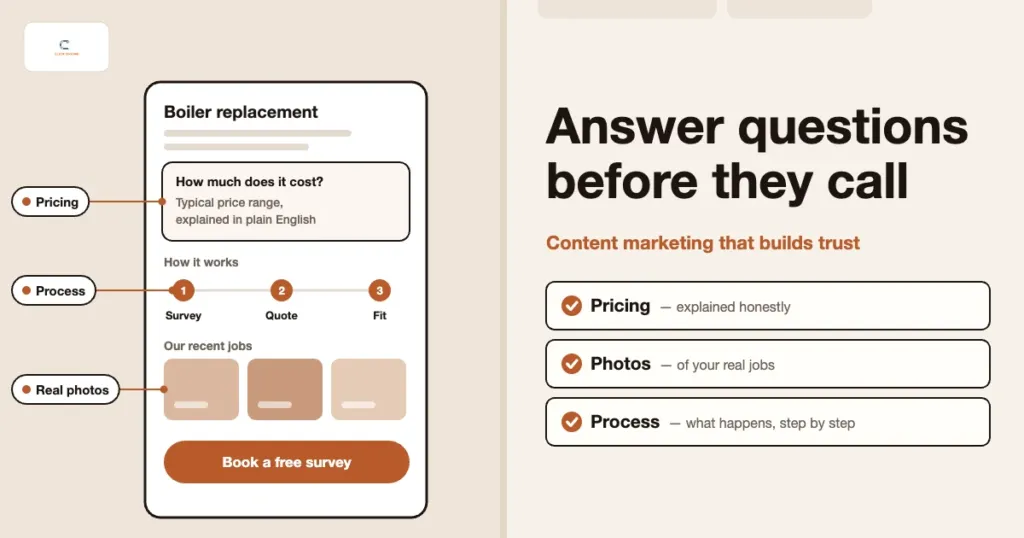
1. Pricing explainers that answer “how much does it cost?”
Pricing is the question every buyer has and most service businesses avoid, because jobs vary. But silence reads as “expensive” or “hiding something”. A good explainer gives typical ranges, what pushes a job up or down, what is included, and how you quote.
You do not need a fixed price list. “Most replacements we fit fall within this range, and here is what moves it” is honest and useful. It also filters out people who were never going to buy.
2. “What to expect” and process pages
Uncertainty stops calls. A buyer who cannot picture what happens next will often wait. A process page walks through it in plain steps: the first call, the visit or consultation, the quote, the work and the aftercare. Add timings and who they will deal with.
Link this page from every service page and from your booking confirmation. It reassures nervous buyers before the call and helps reduce no-shows after it.
3. Case examples with real photos
Stock photos prove nothing. Real photos of real jobs, with a short write-up of the problem, what you did and the outcome, prove a lot. Clinics can use anonymised patient journeys, within their profession’s consent and advertising rules. Professional firms can describe the situation and result without naming the client.
Keep each example specific: the client type, the area, the constraint and the decision you made. Specifics make it believable.
4. Comparison and “is it worth it” pages
Buyers compare: repair against replace, one treatment against another, DIY against hiring someone. Comparison pages answer “which option is right for me?” honestly, including when the answer is not you.
That honesty is the point. “For a small job, a handyman is probably fine; here is when you need a specialist” earns more trust than pretending every job needs you.
5. Expert FAQ answers from your team’s real calls
Your front desk, estimators and practitioners already know what buyers ask. Turn the best answers into short FAQ entries on service pages, and longer posts where a question deserves room. Write them in your team’s phone voice, not marketing language.
These answers often match how people phrase searches, so they attract qualified visits. Check your wording with proper keyword research for service businesses, so you use the phrasing buyers actually use.
6. Team and credentials pages
People buy from people. A team page with real photos, names, roles and qualifications answers “who will turn up?” and “are they qualified?”. For clinics and professional firms, it is often one of the last pages viewed before booking.
Put credentials on service pages too. A line naming who does the work, and what qualifies them, beats a row of footer badges.
7. Local proof: area pages built on jobs you have done
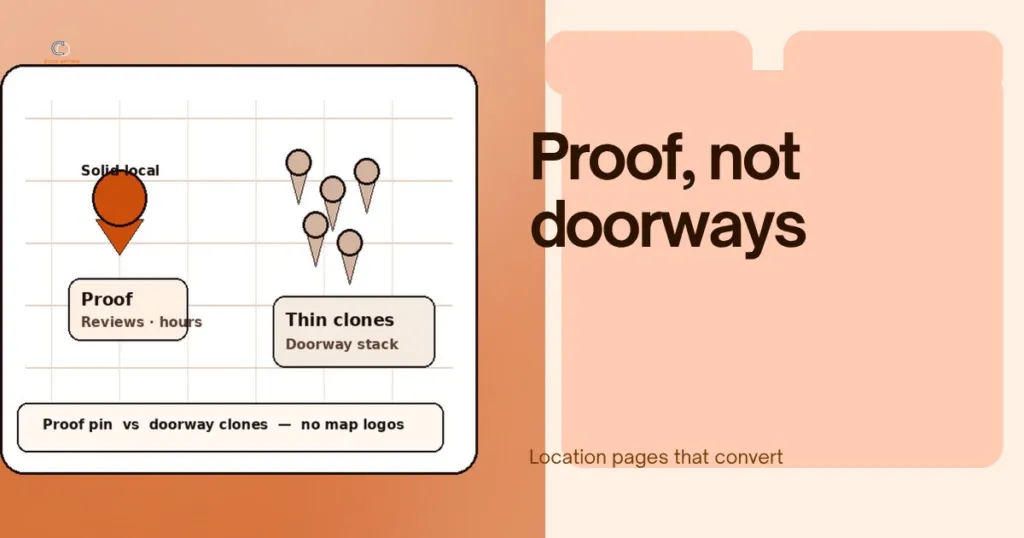
Area pages work when they prove you work there: local jobs, photos, common local issues and nearby reviews. They fail when they are one page with the town name swapped. Google’s spam policies treat near-identical pages built for different places as doorway pages, and buyers see through them too.
Only build one when you have real local proof. Our guide to location pages that convert covers the structure and content in detail.
How to plan content from your sales calls
Your best content plan is already in your phone system, inbox and quote notes. Keyword tools show what people search for; calls show what stops them booking. Run this once a quarter.
- Collect the questions. Ask whoever answers the phone to note every question for two weeks. Add questions from emails and lost quotes.
- Group them by stage. Sort them into early questions (“do you cover my area?”), middle questions (“how much, how long?”) and late objections (“why are you dearer than the other quote?”).
- Match each group to a format. Price questions point to an explainer, nerves to a process page, and doubt about results to case examples.
- Check search demand. Use keyword data and Search Console to see which questions people also search for, and how they phrase them.
- Prioritise by revenue. Start with questions attached to your most profitable services, not the ones that are easiest to write.
Record the answer, then write it. Ask your best salesperson or practitioner to answer one buyer question out loud for three minutes and record it on a phone. Use the transcript as your first draft. It keeps the voice real and saves hours.
Then give each piece an owner and a publish date. A short list that actually gets published beats a long plan that never leaves the spreadsheet.
How to get trust content seen
Publishing is half the job. Trust content needs to reach buyers while they are deciding.
- Search. Link each piece from the relevant service page and back again, so visitors can move from question to booking in one click. Use Search Console to watch your money pages and spot which questions they start appearing for.
- Google Business Profile. Share short excerpts as profile posts and add your real job photos. Google has been replacing the old public Questions and answers section on profiles with AI-generated answers, so keep clear FAQ answers on your website and profile for it to draw on. Our guide to Google Business Profile for calls covers the settings that matter.
- Email. Send your process page and pricing explainer automatically after an enquiry, before the visit or consultation. That sequence sits at the heart of good email automation for service businesses.
- Sales follow-ups. Give your team a short library of links to send after calls and with quotes. A comparison page sent alongside a quote answers “why are you dearer?” before the buyer asks it.
How to measure content in booked calls
Content rarely gets the last click, so last-click reports undersell it. Measure it in three ways, monthly.
Assisted conversions. Look at how often content pages appear in the path before a booked call, not just whether they were the final page. Our guide to attribution and assisted conversions shows how to read this properly.
Booked calls from content pages. Track calls and form submissions that start on, or follow a visit to, your trust pages. This only works if you are already tracking booked calls, not clicks. Otherwise you are measuring noise.
Branded searches. When content works, more people search for your business by name. In Search Console’s Performance report, use the branded queries filter (or filter queries containing your brand name if your site does not have it yet) and watch the trend month by month alongside what you have published.
Finally, add “What helped you decide to call us?” to your intake script. The answers are often the clearest signal you will get.
Common mistakes with service business content
- Writing for volume, not questions. Publishing to a schedule produces thin posts nobody needed. One page that answers a real objection is worth more than ten generic tips.
- Dodging the price conversation. Avoiding cost entirely sends buyers to the competitor who explains it.
- Area pages with nothing local. Swapping town names creates thin pages that rarely rank and never convince. It is one of several SEO mistakes that hurt rankings.
- Orphaned content. Posts that are not linked from service pages, emails or quotes do very little. Every piece needs a clear route to a booking.
- Measuring page views. Traffic without booked calls is a vanity number.
FAQs
How much content does a service business need?
Less than most people think. Start with a pricing explainer, a process page and a handful of case examples for your main service, then add FAQ answers and comparison pages as your call notes reveal gaps. A few strong pages tied to revenue will do more than dozens of generic posts.
Should we publish prices if every job is different?
You do not need a fixed price list, but you should explain typical ranges and what changes them. Buyers mainly want to know whether you are in their ballpark and how quoting works. Clear ranges also filter out enquiries that were never going to convert.
How long before content produces booked calls?
Some benefits are immediate, because a process page or pricing explainer sent after an enquiry can help close calls this week. Search visibility takes longer and depends on your competition and your site’s existing authority, so plan in quarters rather than weeks. Measure the two effects separately.
Can we write the content ourselves?
Yes, and your team’s knowledge is the most valuable ingredient. The usual gaps are time, structure and search: choosing the right questions, linking pages properly and tracking results. Many businesses supply the expertise through recorded interviews and let a content marketing partner handle the planning, writing and measurement.
How can ClickOptimo help?
We turn your sales calls, quotes and search data into a content plan, write the pages in your team’s voice, connect them to your service pages and SEO, and track the booked calls they help produce. If you want to see where trust is leaking before the first call, start with a Growth Diagnostic. Book via /book/.
Next step: turn this week’s calls into your first trust page
This week, ask whoever answers your phone to write down every question callers ask for five working days. On Friday, pick the question that came up most often for your most profitable service, record your best person answering it, and turn that recording into a page linked from the service page.
Book a Growth Diagnostic — we’ll show you which trust gaps are costing you booked calls and what to publish first.
More context: Conversion-focused website design · GA4, call tracking and Google Ads measurement · Ads vs SEO budget in year one
growth@clickoptimo.com · +91-8497982579