Table of Contents
Year-one marketing budgets for service businesses get trapped in a false fight: “all Google Ads” versus “SEO is free traffic.” Neither side books calls alone. Paid demand without durable pages burns cash; SEO without measurement and near-term pipeline leaves the diary empty while foundations compound. The useful question is not a magic percentage — it is how to allocate scarce year-one money across media, tools and implementation so booked calls and qualified enquiries improve without dogma.
This guide is for appointment-led firms — home services, trades, clinics, professional practices — across the US, UK, AU, CA and NZ. Scenarios below are illustrative, not a fixed rule such as 60/40. Soft next steps: a Growth Diagnostic when Ads, SEO and capacity disagree on where money should go, or the 90-Day Lead Engine when year one needs a time-boxed rebuild. Soft proof posture: Results — method, not invented budget outcomes.
Pair paid-channel choices with LSA vs Search Ads when the split inside paid matters. Keep Google Ads for service businesses and SEO for service businesses on one scoreboard: cost per booked call, not vanity CPL alone — see cost per lead vs cost per booked call.
What the budget must cover
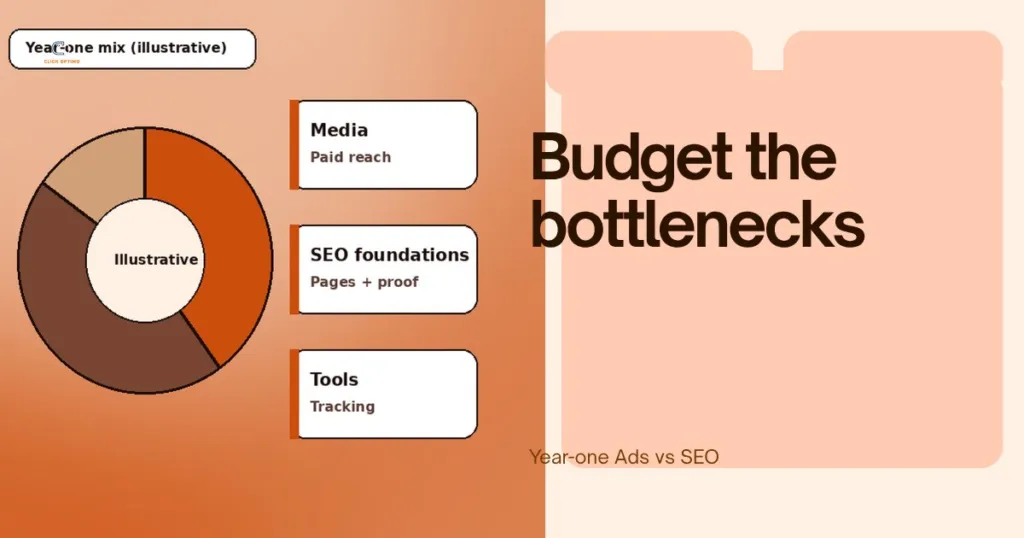
A year-one “Ads vs SEO” conversation that only debates media clicks is incomplete. The budget must cover three buckets: media spend (Search, and where relevant LSA or capped experiments), tools and tracking (call tracking, analytics, CRM hygiene, creative production where needed), and implementation time or management (someone who can change campaigns, pages and definitions weekly). Soft home for the measurement slice: Analytics & tracking. The services hub is where those pieces sit together.
Ignore any bucket and the others lie. Cheap media with no call tracking teaches Smart Bidding the wrong lesson. “Free SEO” that burns founder evenings without money-page craft is unpaid labour, not a strategy. Management fees that nobody includes in unit economics make cost per booked call look prettier than the business feels. Decide deliberately what counts in your unit cost — many owners include management for true economic cost — then keep the definition consistent.
Document the three buckets on one page before you argue percentages. Owners who only fund media discover mid-year that tracking renewals and page work were never owned. Treat the allocation as a framework to adapt, not a fixed formula.
Implementation time is easy to undercount. Someone must mine search terms, update negatives, ship money-page edits, and reconcile booked calls weekly. If that someone is you after 9 p.m., the “cheap” plan still has a labour cost — and quality usually slips first. If that someone is an agency or hire, put the fee where unit economics can see it. Soft rebuild framing when you need the intensive package named: the lead engine rebuild walkthrough.
Ignoring tools sinks “cheap” media
Extremely thin tool budgets produce expensive lessons. Without trustworthy conversions you cannot judge whether Ads or SEO is “working.” Fixing the GA4 + call tracking + Ads stack is often the highest-ROI early spend even when it feels unsexy next to more clicks. A delayed call button or spam-flooded form wastes every pound or dollar of media — speed and lead quality are budget topics too, not only Smart Bidding toggles. Soft pair: track booked calls, not clicks.
Decision drivers
Four drivers shape year-one splits more than influencer templates: time-to-diary need, competition and CPC reality, brand strength, and multi-location complexity. Urgency — empty diary next month — usually requires paid demand while SEO foundations build. High CPCs do not automatically mean “skip Ads”; they mean you must buy cleaner intent, stronger landings and tighter geo. Weak brand increases the cost of non-brand learning and the value of brand defence. Multi-area firms pay more for coherent location architecture and GBP consistency — thin doorway farms are not a bargain.
Competition CPCs interact with offer margins. A high CPC job with healthy margins and clear booking paths can still deserve paid; a low-margin DIY-prone theme may deserve negatives and SEO disambiguation instead of more spend. Brand strength changes the mix: strong name search needs defence funding; weak brand needs message-matched landings before scale. Soft local cluster: local SEO and Google Ads.
Drivers also include seasonality and learning periods. Buying a tiny budget that never exits learning wastes the line item. Sometimes consolidating themes beats spreading spend across twelve half-starved campaigns. Soft waste discipline: wasted Google Ads spend checklist.
Capacity ceiling as a budget governor
Capacity is a hard governor. If the diary is eighty per cent full, buying more unqualified forms is vanity — shift toward higher-margin jobs, tighter geo, brand defence or SEO that compounds without flooding spam. Peak weeks without an SLA burn goodwill and cash; see seasonal demand planning and lead quality scoring. Budget that ignores capacity is an auction you cannot staff.
Governor: Never fund volume your phone and diary cannot serve well.
Three illustrative scenarios (label clearly)
These scenarios are illustrative planning sketches, not prescriptions. Relabel them to your market; revisit when measurement matures.
Scenario A — Urgent pipeline. Diary thin, brand weak-to-moderate, CPCs manageable on a few high-intent themes. Year-one skew often leans paid-heavy for near-term booked calls, with a non-negotiable slice for tracking and two or three money pages that match ads. SEO work is practical: GBP hygiene, money-page clarity, Search Console fixes — not a content mill. Soft paid home: Google Ads for service businesses. Soft landing bar: landing pages that book calls.
Scenario B — Balanced build. Some inbound brand, steady capacity headroom, competition real but not absurd. Split media and SEO foundations more evenly: paid captures job-intent while SEO strengthens money pages, internal links and local trust. Shared KPI remains booked calls. Soft SEO home: SEO for service businesses. Soft money-page ops: Search Console for service money pages.
Scenario C — SEO-heavy brand markets. Strong brand, reviews and referrals already fill much of the diary; paid is expensive or mainly defensive. Year one may weight SEO and reputation systems more heavily — GBP, location quality, money pages — while keeping a funded brand and selective non-brand paid line so competitors do not own your name. Soft GBP: Google Business Profile for calls. Soft location quality (not doorways): location pages that convert.
In all three, tools and management remain visible line items. Soft commercial path when the whole system needs a reset: the 90-Day Lead Engine and day-by-day walkthrough. Soft decision framing for who runs it: integrated Ads + SEO vs specialists.
Label your chosen scenario in the finance notes for six months. When someone asks “why so much on tools?” you can point to the scenario assumptions — urgency, brand, capacity — instead of re-litigating Twitter. If reality diverges (capacity fills early, a theme never books), that is a trigger to move, not a failure of planning.
How splits evolve after measurement matures
After conversions become trustworthy, reallocate toward what actually books — not what looked cheap on CPC. Some firms discover brand defence deserved more; others discover a theme never books and should die. SEO investment often rises once money pages exist and content can support them without guessing. Paid may consolidate. Soft attribution nuance when cycles stretch: attribution for assisted conversions. Soft remarketing ethics when you re-engage: ethical remarketing. Evolution is scheduled review, not set-and-forget religion.
What not to fund yet
Do not fund vanity content mills that never touch money pages. Do not fund untracked campaigns “just to see.” Do not fund doorway location farms. Do not fund social-as-core experiments if your wedge is Google demand and booked calls. Do not fund decorative rebrands while the call button is broken on mobile. Soft speed note: Core Web Vitals and page speed — slow landings tax every media pound.
Decline also applies to exotic tools before basics: warehouses before call tracking, creative suites before negatives, five landing variants before one clear path. Soft next step when priorities are cloudy:
Reallocation triggers mid-year
Revisit the split when: conversion definitions change and hold for several weeks; capacity shifts; a season approaches; CPCs or margins move materially; money pages finally convert and SEO deserves more craft; or paid learning stalls because the budget is too thin to exit learning. Soft commercial rebuild when the stack is tangled: the 90-Day Lead Engine. Soft service homes: Google Ads, SEO, Analytics & tracking.
Triggers should be written before panic. A one-page rule — “if booked-call rate collapses under spam, pause themes X; if capacity hits Y, shift to brand and qualification” — saves Slack chaos. Soft negatives and waste habits keep mid-year moves surgical rather than theatrical.
Mid-year reviews also catch silent SEO debt: money pages that still say “welcome,” GBP hours that drifted, or location clones that never earned a call. Reallocation is allowed to fund craft on pages that already attract demand — not only more media. Soft local quality bar when that debt is geographic: location pages that convert. Soft speed tax when landings waste clicks: Core Web Vitals and page speed.
FAQs
Should service businesses spend more on Google Ads or SEO in year one?
It depends on urgency, competition and brand strength. Many need paid demand while SEO foundations build—both should share booked-call KPIs.
Is there a perfect Ads vs SEO percentage split?
No universal split. Use scenarios and revisit as measurement and capacity change.
Does SEO cost money if I’m not paying for clicks?
Yes—time, tools, content/pages and expertise. Treat it as investment, not “free traffic”.
What if my Ads budget is too small to learn?
Extremely thin media budgets struggle. Sometimes consolidating themes or fixing conversion first beats spreading spend.
Should management fees count in cost per booked call?
Decide deliberately and keep the definition consistent. Many owners include management for true economic cost.
How can ClickOptimo help with allocation?
A Growth Diagnostic ranks gaps so budget follows impact. Book via /book/.
Next step: fund bottlenecks, not slogans
Do not let year one become a Twitter argument with invoices attached. Cover media, tools and implementation; let urgency, competition, brand and capacity drive scenarios; starve vanity and untracked work; reallocate when measurement matures. Soft proof stays method-only on Results. When you want a guided pass, book a short diagnostic.
Book a Growth Diagnostic — twenty minutes, gaps ranked by diary impact.
More context: Growth Diagnostic · services · Google Ads for service businesses · SEO for service businesses
growth@clickoptimo.com · +91-8497982579