
Table of Contents
Service owners shopping for a rebuild usually get either a sales deck of invented before/after charts or a retainer brochure that never shows the working. This post does neither. It is a composite, anonymised walkthrough of how ClickOptimo thinks through a lead generation system rebuild for appointment-led firms — home services, trades, clinics and professional practices across the US, UK, AU, CA and NZ. No named clients. No fabricated percentage lifts, ROAS screenshots or invented lead counts. Soft public posture for method proof sits on Results; logos do not replace a decision sequence you can recognise.
The promise is a decision log: starting conditions we often see, diagnostic questions that unlock the plan, first rebuild moves and why order matters, how we judge early signals without fake victory laps, and owner responsibilities that make or break the work. Soft next steps: a Growth Diagnostic when priorities are unclear, or the 90-Day Lead Engine when you need a time-boxed Ads, SEO and tracking rebuild aimed at booked calls.
We don’t invent proof—we show our working.
If you want the calendar view of intensive work, pair this with the 90-day Lead Engine day-by-day. If you are still choosing integrated versus specialist delivery, see integrated Ads + SEO vs specialists. This piece is the reasoning spine behind both.
Starting conditions we often see
Composite patterns recur. Spend is live — sometimes substantial — but “conversions” are form fills, thank-you views or short calls that never become diary events. SEO sits in a separate silo publishing blog posts that do not support money pages or Google Ads themes. Landing pages say “welcome” while ads promise a specific job. Call tracking is half-installed or counted twice. Capacity is unknown to whoever buys media. Brand is under-defended. Negatives are thin. The owner feels busy and underinformed at once.
None of that is a morality play. It is what happens when channels optimise to their own dashboards. A rebuild starts by refusing to treat the loudest dashboard as truth. Soft method proof can point to Results; never invent “booked calls up 47% in six weeks” for content. Tie the north star to booked calls, not clicks and cost per booked call before anyone rewrites campaigns for cosmetics.
Owners who skip starting-condition honesty default to creative theatre: new ads, new slogans, same lying conversion action. The account learns the wrong customers faster. Naming the mess — measurement fiction, siloed SEO, weak money pages — is the first commercial kindness.
When we first open an account, we also note what is already working: a strong brand campaign, a money page that books, a receptionist SLA that catches after-hours forms. Rebuilds that torch assets to look busy are vanity. Preserve what converts; replace what teaches the wrong lesson.
What we refuse to assume on day one
We refuse to assume that Ads “conversions” equal booked work, that Search Console impressions equal demand you can serve, that last agency’s structure is sacred, that capacity can absorb whatever paid buys, or that a week of clever copy will fix a tracking lie. We also refuse to assume a full site rebuild is required on day one. Assumptions become expensive when Smart Bidding trains on them. Day one is questions and access, not heroics. Analytics & tracking is often the first honest home when the stack cannot name a booked call.
Diagnostic questions that unlock the plan
Diagnostic work is not a fifty-page audit for theatre. It is a short set of questions that force commercial clarity: What jobs do you sell — and refuse? Which areas can you actually serve this quarter? What does a good enquiry look like to sales or reception? Where do calls and forms land, and who owns first response? What is true capacity before quality collapses? Which CRM or sheet is the diary of record? Soft entry when the answers disagree across people: a Growth Diagnostic via /book/.
Capacity, areas, offer and CRM reality decide more of the rebuild than a keyword list. A clinic that cannot take new patients on Tuesdays should not buy Tuesday volume theatre. A trade firm with a sixty-minute travel radius should not bid into three cities of vanity. Offer clarity includes exclusions — DIY, tyre-kickers, out-of-scope jobs — so negatives and SEO “do not chase” notes share one vocabulary. CRM reality means stages you will defend in a Monday meeting, not a fantasy funnel nobody updates.
Ask who owns the phone after hours and what happens to spam. Lead handling is part of the engine; media cannot book a call that never gets answered. Patterns from lead quality scoring and spam form defence matter when forms are drowning the diary. Measurement questions sit beside commercial ones: which conversion is primary, which events are noise, whether call tracking and GA4 agree enough to learn.
Ranking problems vs measurement problems
Many “we need more SEO” briefs are measurement problems wearing a ranking costume. If you cannot trust which channel produced a booked call, buying more organic content will not clarify the P&L. Ranking problems are real — thin money pages, weak GBP, doorway clones — but they are diagnosed after you can define success. See the minimum viable measurement stack and Search Console for money pages when the issue is genuinely discoverability of pages that book. Soft honesty: if the diary and Ads disagree, fix instrumentation before arguing about pack rankings.
Day-one rule: Rank problems after you can name a booked call the owner will defend.
First rebuild moves (and why order matters)
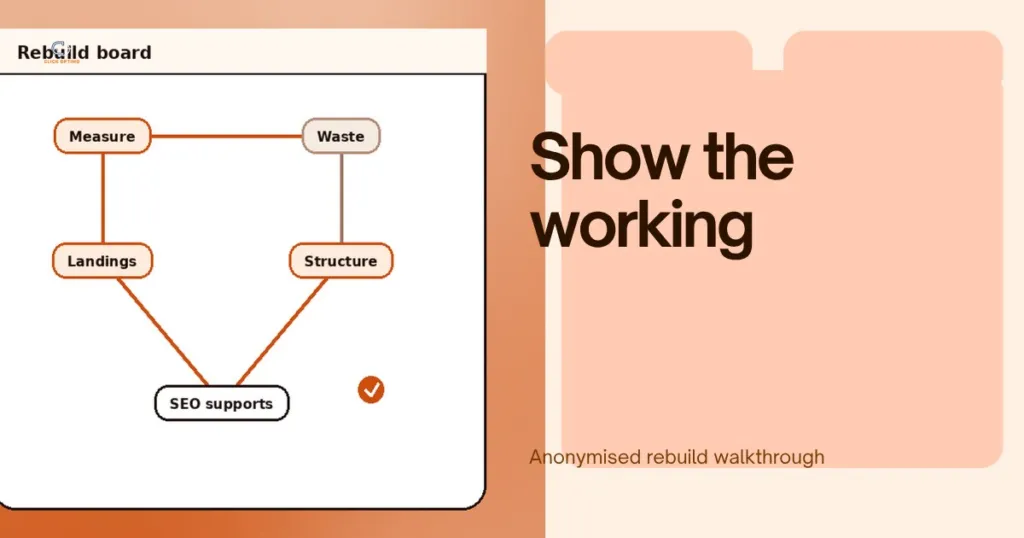
Order is the product. We typically sequence: tracking truth → waste cuts → landing and message match → campaign structure → SEO supports. Reverse that and you teach Smart Bidding on junk, polish structure on a lying scoreboard, or publish SEO while paid still lands on a slow form that hides the call button.
Tracking first. Confirm account ownership, conversion hygiene, call paths, thank-you discipline and a baseline of Spend | Ads conversions | GA4 | Booked (even a sheet). Align with track booked calls, not clicks. Without this, every later test is a story.
Waste next. Pause or cut clearly junk themes, restore negatives, stop duplicate fires. Use the mindset of the wasted Google Ads spend checklist and negative keyword playbook without claiming a weekend cleanup is a full strategy.
Landing and message match. Ads that promise a job must land on pages that book that job — proof, click-to-call, form friction, area honesty. See landing pages that book calls. Soft hosting for the paid system: Google Ads for service businesses.
Structure. Cleaner campaign and ad-group roles: brand defence, high-intent non-brand, capped experiments. Naming a non-marketer can read. Smart Bidding only when signal is trustworthy.
SEO supports. Money-page clarity, internal links that match ad themes, GBP hygiene, Search Console priorities — not a twelve-month content fantasy in week two. Soft home: SEO for service businesses. Local alignment with local SEO and Google Ads and Google Business Profile for calls when those paths matter.
The services hub is where Ads, SEO and analytics sit as one vocabulary. Soft commercial path when the rebuild must be time-boxed: the 90-Day Lead Engine.
What we deliberately postpone
We deliberately postpone vanity content mills, full site redesigns unless money pages are unusable, exotic attribution theatre before basic booked-call truth, aggressive scaling into unanswered phones, and “rebrand the campaigns” mid-spike for cosmetic pride. Ethical remarketing and assisted-path nuance belong after the spine exists — see ethical remarketing and attribution for assisted conversions. Seasonal pacing belongs to capacity planning, not FOMO — seasonal demand planning. Postponement is discipline, not neglect.
How we judge early signals without fake victory laps
Early signals are leading indicators: cleaner search terms, fewer duplicate conversions, faster dial paths, money-page message match, reduced junk form volume. They matter. They are not booked-call victory laps. Smart Bidding “improving” on a thank-you view is not proof. We judge early work on whether the scoreboard became honest and whether waste themes shrank — then on booked calls and qualified enquiries the owner recognises.
Leading versus lagging discipline matches how we talk about measurement elsewhere: prepare with indicators, decide with diary outcomes. Do not publish invented ROAS for a composite story. Soft proof posture: Results. Soft commercial CTA when you want the intensive package named:
Weekly cadence matters more than heroic month-end decks. A short operating rhythm — search terms, lead quality notes, capacity flags, next experiments — beats a quarterly novel. Owners who only appear for the novel never course-correct in time. Soft honesty when early signals show the bottleneck is pricing or SLA, not media: that is a successful diagnosis, not a failed campaign.
Honest early signals beat theatrical dashboards.
Owner responsibilities that make or break rebuilds
Agencies cannot book calls the phone never answers. Owners (or named operators) must provide: account and billing access you retain, clear service areas and offer exclusions, honest capacity, lead-handling commitments with first-response targets, and a willingness to change landings when message match is broken. Decisions delayed for three weeks become three weeks of paid learning on yesterday’s lie.
Refuse access and you refuse a rebuild — you buy reporting theatre. Soft next step when you want gaps ranked before a package:
Owner presence in the first fortnight is non-negotiable: approve primary conversion definitions, confirm what sales will defend, and kill vanity events that inflate Smart Bidding. After that, a steady weekly touchpoint beats sporadic panic. Soft pair when choosing who runs the system long-term: integrated Ads + SEO vs specialists and how to brief or fire a Google Ads agency.
FAQs
Is this a real client case study with results?
No. It is an anonymised walkthrough of how we think. We do not invent metrics for content. See /results/ for the site’s public proof posture.
What is a lead engine rebuild?
A structured reset of Google Ads, SEO and tracking so optimisation targets booked calls and qualified enquiries.
Why start with measurement?
Without trustworthy conversions, bid changes and creative tests teach the wrong lessons.
How long does a rebuild take?
ClickOptimo packages intensive rebuild work in a 90-day Lead Engine; exact timelines still depend on access and complexity.
What must the owner provide?
Account access, clear service areas/offers, honest capacity, and lead-handling commitments.
How do I start?
Book a Growth Diagnostic via /book/.
Next step: see the working, then decide
Do not buy a rebuild on invented charts. Recognise starting conditions, insist on diagnostic questions that unlock capacity and offer truth, demand a first-move order that starts with measurement, judge early signals without victory laps, and own the responsibilities only you can own. Soft public honesty stays on Results. When you want a guided pass across Ads, SEO and tracking, book a short diagnostic.
Book a Growth Diagnostic — twenty minutes, gaps ranked by diary impact.
More context: Growth Diagnostic · 90-Day Lead Engine · services · Google Ads for service businesses · SEO for service businesses
growth@clickoptimo.com · +91-8497982579