Table of Contents
- What SEO and PPC actually mean for a service business
- SEO vs PPC at a glance
- Six situations, and what to start with in each
- Why most service businesses end up doing both, and in what order
- How to measure SEO and PPC the same way
- Common mistakes when choosing between SEO and PPC
- FAQs
- Next step: pick your situation and set your ceiling
“Should we start with SEO or Google Ads?” is one of the first questions service business owners ask us. It’s usually framed as a contest, as if one channel is right and the other is a waste of money. In practice, the honest answer depends far more on your situation than on the channels themselves.
A brand-new plumbing firm with three reviews has very different needs from a 15-year-old law firm with a strong reputation and a tired website. Pick the wrong starting channel and you can lose six months waiting for rankings, or paying for clicks your site can’t convert.
This guide is for owners and marketing leads of service businesses — trades, clinics, home services and professional firms — across the US, UK, AU, CA and NZ. It explains what SEO and PPC mean for a local service business, compares them side by side, walks through six common situations and what to start with in each, and shows how to measure both by one yardstick: booked, qualified calls.
The right first channel isn’t the one with the best reputation. It’s the one that can produce booked calls within the time and money you actually have.
What SEO and PPC actually mean for a service business
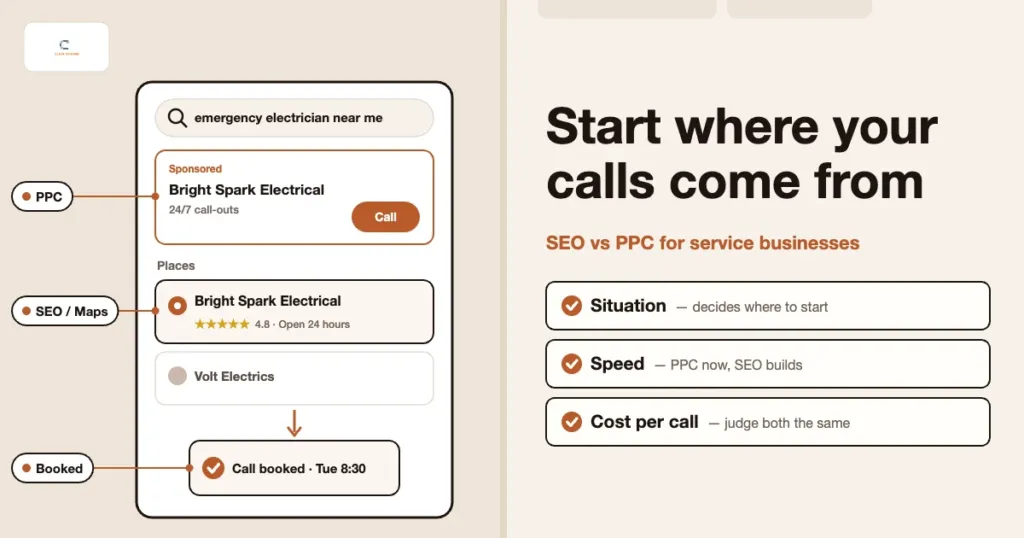
SEO means earning visibility without paying per click. For most service businesses it has two parts: organic results, where your service and location pages rank for searches like “emergency electrician near me”, and map results, driven largely by your Google Business Profile, reviews, categories and proximity to the searcher. Getting your Google Business Profile set up for calls is often the quickest SEO win, because the map results sit above organic listings for many local searches. Our SEO service covers both halves.
PPC (pay-per-click) for service businesses mostly means two Google products. Google Search ads appear against keywords you choose, and you pay per click. Local Services Ads, where available for your country and category, appear at the top of results, can carry a Google Verified badge and charge per lead rather than per click. Google is now moving them into standard Google Ads accounts, starting in the US. Our comparison of Local Services Ads vs Search ads covers the differences. Either way, PPC buys visibility straight away and stops the moment you stop paying. Our Google Ads management is built around turning that spend into booked calls.
For most service businesses with existing search demand, the real starting decision is between search visibility you earn and search visibility you rent.
SEO vs PPC at a glance
Here is how the two compare on the factors that matter most when deciding where to start.
| Factor | SEO (incl. Google Maps) | PPC (Search ads and LSA) |
|---|---|---|
| Speed to first enquiries | Usually months; Google Business Profile work can move sooner | Days, once tracking and landing pages are ready |
| Cost model | Steady monthly investment in content, technical work and reviews | Ongoing spend per click or per lead, plus management |
| What happens when you stop | Rankings fade gradually; some visibility usually remains | Visibility and enquiries stop almost immediately |
| Control and testing | Limited; you influence rankings but can’t set them | High; you choose keywords, areas, hours, budgets and messages |
| Best for | Lower long-term cost per call, trust, and markets you’ll serve for years | Fast demand capture, testing offers and filling gaps in rankings |
Neither column is “better”. They solve different problems on different timelines.
Six situations, and what to start with in each
Find the situation closest to yours. Each points to a clear first move.
1. A brand-new business with few reviews
Start with PPC, but keep it tight. A new business has no rankings and too few reviews to compete in the map results, so SEO alone means months of silence. Search ads on a small set of high-intent keywords, such as the service plus “near me” or your town name, can bring in the first calls while you build the foundations.
Use those early jobs to earn reviews. Set up your Google Business Profile properly from day one and ask every happy customer for a review. Reviews help map rankings and lift ad conversion rates.
2. An established business with good reviews but a weak website
Start with SEO, beginning with the website and Google Business Profile. You already have the hardest asset to build: a reputation. If your site is thin, slow or confusing, fixing it and its service pages often unlocks rankings and enquiries you’ve been leaving on the table.
Running ads to a weak website is usually wasteful, because you pay for every click and the page loses most of them. Fix the pages first, then add PPC where you want faster growth. Our piece on how local SEO and Google Ads together lower cost per acquisition shows how the two then reinforce each other.
3. Emergency or urgent services
Start with PPC, and add Local Services Ads if your country and category qualify. Someone with a burst pipe or a broken boiler in winter isn’t browsing. They call one of the first few results they see, usually from a phone, within minutes.
Make the ads call-first: call assets, ad scheduling that matches the hours you can answer, and a properly staffed phone line. In parallel, work on your Google Business Profile, because urgent local searches lean heavily on the map results.
4. High-value consultations (legal, dental implants and similar)
Start with both, but weight early budget towards PPC while SEO content builds. When one consultation can be worth thousands, clicks are expensive but can still pay back quickly, provided you track through to booked consultations rather than form fills. These buyers research heavily before they call.
That is where SEO earns its keep. Detailed service pages, honest pricing guidance and clear answers to pre-booking questions help you rank and help people trust you. Judge both channels on cost per booked consultation over a few months, not week by week.
Know your ceiling first. Before choosing a channel, work out the most you can afford to pay for one booked call, using your average job value, margin and the share of booked calls that become paying jobs. That number lets you judge both channels against the same line.
5. Strongly seasonal demand
Start SEO well before the season, and use PPC to flex during it. If most of your work lands in a few months (air conditioning in summer, heating in winter, accounts work around year-end), your SEO needs doing well ahead of the peak so pages have time to rank.
PPC then acts as the volume dial. Raise budgets as demand rises, lower them in quiet months, and use the off-season to improve landing pages. Our guide to seasonal demand planning for trades and clinics sets out how to time each step.
6. A tight budget with spare owner time
Start with owner-led SEO, and keep any PPC very small. If money is short but you have a few hours a week, the highest-return work is usually unpaid: completing your Google Business Profile, asking for reviews, writing clear service pages and keeping your contact details consistent.
If you do run ads, focus on a handful of high-intent searches in your core area and add negative keywords early. A small budget spread across broad terms tends to disappear without a single call. Work through the wasted Google Ads spend checklist before you spend anything.
Why most service businesses end up doing both, and in what order
Whichever channel you start with, most established service businesses end up running both. Each covers the other’s weaknesses. PPC gives you speed, control and data. SEO gives you a lower cost per extra call and visibility that doesn’t vanish when a budget is paused.
Paid search data also makes SEO smarter: the search terms report shows which phrases lead to calls, so you know which pages to build first. In return, strong rankings and reviews tend to lift ad conversion rates.
A sensible order for most businesses: fix tracking, then the Google Business Profile and core service pages, then PPC on the highest-intent services, then broader SEO content as data comes in. How to split the money is its own question, covered in how to split your Ads vs SEO budget in year one. Whether to hire one team or separate specialists is another, covered in integrated Ads and SEO vs specialists.
Search itself is also changing. AI-generated answers are reshaping some results, but they still lean on clear, trustworthy websites, as we explain in why SEO still matters in 2026.
How to measure SEO and PPC the same way
Measuring each channel differently leads to bad decisions. PPC reports clicks and cost per lead. SEO reports rankings and traffic. Neither tells you whether the phone rang with a real job.
Use one yardstick for both: cost per booked call. For PPC, that’s media spend plus management fees divided by booked calls from ads. For SEO, it’s your monthly SEO investment divided by booked calls from organic search and your Google Business Profile. Our guide to cost per lead vs cost per booked call explains why this beats lead volume. You need a few basics in place:
- Call tracking by channel. Separate tracking numbers or dynamic number insertion credit each call to the channel that drove it.
- Profile calls counted. Calls from your Google Business Profile show in its performance reports, so include them in your SEO numbers.
- Booked outcomes recorded. Whoever answers notes whether the call became a booked job, so you count outcomes, not rings.
- One conversion for decisions. In Google Ads, mark booked or qualified calls as Primary and softer actions as Secondary, so bidding chases the outcome you care about.
Then watch a blended figure: total spend across both channels divided by total booked calls. Someone might see an ad, search your name a day later and call from your profile. The blended number keeps you honest about the whole system.
Common mistakes when choosing between SEO and PPC
- Expecting SEO to pay the bills in month one. SEO compounds. If you need calls this month, it can’t be your only channel.
- Running ads to a page that can’t convert. Sending paid clicks to a slow, vague homepage wastes money. Fix the landing page before you scale spend.
- Dropping SEO the moment ads work. Businesses that rely only on ads are exposed to rising click costs with nothing to fall back on.
- Judging channels on different metrics. Rankings versus cost per lead isn’t a comparison. Use cost per booked call for both.
- Ignoring the Google Business Profile. For local services, map results often matter as much as organic rankings, and the profile costs nothing to improve.
- Giving up on either too early. A few weeks of ads or a few months of SEO rarely tells you enough. Set a review date and a target cost per booked call before you start.
FAQs
Is SEO or PPC cheaper for a service business?
Over the long run, SEO often produces a lower cost per booked call because you aren’t paying for each click. In the short run, PPC is usually cheaper per call simply because SEO hasn’t had time to produce any. The fair comparison is cost per booked call over six to twelve months, measured the same way for both.
How long does SEO take to bring in calls?
It depends on competition, your starting point and how much work goes in. Google Business Profile improvements can show movement within weeks, while ranking new pages for competitive services usually takes several months. Be wary of anyone promising a fixed timeline or guaranteed positions.
Can I run PPC without a proper website?
Local Services Ads can send leads without a landing page, so it’s possible. For Search ads, though, a weak page wastes a large share of every click you pay for. One focused, fast page per core service helps a lot.
Should I stop SEO once my ads are working well?
We wouldn’t recommend it. Ads stop producing calls the day the budget stops, and click costs can rise when competitors bid harder. SEO keeps working in the background and usually lowers your blended cost per booked call over time.
How can ClickOptimo help?
We look at your search demand, reviews, website, tracking and capacity, then recommend which channel to start with and when to add the other. We run Google Ads and SEO together and report on booked calls, not clicks. Book via /book/.
Next step: pick your situation and set your ceiling
This week, decide which of the six situations is closest to yours and write down the most you can afford to pay for one booked call. Then check: for last month, can you say how many booked calls came from ads, organic search and your Google Business Profile? If not, fix that before committing more money to either channel.
Book a Growth Diagnostic — we’ll review your situation and tell you where to start, with the reasoning behind it.
More context: Tracking booked calls, not clicks · Landing pages that turn ad clicks into booked calls · Attribution and assisted conversions
growth@clickoptimo.com · +91-8497982579