Table of Contents
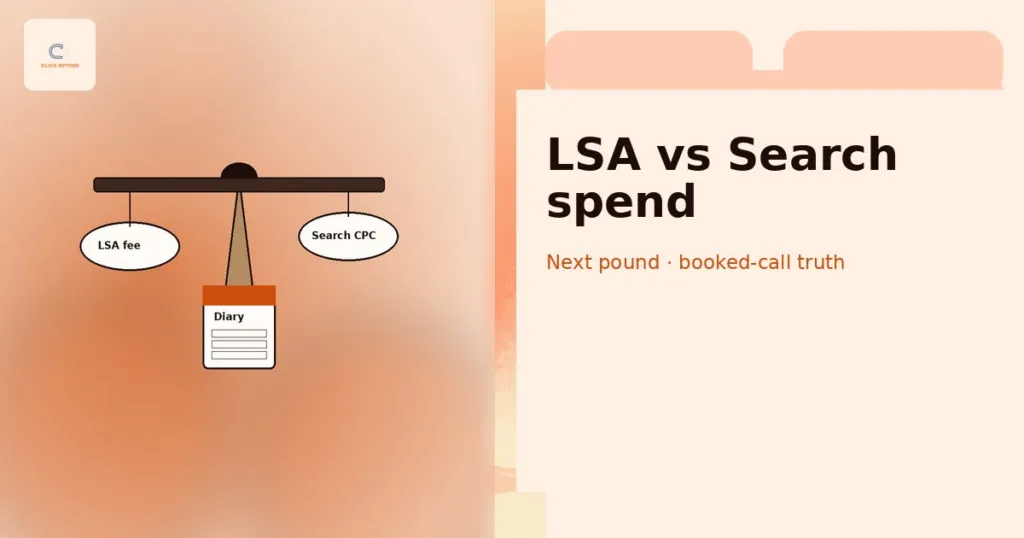
Two Google products. One diary. Local Services Ads (LSAs) sell leads with trust badges; Search Ads sell clicks you control with keywords, ads and landing pages. Owners often ask which is “better.” The useful question is narrower: where should the next pound or dollar go so booked calls rise, not just lead counts or impression share.
This guide is a decision framework for service businesses — home services, trades, clinics, professional firms — across the US, UK, AU, CA and NZ. Eligibility for LSAs differs by country and category (they are not offered in Australia or New Zealand); nothing here pretends every vertical can run both. No fake lead-fee tables. No guaranteed CPA. Soft next steps: a Growth Diagnostic when the split is unclear, or the 90-Day Lead Engine when Ads, SEO and tracking need one rebuild.
Owners rarely get a clean A/B of identical demand. LSA and Search intercept overlapping intent with different UX, billing and control. That is why “cheaper leads” on one product and “better Quality Score” on the other can both be true — and still fail the diary. Treat this as capital allocation under uncertainty: small tests, shared definitions, and a bias toward outcomes the front desk recognises.
What LSAs and Search Ads each buy
Local Services Ads (where available) typically charge a lead fee: you pay when Google delivers a phone call or message lead through the LSA flow. Placement sits at the top of Search results with a trust emphasis — the Google Verified badge for businesses that pass Google’s checks, though not every ad shows it. You get less creative and landing-page control than classic Search; quality matters as much as bid. Google now credits invalid leads automatically in most markets, and wrong-job or wrong-area leads are no longer credited, so set categories and service areas tightly.
Search Ads charge per click (or related auction outcomes). You choose keywords, match types, ads, assets and landing experiences. That control is why Google Ads for service businesses remains the primary paid lever for many owners — especially when LSA is unavailable, offer complexity is high, or brand defence needs explicit messaging. Soft proof of method sits on Results; product logos do not replace diary outcomes.
Neither product absolves weak offer clarity. If your team cannot describe who is a good customer in one sentence, LSA disputes and Search junk will both rise. Fix the brief to sales before you argue about lead fees versus CPC. When budget is scarce, the first pound often belongs to measurement hygiene and capacity — not a new auction — because blind spend teaches the wrong lesson to both systems.
Think in units of budget you can move this month. An LSA lead fee that looks cheap can still be expensive if dispute rates are high and booked-call show rates are low. A Search CPC that looks dear can be efficient if the landing and offer convert to diary events. Compare cost per lead vs cost per booked call on both products before you crown a winner.
Eligibility and “Google Verified” realities (high level)
LSAs are not universal. Categories, licences, background checks, insurance and country availability change. “Google Verified” (which replaced Google Guaranteed and similar badges) is a trust check with requirements — it is not a magic lead-quality guarantee, and it does not mean every lead is a booked job. Google is also moving LSAs into standard Google Ads (select US advertisers from August 2026, non-US accounts in 2027): you still pay per valid lead, but manual max-per-lead bids give way to a campaign-level target CPA. If your category or market is not eligible, do not force the product into the plan. Use Search plus strong local SEO and GBP instead — see local SEO and Google Ads working together and SEO for service businesses.
Comparison table owners actually need
| Dimension | Local Services Ads | Search Ads |
|---|---|---|
| How you pay | Typically per lead (eligible markets) | Typically per click |
| Control | Limited keywords/ads/landing | High: keywords, ads, landings |
| Messaging | Constrained by LSA UX | Full ad + landing narrative |
| Landing experience | Google-led lead flow | Your money pages |
| Trust signals | Google Verified badge (where shown) | Reviews, site proof, assets |
| Dispute / quality | Automatic lead credits + feedback | Negatives, search terms, QA |
| Tracking depth | Lead + dispute + CRM join | Deep if stack is clean |
| Brand coverage | Category/local lean | Strong for brand + non-brand |
Owners need this table more than a fanboy thread. Control and landing experience favour Search when your offer needs nuance (financing, multi-service exclusions, “we don’t do X”). Lead-fee simplicity and badge trust favour LSA when eligibility fits and your capacity can answer fast. Tracking depth on either product is only as good as your Analytics & tracking hygiene — see the minimum viable measurement stack.
Read the table as trade-offs, not a verdict. A clinic with consultative intake may need Search landing copy that LSA cannot host. A residential trade with standardised jobs and strong reviews may find LSA lead flow fills mornings while Search covers brand and evening emergencies. Revisit after four weeks of diary-reconciled data, not after one noisy weekend.
How “cost per lead” on LSA still needs booked-call truth
An LSA “cheap lead” that never books is not cheap. Count dispute rate, no-shows, wrong-geo and tyre-kickers. Join leads to CRM or calendar stages the way you would for Search forms and calls. If you only track clicks or raw LSA lead volume, you will misallocate the next pound. North star remains booked calls / sales-accepted appointments — same as Search.
Ops rule: Report LSA and Search on the same scoreboard: Spend | Leads/enquiries | Booked | Showed/Won. If only one product has diary truth, stop comparing “efficiency” until both do.
Decision framework: where the next unit of budget goes
Move the next unit of budget using five checks — not loyalty to a product logo.
- Capacity. Can the phone and diary absorb more leads this week without SLA collapse? If not, fix handling before buying more of either product.
- Dispute / waste rate. High LSA disputes or high Search junk (DIY, jobs-you-don’t-do, wrong geo) mean hygiene before scale. Use the wasted Google Ads spend checklist on Search; use dispute patterns on LSA.
- Coverage gaps. If Map pack and organic already take category demand, Search may defend brand and fill evenings; if LSA is eligible and phones are quiet, a measured LSA test can fill the top-of-local slot.
- Brand defence. Competitors bidding on your name usually need Search coverage; LSA alone rarely replaces branded Search strategy.
- Offer complexity. Multi-SKU, exclusions, high ticket consultative sales often need Search landings and message control. Simple, standardised home-service jobs may suit LSA lead flow better — when eligible.
When the answer is still fuzzy, a measurement-first Growth Diagnostic ranks eligibility, waste, tracking and capacity so the next pound follows evidence. The wider services hub covers Ads, SEO and tracking as one system.
Write the decision down. “Next £500 / $500 goes to LSA because phones are idle before noon” beats “LSAs are cheaper.” Equally: “Next unit goes to Search brand + high-intent themes because competitors own our name.” If you cannot write the sentence, diagnose before you move budget.
Illustrative only: some owners keep a floor on LSA for presence, then pour incremental budget into Search once hygiene improves booked-call CPA. Others pause LSA when disputes spike — the product is not broken; lead quality or handling is. Either path is valid when the diary is the judge.
Home services patterns vs professional services (when LSA unavailable)
Home services (where LSA is common in some markets): many owners run a modest LSA presence for badge + lead flow, plus Search for brand, niche jobs and hours LSA under-serves. Capacity and dispute discipline decide the split more than theory.
Professional services (legal, finance, B2B consultancies, many clinics): LSA is often unavailable or a poor fit. Search plus SEO for service businesses and GBP become the primary paid/organic levers. The same framework still applies — capacity, waste, coverage, brand, offer complexity — with organic investment competing for the “next pound” alongside Search.
Running both without double-counting chaos
Eligible accounts can run LSA and Search together. Expect overlap on category and sometimes branded demand. Without hygiene, you will celebrate two “leads” for one customer who rang twice, or blame the wrong product when the diary is flat.
Practical hygiene:
- Shared definition of booked across LSA leads, Search calls and forms.
- CRM source fields that distinguish LSA vs Search vs organic/GBP.
- Deduping when the same phone appears on both within a short window.
- Weekly reconcile: Spend by product | Enquiries | Booked — not separate vanity decks.
- Clear owner for lead feedback and credits (LSA) and search-term mining (Search).
Measurement detail lives in Analytics & tracking and the GA4 + call tracking + Ads stack. Do not scale either product while conversions disagree with the diary for a full week.
Also agree response SLAs per product. LSA leads that sit unanswered become expensive fast; Search calls that hit voicemail after you paid CPC are the same waste in a different costume. Tracking without handling is still a leak. Document who owns callbacks and how source is written into the CRM so next month’s split debate uses facts.
When to revisit the split
Revisit LSA vs Search at least when:
- Seasonality shifts capacity or lead quality (busy season vs quiet).
- Review velocity or badge status changes trust dynamics on LSA.
- Creative and landing tests on Search unlock a step-change in booked-call CPA.
- Dispute rates or Search junk themes spike without a fix plan.
- You expand service areas or add/remove offers that change eligibility or message needs.
Local SEO progress can also change the mix — Maps and GBP wins may reduce the need to buy every category click; see local SEO + Ads and CPA. When the problem is structural — wrong campaigns, broken tracking, siloed SEO — soft next step is the 90-Day Lead Engine, not another blind budget shift.
Build a simple trigger list on one page: dispute rate threshold, Search junk % of spend, branded CPA drift, missed-call rate, and review velocity. When a trigger fires, revisit the split within a week — not at the next annual planning offsite. Small, frequent reallocation beats heroic quarterly swings that ignore capacity.
FAQs
What is the difference between LSAs and Search Ads?
Local Services Ads typically charge per lead in eligible categories and emphasise trust badges and a lead flow. Search Ads charge per click and give more control over keywords, ads and landing pages.
Are Local Services Ads cheaper than Search Ads?
Not automatically. Compare cost per booked call (and show rate), not headline lead fees versus CPC alone.
Can I run LSA and Search Ads together?
Often yes, where eligible—but align tracking and expect overlap in branded or category demand. Measure diary outcomes across both.
What if my category or country doesn’t offer LSAs?
Use Search (and strong local SEO/GBP) as the primary paid lever; the decision framework still applies to budget vs organic investment.
Should agencies push only one product?
Prefer partners who explain trade-offs and measure booked calls. Product loyalty is not a strategy.
How does a Growth Diagnostic help with budget split?
It reviews eligibility, waste, tracking and capacity so the next pound or dollar follows evidence. Book via /book/.
Next step: fund the diary, not the logo
Do not award the next pound to whichever product your last vendor preferred. Check capacity, waste, coverage, brand and offer complexity — then compare cost per booked call on the same scoreboard. When you want a guided, measurement-first pass across eligibility and channel roles, book a short diagnostic.
Book a Growth Diagnostic — twenty minutes, gaps ranked by diary impact.
More context: Growth Diagnostic · services · Google Ads for service businesses
growth@clickoptimo.com · +91-8497982579