Table of Contents
The tags are installed. Tag Assistant lights up green. Yet when you ask which campaigns drove booked calls last week, the room goes quiet. That is the gap this post closes: not another tool list, but a minimum viable measurement stack — Google Ads conversions, GA4 (often via GTM), call tracking, and a CRM or calendar mark for “booked” — so service businesses can scale spend without guessing.
This guide is for owners and growth leads of service businesses — home services, trades, clinics, professional firms — across the US, UK, AU, CA and NZ. It is stack blueprint, not a fifteen-minute “set and forget” claim. No fake dashboards. No guaranteed attribution precision. Illustrative patterns only. If you still measure clicks instead of diary events, start with how to track booked calls, not clicks. Soft next steps: a Growth Diagnostic or the 90-Day Lead Engine when the rebuild is structural.
What “minimum viable” means
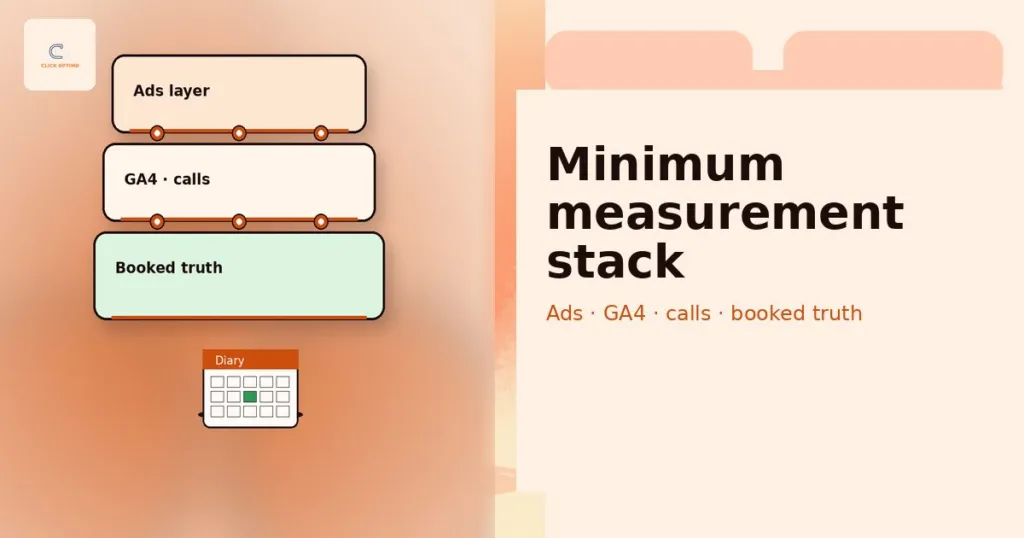
Minimum viable measurement is enough shared signal to decide where budget should go — and enough reconciliation to catch lies early. It is not a data warehouse, a five-tool CDP, or perfect multi-touch attribution. For local and appointment-led services, “good enough” means Ads, GA4 and the phone/CRM agree on what a meaningful enquiry is, often enough that Smart Bidding and weekly reviews chase the same thing.
Over-engineering usually adds second definitions of conversion, duplicate fires, and weekends spent arguing about which export is “right.” Under-engineering leaves you blind: spend rises, booked calls do not, and nobody can name the leak. The middle path is deliberate: four layers, one north star, a go-live checklist before you raise budget. ClickOptimo’s Analytics & tracking work starts there — measurement that sales can verify.
Owners often ask for “full attribution” when they still cannot name last week’s booked-call count by campaign. Start with reconcile frequency, not model sophistication. A single shared definition reviewed every Monday beats a polished multi-touch story nobody trusts.
North-star: booked calls / qualified enquiries
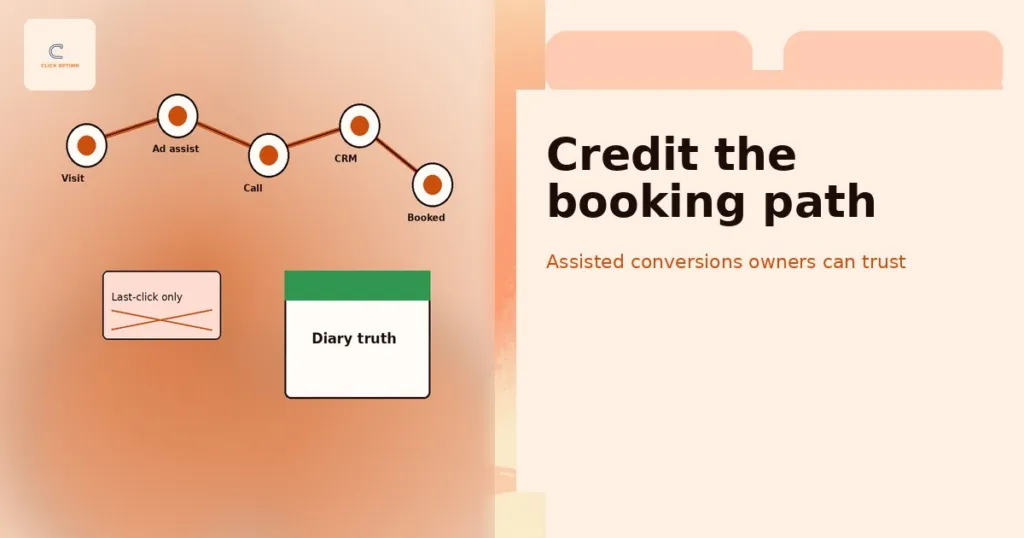
Your north star is a booked call, sales-accepted enquiry, or diary-confirmed appointment — not a scroll, video play, or soft micro-conversion. Forms that create a real CRM record and calls that meet a useful duration or disposition can sit next to that star as supporting conversions. Vanity events stay secondary or off. If the diary and the Ads column diverge every week, fix the definition before you “optimise” bids. That same discipline sits behind cost per lead vs cost per booked call.
Layer 1 — Google Ads conversion actions
Google Ads for service businesses needs conversion actions that mean something a sales lead would recognise. Primary actions should be scarce and sales-verifiable: qualified form submit, meaningful call (from a tracked number or call asset), booking confirmation from a scheduling tool, or an offline/booked import when CRM process is reliable. Secondary actions can include softer steps you want to observe but not bid toward — page views of a thank-you, short calls, or newsletter sign-ups.
Name actions so a non-marketer understands them. Prefer one primary per funnel stage over three overlapping “lead” events for the same submit. Import GA4 key events only when the event hygiene is clean; otherwise you teach the algorithm to love ghosts. Enhanced conversions and consent-mode settings matter at a high level — implement them properly for your regions — but they do not replace a clear primary.
What not to optimise towards
Do not set primary conversion on scroll depth, time-on-site, “engaged session,” PDF download alone, or every click-to-call regardless of duration. Do not count duplicate thank-you fires as two wins. Do not mix brand and non-brand into one “conversion” story without separation. And do not raise budget because secondary soft events look green while the diary is flat. Soft proof of method sits on Results; vanity volume does not.
Ops rule: Primary = sales-verifiable enquiry or booked stage. Secondary = observe only. If Ads “conversions” and CRM bookings disagree for a full week, pause bid theatre until they reconcile.
Layer 2 — GA4 (and GTM) for the same events
GA4 should mirror the same meaningful events Ads cares about — not a parallel fantasy funnel. Use Google Tag Manager when you need control and debugging without hard-coding every change. Mark one (or few) key events that match Ads primaries: form success that hits a real thank-you or CRM create, call click with call-tracking partnership where used, booking confirmed. Keep naming consistent across tools so weekly reconciliation is possible.
Debugging mindset beats tutorial dumps: Preview in GTM, Confirm in GA4 DebugView or realtime, then a real submit or call from a known device. Filter internal traffic where practical. Do not promote every interaction to a key event “just in case.” Shared event language also helps SEO for service businesses and paid search read the same money-page behaviour later.
Document ownership: who changes GTM, who approves a new primary in Ads, who checks the CRM stage after a deploy. Without ownership, “temporary” test tags become permanent lies. Keep a one-page stack map — Layer 1–4, event names, and last reconcile date — so agency or staff handoffs do not reset truth.
Thank-you and event hygiene
Thank-you pages should fire once per successful enquiry. Avoid firing on page load of a reusable URL that people refresh. Prefer a dedicated thank-you or a dataLayer push tied to successful submit — not “any form interaction.” Deduplicate if both a GTM form listener and a native plugin send the same lead. Document which event is canonical for Ads import. Hygiene is dull; duplicate conversions are expensive.
Layer 3 — Call tracking without wrecking attribution
Most service businesses win or lose on the phone. Call tracking must preserve campaign context where possible: dynamic number insertion on money pages and ad landings, campaign or keyword parameters retained, and a handoff into CRM or a sheet that sales actually uses. Static numbers alone under-count paid influence; reckless number swapping can break Ads click association and inflate or deflate the wrong campaigns.
Choose duration and disposition rules you believe — a two-second pocket-dial is not a booked job; a ninety-second tyre-kicker is not automatically qualified. Align call assets in Google Ads with tracked numbers where available. Missed-call handling and callback SLA are capacity problems as much as tracking problems: a perfect tag on an unanswered line still wastes spend. For a practical waste pass after measurement is clean, see the wasted Google Ads spend checklist.
Common ways call tracking breaks Ads data
Numbers swap after the click so the session loses gclid or campaign parameters. Duplicate conversions fire from both a call asset and a site number for the same ring. Pool numbers change too aggressively and break local trust or GBP consistency. Offline call imports double-count an online call conversion. Or the CRM never receives source fields, so “booked” cannot be joined back to Ads. Configure for attribution preservation first; pretty call recordings second.
Layer 4 — CRM / calendar as source of truth for “booked”
The diary or CRM is where “booked” becomes real. Forms and calls are candidates; sales-accepted appointments are truth. At a high level, offline conversion import and booked-stage uploads help Google Ads learn from outcomes that happen after the click — when your CRM process is reliable enough to trust. Google now recommends enhanced conversions for leads for this, and new API uploads have run through its Data Manager API since 15 June 2026. Day one does not always need offline import. Day one needs clean online enquiry and call conversions plus a weekly reconcile: Spend | Ads conversions | GA4 | Booked calls.
Use a simple stage model: Enquiry → Qualified → Booked → Showed / Won (labels that match how you work). Export or sync only stages you would defend in a meeting. Soft proof and method examples sit on Results; do not invent win rates for the blog.
If your CRM is a shared inbox and a paper diary, you can still run minimum viable: a weekly sheet with date, source hint, enquiry type, and booked yes/no. Fancy sync comes after the habit. Offline import into Google Ads waits until that habit produces clean rows — importing chaos teaches the algorithm the wrong customers.
Deduping forms and calls
The same person often submits a form and rings. Count one enquiry for human reporting unless your ops deliberately want both. In Ads, avoid two primary conversions for one customer journey without a clear rule. Match on phone, email or CRM ID where tools allow. Train the front desk: if they book from a missed-call list, the source should still land in the CRM. Deduping is how you stop “optimising” for double-counted noise.
“Good enough” go-live checklist
Run these ten checks before you increase budget. Tick what is clean; fix what is not.
- Primary conversion is sales-verifiable (enquiry, meaningful call, or booked stage) — not scroll or soft micro.
- Secondary actions are observe-only; they do not drive Smart Bidding as primary.
- GA4 key events match Ads primaries in name and trigger logic.
- Thank-you / submit fires once; refresh and back-button do not double-count.
- Call tracking appears on money pages and ad landings; parameters preserved where possible.
- Call duration / disposition rules are written down and applied.
- CRM or calendar can mark Booked; weekly reconcile exists (even a sheet).
- Spam and test traffic filtered or tagged; internal team excluded where practical.
- Brand vs non-brand reporting is separable so wins are honest.
- One week of reconcile — Spend | Ads | GA4 | Booked — reviewed before any scale-up.
If half the list fails, do not “optimise creatives” first. Fix the stack. When Ads, SEO and tracking need a shared rebuild — not another tag — see the 90-Day Lead Engine and the wider services hub.
FAQs
What is a minimum viable measurement stack for service businesses?
Google Ads conversion actions for meaningful enquiries and calls, GA4 (often via GTM) mirroring those events, call tracking that preserves campaign context where possible, and a CRM or calendar mark for booked appointments.
Do I need both GA4 and Google Ads conversions?
Yes for most accounts. Ads needs conversion signals to optimise; GA4 helps diagnose site behaviour and assists reporting across organic and paid.
Can call tracking break Google Ads attribution?
Yes—if numbers swap incorrectly, parameters drop, or duplicate conversions fire. Choose and configure call tracking with attribution preservation in mind.
Is offline conversion import required on day one?
Not always. Start with clean online enquiry and call conversions; add offline/booked imports when your CRM process is reliable.
Should I fix the stack before raising budget?
Yes if you cannot see which campaigns drive booked calls. Scaling blind spend rarely teaches the algorithm what good looks like.
How does ClickOptimo’s Growth Diagnostic relate to measurement?
It is measurement-first: gaps in Ads, SEO and tracking ranked by impact on booked calls. Book via /book/.
Next step: wire truth, then scale
Do not fund another month of busy dashboards while booked calls stay unexplained. Align Layers 1–4, run the go-live checklist, and reconcile one week before you raise budget. When you want a guided, measurement-first pass across Ads, SEO and tracking, book a short diagnostic.
Book a Growth Diagnostic — twenty minutes, gaps ranked by diary impact.
More context: Growth Diagnostic · services
growth@clickoptimo.com · +91-8497982579