
Table of Contents
Most service business owners can describe their marketing problem in one sentence. “The phone’s gone quiet.” “We get leads, but they’re rubbish.” “Google Ads keeps getting more expensive.” Those sentences are useful, because each one points to a specific cause you can find and fix.
The trouble is that the symptom and the cause rarely sit in the same place. A quiet phone might be a tracking gap, a slow website or a seasonal dip. Spending money on the wrong fix is how budgets drain away while nothing changes.
This guide is for owners and marketing leads of service businesses — trades, clinics, home services and professional firms — across the US, UK, AU, CA and NZ. It covers the eight challenges we hear about most often, the symptom you are likely to notice for each, the first fix worth trying, and a 30-day order for tackling them so you are not trying to fix everything at once.
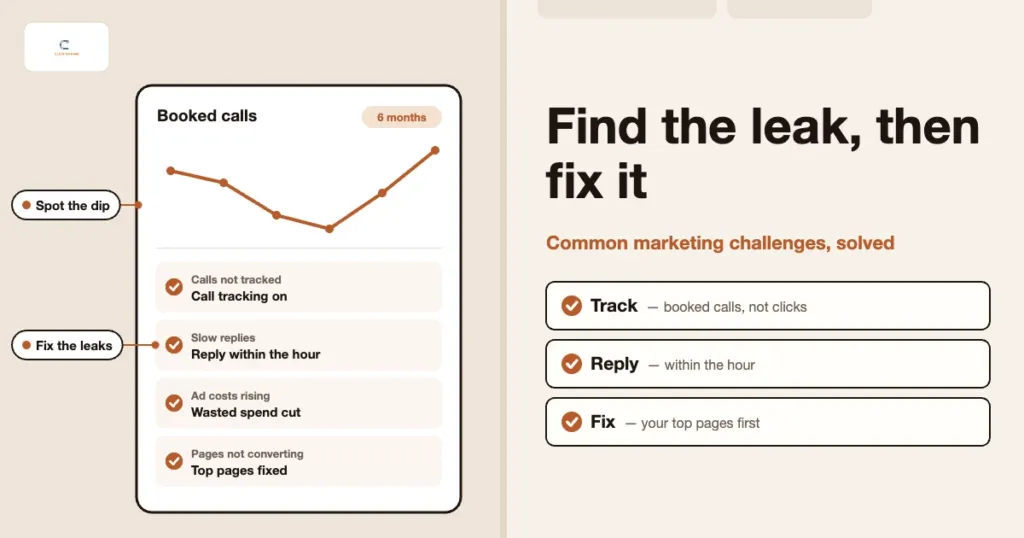
Most marketing problems look different on the surface but end in the same place: fewer booked, qualified calls. Fix the cheapest thing to check first.
Challenges, symptoms and first fixes at a glance
Use this table as a quick diagnostic. Find the symptom that sounds most like your business, then read the matching section below.
| Challenge | Symptom you notice | First fix |
|---|---|---|
| Not knowing what’s working | Reports show clicks and “leads”, but nobody can say which channel books jobs | Track booked calls as the main conversion |
| Poor-quality leads or slow replies | Plenty of enquiries, few appointments; prospects say they’ve booked elsewhere | Score leads, filter spam and set a same-hour reply rule |
| Rising Google Ads costs | Spend climbs each month while booked calls stay flat | Review search terms and add negative keywords |
| Visits but few calls | Traffic looks healthy, but the phone doesn’t ring | Fix your top landing pages for mobile callers |
| Seasonal swings or one-channel reliance | Feast-and-famine months; worry whenever referrals slow down | Plan budgets by season and build a second channel |
| No time or in-house skills | Marketing tasks slip for weeks; agency reports go unread | Write a one-page brief with a booked-call target |
Eight marketing challenges service businesses tell us about
Each section below covers what the problem looks like from the owner’s chair and the first fix to try. Start with whichever one sounds most familiar.
1. Not knowing what’s working
This is the most common challenge, and it sits underneath most of the others. Reports are full of impressions, clicks and “conversions”, yet nobody can say which campaign or page produced last month’s booked jobs. Without that, every budget decision is a guess.
What you notice: you ask “where did our best customers come from?” and get three different answers, or a shrug.
First fix: decide what a conversion actually is. For most service businesses it is a booked, qualified call or appointment, not a form view or a click. Our guide to tracking booked calls, not clicks walks through the setup. Google Ads lets you mark conversions as Primary or Secondary, so make booked calls Primary and the bidding learns from what matters.
2. Plenty of leads, but poor quality
Volume looks good on paper. In practice, the team wastes hours on spam forms, price shoppers, people outside the service area and requests for work you don’t do.
What you notice: lead numbers rise while booked appointments stay flat, and staff start ignoring the form inbox.
First fix: give every enquiry a simple quality score (in area, right service, reachable, booked) and filter obvious spam at the form with a hidden honeypot field and sensible required fields. Then send only qualified leads back to your ad platforms as conversions. Our lead quality scoring guide includes a template you can copy.
3. Enquiries not answered fast enough
Someone with a burst pipe or a painful tooth usually contacts more than one business. Whoever replies first, clearly and helpfully, is well placed to win the job. Many “lost” leads were never bad leads; they were simply answered the next morning.
What you notice: callbacks go to voicemail, prospects say they’ve “already sorted it”, and weekend enquiries sit untouched until Monday.
First fix: send an instant acknowledgement by email or SMS that confirms what happens next, and set a team rule for a callback within the hour during opening times. Simple email automation handles the acknowledgement and follow-ups, so nothing depends on someone remembering.
4. Rising Google Ads costs
Competition for local service keywords can push click prices up, and that part is largely outside your control. What you can control is how much of your budget goes on searches that were never going to book.
What you notice: monthly spend creeps up, cost per lead looks acceptable, but cost per booked call keeps rising.
First fix: open the search terms report and look for irrelevant searches such as jobs, DIY, free, training or courses, then add them as negative keywords. Check location settings and ad schedules while you are there. Our wasted Google Ads spend checklist covers the usual leaks, and our Google Ads management is built around fixing them.
Fix the leak before adding budget. If booked calls are flat, raising spend usually buys more of the same problem. Spend an hour on tracking and search terms before you approve any increase.
5. A website that gets visits but few calls
Traffic is up and rankings look decent, yet the phone stays quiet. That usually means visitors land, can’t quickly tell whether you cover their area or do their job, and leave.
What you notice: healthy sessions in analytics, but few calls or form fills, especially from mobile visitors.
First fix: pick the three pages that get the most paid and organic visits, open them on a phone and check three things. Is the phone number tappable? Is the service area obvious? Is there one clear next step near the top? Our list of signs your website is costing you leads gives a fuller checklist. If your ads point at the homepage, read our guide to landing pages that turn ad clicks into booked calls.
6. Feast-and-famine seasonal demand
Roofers, heating and cooling firms, garden services and many clinics see demand move with the weather or the calendar. A common pattern is spending hardest when the diary is already full, then going quiet just as demand dips.
What you notice: weeks of turning work away, followed by weeks of empty slots.
First fix: pull the last 12 to 24 months of booked jobs by month and mark your peaks and troughs. Then plan around them: build visibility before the peak, cap spend when you are full, and use quieter months for maintenance offers and emails to past customers. Our seasonal demand planning guide shows how to lay this out.
7. Relying on one channel (or referrals)
Referrals are often excellent leads. They are also outside your control. The same is true of a single ad platform or one page that ranks well: a policy change, an algorithm update or a lost partner, and the pipeline dries up.
What you notice: a sudden drop that nobody can explain, and no plan B.
First fix: keep what works and add one channel that suits how your buyers search. That is usually search ads plus local SEO, or SEO plus email to past customers. Make sure both share the same tracking so you can compare them fairly. If you are deciding who should run them, our comparison of integrated ads and SEO versus separate specialists sets out the trade-offs.
8. No time or in-house skills
Most owners we speak to are already juggling jobs, staff and cash flow. Marketing gets done in the gaps, which means it often doesn’t get done at all.
What you notice: tasks agreed months ago are still on the list, and agency reports arrive but nobody reads them.
First fix: decide what you will own (approvals, lead feedback, a monthly review) and what you will hand off. If you use an agency or freelancer, give them a one-page brief with a booked-call target and agree how lead quality will be reported. Our guide on how to brief (or fire) a Google Ads agency lists the questions worth asking.
Where to start: a 30-day order of fixes
If several of these sound familiar, resist the urge to fix them all at once. This order works because each step makes the next one measurable.
- Week 1: tracking. Set booked calls as the primary conversion, check that call and form tracking fire correctly, and agree how the team records whether each lead booked. Everything else depends on this.
- Week 2: response. Add instant acknowledgements, a callback rule and a simple way to log outcomes. This is often the quickest win, because it uses leads you are already paying for.
- Week 3: waste. Review search terms, negative keywords, locations and ad schedules. Pause anything that spends without producing booked calls, now that tracking can show it.
- Week 4: pages. Fix your top landing pages for mobile: a tappable number, a clear service area, a short form and proof near the call to action.
After 30 days you will have cleaner data and fewer leaks. Lead quality, seasonal planning, channel mix and resourcing are much easier to judge from there. If you would like a fuller plan that follows the same order, our 90-Day Lead Engine takes it further.
How to measure progress in booked calls
Pick a small set of numbers and review them monthly with whoever runs your marketing. Clicks and impressions are useful diagnostics, but they shouldn’t be the scoreboard.
- Booked calls by channel. How many qualified appointments came from ads, organic search, your Google Business Profile, email and referrals.
- Cost per booked call. Spend divided by booked calls, not by raw leads. Our article on cost per lead vs cost per booked call explains why the gap matters.
- Lead-to-booking rate. The share of enquiries that become appointments. A falling rate usually points to lead quality or response speed.
- Response time. The typical time from enquiry to first human reply during opening hours.
- Year-on-year comparison. Compare each month with the same month last year to separate seasonal swings from real change.
If your current setup can’t produce these numbers, that is the first problem to fix. Our analytics and tracking service connects GA4, call tracking and Google Ads conversions so they report on booked calls.
FAQs
What is the most common digital marketing challenge for service businesses?
In our experience, it is not knowing what is working. When tracking stops at clicks or form views, every decision about budget, channels and pages becomes guesswork. Fixing measurement first makes the other challenges far easier to diagnose.
Should I increase my Google Ads budget if leads have dropped?
Not until you know why they dropped. Check tracking, search terms, location settings and landing pages first, because more budget can simply magnify the same leak. Once booked calls are measured cleanly, you can judge whether extra spend will pay back.
How quickly should we respond to new enquiries?
As fast as you reasonably can during opening hours, ideally within the hour. An instant automated acknowledgement buys time and sets expectations, but it doesn’t replace a real person calling back. Track response time so it stays visible.
Is it fine to rely on referrals if they bring our best customers?
Keep them, and look after the customers who send them. Just don’t make referrals your only source, because you can’t control when they arrive. One extra channel with solid tracking gives you a steadier baseline.
How can ClickOptimo help?
We help service businesses find where booked calls are leaking and fix them in a sensible order, starting with tracking. Depending on what the data shows, that can mean Google Ads, SEO, landing pages, email or a mix. Book via /book/.
Next step: find your biggest challenge this week
This week, ask whoever handles enquiries to log every lead for five working days: source, time received, time of first reply and whether it booked. It takes a few minutes a day and will usually show which of the eight challenges matters most for your business.
Book a Growth Diagnostic — we’ll review your tracking, lead flow and top pages, and tell you what to fix first.
More context: GA4, call tracking and Google Ads measurement stack · The 90-day lead engine, day by day · Client results
growth@clickoptimo.com · +91-8497982579