
Table of Contents
Most service businesses don’t have a marketing strategy. They have a list of activities: a Google Ads account set up years ago, a website that “needs refreshing”, a few social posts and a newsletter that goes out when someone remembers. Together they don’t add up to a plan, and nobody can say which of them fills the diary.
The fix is not a 40-page document. It’s a strategy that fits on one page, specific enough to act on by Monday and tied to the number that pays the bills: booked, qualified calls. If a plan can’t tell you how many calls you need, what each one is worth and where they’ll come from, it isn’t a strategy yet.
This guide is for owners and marketing leads of service businesses — trades, clinics, home services and professional firms — across the US, UK, AU, CA and NZ. It walks through the seven sections of a one-page plan, with worked examples from a plumbing firm and a physio clinic, then covers what to leave out, how to measure progress and the mistakes that quietly waste budget.
A strategy isn’t a list of channels. It’s a short set of decisions about who you want, what they’re worth and where you’ll meet them first.
Why one page is enough
Long strategy documents fail because nobody reads them after the first meeting. A one-page plan gets pinned up and argued about, which is exactly what you want. It forces choices rather than a list of every possible tactic, and if you can’t fill in a line, that’s the line to work on first.
The one-page plan at a glance
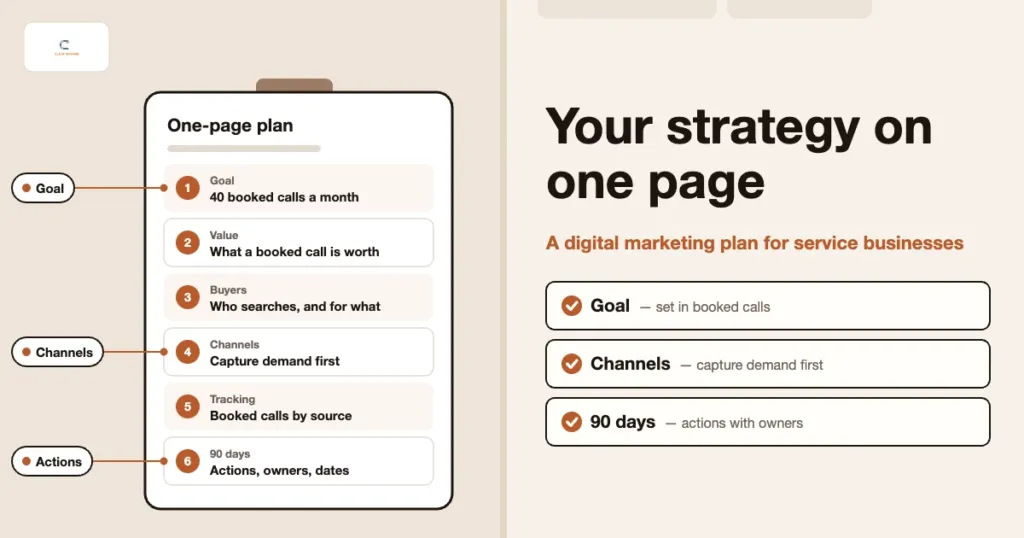
Here’s the skeleton. Each row is a section of your page, the question it has to answer, and a short example of what a good answer looks like.
| Plan section | Question it answers | Example answer |
|---|---|---|
| Goal and capacity | How many booked calls do we need, and how many can we handle? | Plumbing firm: 25 booked jobs a week across two vans, with room for 8 more. |
| Value of a booked call | What is one booked call worth, and what can we afford to pay for it? | Physio clinic: a booked assessment is worth about £240 in gross profit; ceiling cost £80. |
| Buyer and search | Who buys, what triggers the need, and what do they type? | Homeowners with a leak today: “emergency plumber near me”, “boiler not working”. |
| Channels in order | Where do we capture existing demand first, and how do we nurture the rest? | Google Business Profile, search ads and service pages first; email and remarketing second. |
| Tracking | Can we see which channel produced each booked call? | Call tracking on ads and site, form submissions marked as qualified or not. |
| 90-day actions and review | What happens this quarter, and when do we check? | Twelve weekly actions, a monthly review, a quarterly reset. |
Seven steps to build your one-page plan
Work through these in order. Each step depends on the one before it, so resist the urge to jump straight to channels.
1. Set the goal in booked calls and capacity
Start with what the business needs. Translate revenue targets into booked calls, because that’s what marketing can actually influence. If you know your average job value and how many booked calls turn into jobs, you can work out how many calls you need each week.
Then check capacity. There’s no point generating calls you can’t attend. A plumbing firm with two vans might set a goal of “fill 25 slots a week reliably, and test whether we can handle 33 before hiring a third engineer.” A physio clinic might set its goal by practitioner hours: “fill 80% of available assessment slots, Monday to Saturday.”
2. Work out what a booked call is worth and what you can afford to pay
This is the line most plans skip, and it’s the one that makes every later decision easier. Take the physio clinic: if a new patient is worth about £400 in gross profit across a course of treatment, and six in ten booked assessments become paying patients, a booked call is worth around £240 before marketing costs. Decide what share of that you’re willing to spend to win it. If the answer is a third, your ceiling is about £80 per booked call.
Use your own figures, rough at first. The point is a number you judge every channel against. Cost per lead looks tidy but hides junk enquiries and no-shows, which is why we judge on cost per booked call rather than cost per lead. Once you know your ceiling, you can also start to answer the budget question, including how to split ads and SEO budget in year one.
3. Define who buys and what they search
Describe your best customers plainly: who they are, what has just gone wrong, how urgent it is and what worries them when choosing a provider. A homeowner with a leaking ceiling wants someone today. A runner with a sore knee will compare clinics and read reviews first.
Then list the searches that match those moments. Urgent, local searches (“emergency electrician near me”) behave very differently from research searches (“how long does a sprained ankle take to heal”), and the urgent ones produce booked calls fastest. Keyword research for service businesses gives you the real phrases, so the plan reflects what people type, not your internal service names.
4. Choose channels in order: capture demand, then nurture
For most service businesses, the order matters more than the mix. Capture existing demand first. People are already searching for what you do; be visible and convincing when they do. That usually means:
- Google Business Profile. Often the cheapest source of calls for local services. Get categories, services, photos and reviews right, and follow our guide to Google Business Profile for calls.
- Search ads. Tightly targeted Google Ads on high-intent, local searches, with call assets (formerly call extensions) and sensible negative keywords.
- Service pages. One clear page per core service, built for SEO and for converting visitors into calls, with your phone number and booking option easy to find on mobile.
Nurture second. Once you’re catching the demand that exists, add channels that bring people back: email automation for enquiries that didn’t book, ethical remarketing for visitors who left, and helpful content that answers the questions people ask before they’re ready to call. They rarely fill a diary alone, but they lift the return on everything above them.
Write one sentence per channel. For every channel on your page, finish this line: “We use this to win booked calls from people who…”. If you can’t finish it, the channel doesn’t belong in this quarter’s plan.
5. Fix tracking before you spend more
If you can’t see which channel produced a booked call, you can’t make the decisions this plan depends on. Before adding budget, make sure calls from ads, your website and your Business Profile are tracked, forms are recorded, and someone marks which enquiries were genuine and which booked. Our guide to tracking booked calls, not clicks covers the practical setup.
In Google Ads, you can mark conversions as Primary or Secondary, so the bidding system optimises towards the actions you care about rather than every page view or button tap. If your setup is messy, analytics and tracking work should come before any new channel.
6. Write a 90-day action plan
Strategy turns into results through dated actions. Ninety days is long enough to see whether something works and short enough to stay focused. List roughly one action per week, each with an owner: “Week 1: fix call tracking on the website. Week 2: rewrite the emergency plumbing page. Week 3: launch search ads for three core services.”
Sequence matters here too. Tracking and the basics go first, demand capture second, nurture third. If you want a worked example, our 90-day lead engine, day by day shows how we sequence the first quarter. And if your work is seasonal, build the plan around it; seasonal demand planning explains how to shift effort before the busy months, not during them.
7. Review monthly and reset quarterly
Put two dates on the page. The monthly review is a short check: booked calls by channel, cost per booked call against your ceiling, and whether the weekly actions happened. Adjust, but don’t rewrite the strategy.
The quarterly reset is where you revisit the whole page. Has capacity changed? Has the value of a booked call moved? Did a channel earn its place, or should it be cut? Then write the next 90 days.
What to leave off the page (for now)
A good plan is defined as much by what it excludes. Leaving a channel out doesn’t mean it will never work, only that it doesn’t fit yet. Common candidates for “not this quarter”:
- Broad social media campaigns. Useful for awareness and some consumer services, but rarely the first source of booked calls when search demand is going uncaptured.
- New service lines or areas. Expanding before your core services convert well spreads budget too thin.
- A full website rebuild. If the site works on mobile and the phone number is easy to find, fix key pages first and rebuild later if needed.
- Channels you can’t track. If you can’t connect a channel to booked calls, park it until you can.
List these in a small “parked” box at the bottom of the page, so the same debate doesn’t return every meeting.
How to measure whether the strategy is working
Keep the scoreboard small. Clicks, impressions and followers can sit in a channel report, but they don’t belong on the one-page plan. Track these instead:
- Booked, qualified calls per week. The headline number, compared with your goal and your capacity.
- Booked calls by channel. So you know where to add or cut budget at each monthly review.
- Cost per booked call. For paid channels, judged against the ceiling you set in step 2.
- Enquiry-to-booking rate. If calls are coming in but not booking, the problem may be call handling or follow-up rather than marketing.
- Actions completed. How many of the planned weekly actions actually happened. A plan that isn’t executed can’t be judged.
A simple spreadsheet updated weekly is enough, as long as the same numbers are reviewed the same way every month.
Common mistakes when building a marketing strategy
- Starting with channels. Picking tactics before setting the goal and the value of a booked call means you have no way to judge whether they work.
- Ignoring capacity. Generating more enquiries than you can serve wastes money and damages reviews when people wait too long.
- Chasing new demand before capturing existing demand. Awareness campaigns are hard to justify while today’s searchers find competitors.
- Spending more before tracking works. Scaling a channel you can’t measure is guessing with a bigger budget.
- Rewriting the plan every month. Most channels need weeks of data before you can judge them fairly. Adjust monthly, reset quarterly.
- Treating the plan as marketing-only. Call handling and follow-up decide whether enquiries become bookings. Put them on the page too.
FAQs
How long should a digital marketing strategy be?
For most service businesses, one page is enough. It should cover your goal and capacity, the value of a booked call, who buys and what they search, your channels in order, tracking, and a 90-day action list.
How much should a service business spend on marketing?
Work it out from your own numbers rather than a rule of thumb. Multiply the booked calls you need by the cost per booked call you can afford, then check that against cash flow. Start with the channels most likely to hit that ceiling, and increase spend only once tracking shows they do.
Should we start with Google Ads or SEO?
Many service businesses do both, in proportion. Search ads can produce booked calls within weeks, while SEO and your Business Profile build over months. The balance depends on urgency, local competition and the cash you can commit.
How often should we change the strategy?
Review the numbers monthly and make small adjustments, such as moving budget between campaigns or fixing a weak page. Revisit the whole page each quarter, when you have enough data to judge channels fairly. Change sooner only if something fundamental shifts, like capacity or pricing.
How can ClickOptimo help?
We help service businesses build and run plans like this, from tracking and Google Ads to SEO, websites and email. A Growth Diagnostic is the usual starting point: we review your numbers and channels and show you what to fix first. Book via /book/.
Next step: draft your one page this week
Block out one hour this week. Copy the six rows from the table onto a blank page and fill in what you know: weekly capacity, a rough value for a booked call, your top three searches and current channels. Every line you can’t answer confidently is a first 90-day action.
Book a Growth Diagnostic — we’ll go through your one-page plan with you and point out where booked calls are being lost.
More context: Integrated ads and SEO vs specialists · The GA4, call tracking and Google Ads measurement stack · Local SEO for Google Maps
growth@clickoptimo.com · +91-8497982579