
Table of Contents
Peak season is when service firms discover whether marketing was ready or merely loud. Heatwaves, boiler failures, back-to-school appointments, allergy clinics, tax-deadline consults — demand arrives while tracking is half-built, landing pages still say “welcome,” and the phone queue eats every closer. Owners then throw budget at the spike, burn learning periods, and call the chaos “marketing.” Seasonal demand planning for trades and clinics is the opposite: align Google Ads, SEO and capacity before the diary fills — or before it should.
This guide is for appointment-led firms — home services, trades, clinics, professional practices — across the US, UK, AU, CA and NZ. Illustrative seasons only; your diary history beats generic calendars. Soft next steps: a Growth Diagnostic when Ads, SEO and tracking disagree on readiness, or the 90-Day Lead Engine when peak prep needs a time-boxed rebuild with Google Ads for service businesses and SEO for service businesses.
Plan with capacity, not FOMO. Soft proof of method sits on Results; logos do not replace a diary that survived last year’s peak. Use this blueprint to map demand, pace bids, prep money pages and GBP, harden lead handling, then use the off-season for brand and ethical remarketing — not panic content.
Map your demand year (without fake precision)
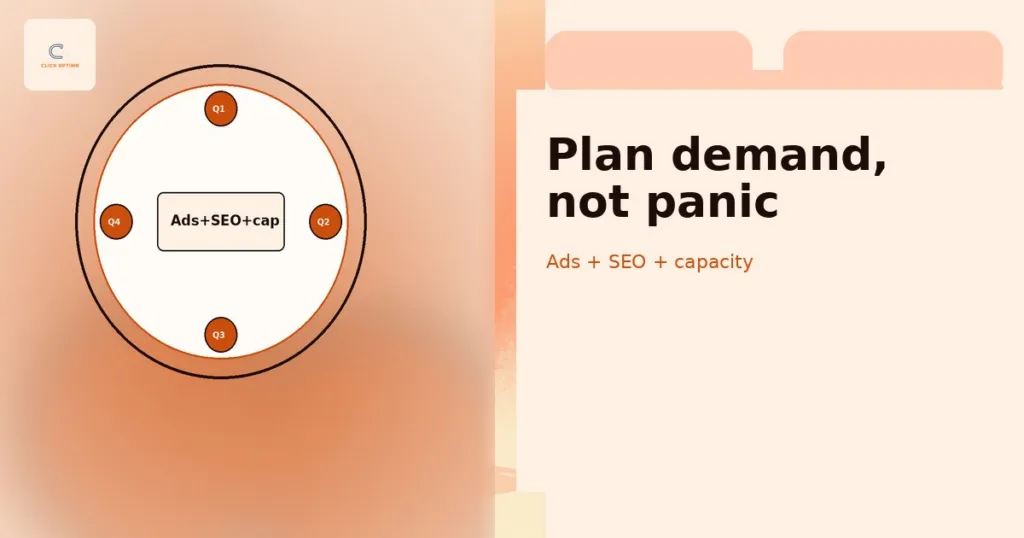
Draw a simple year wheel: months across the top, your core jobs down the side, then shade high / medium / low demand from last two to three years of booked calls — not impressions. Trades often track weather and maintenance cycles (heating failures, AC installs, storm damage, spring plumbing). Clinics and practices often track school terms, insurance renewals, allergy seasons, elective windows and referral rhythms. Patterns are illustrative; a coastal HVAC firm and an inland clinic will not share the same peaks. The point is shared language for owners, Ads and SEO: “these six weeks need budget and pages ready; these eight weeks need qualification and brand, not volume theatre.”
Refuse fake precision. A neat PowerPoint season chart that ignores capacity, travel time and clinician leave is fiction. Annotate the wheel with staffing limits, holiday closures and jobs you refuse. Soft method proof can point to Results; never invent “peak CPC down 40%” claims. Tie the map to booked calls, not clicks and cost per booked call so seasonal planning has a commercial filter.
Owners who skip the wheel default to last year’s panic: raise budget the Monday demand explodes, rewrite titles mid-spike, and blame “the algorithm.” Mapping first turns peak weeks into a checklist — pacing, pages, SLA — instead of a surprise. When you first draw the wheel, invite whoever owns the diary and whoever owns Ads into the same hour. Disagreements about “when peak starts” usually reveal missing data, not personality. Resolve them with booked-call history before you rewrite budgets. A shared wheel also stops SEO publishing spring content the week after demand already peaked — timing is a commercial skill, not a content quota.
Leading indicators vs lagging booked calls
Leading indicators — search interest, weather forecasts, school calendars, GBP insights trends, enquiry volume rising ahead of bookings — help you prepare. Lagging booked calls tell you whether preparation worked. Do not optimise only to leading charts; a surge in “DIY fix” queries is not a mandate to buy more leads. Watch indicators early, then judge success on booked work and capacity utilisation. When measurement is messy, fix the GA4 + call tracking + Ads stack before arguing about seasonality models. Analytics & tracking is the readiness home when peaks expose broken conversion paths.
Budget and bid pacing before the spike
Raise budget early enough to gather conversion history and clear waste — not the morning demand explodes. Smart Bidding already models regular seasonality, but new strategies, setting changes and restructures trigger a learning period, so mid-spike tinkering means paying high CPCs while it recalibrates. For short, unusual events (roughly one to seven days), Google Ads seasonality adjustments tell Smart Bidding to expect a conversion-rate shift. Build a conversion history on clean definitions weeks ahead; tighten negative keywords and message match so peak spend buys job-intent, not DIY theatre. High-level rule: pace into the spike, protect brand and money-page landing match, and avoid resetting campaigns for cosmetic restructures mid-peak.
Pacing also means knowing when not to buy volume. If capacity is eighty per cent booked two weeks out, buying more unqualified forms is vanity. Shift spend toward higher-margin jobs, tighter geo, or brand defence. Pair Ads pacing with the wasted Google Ads spend checklist so seasonal waste is visible on one scoreboard. Use Google Ads for service businesses as the system home for service-shaped campaigns — not eCom holiday playbooks.
Document a pre-peak change freeze: no playful restructuring the week before your known spike unless tracking is broken. Soft next step when the rebuild must be time-boxed before the season: the 90-Day Lead Engine. Budget pacing also needs a waste ceiling: decide in advance what you will pause if CPL looks fine but booked-call rate collapses under spam or DIY. Peak season without that ceiling becomes an auction you cannot staff. Keep brand campaigns funded enough to protect name searches when competitors surge — brand defence is capacity protection, not vanity. Document who can approve mid-peak budget moves so panic does not live in three Slack threads.
Geographic and schedule adjustments
Geographic targeting and budget splits belong where you can actually serve and convert — travel radius, clinician coverage, storm corridors — not everywhere a CPC looks cheap. Ad schedules matter when call centres close or after-hours emergency work has different margins; target CPA, target ROAS and Maximise conversions ignore manual location and schedule bid adjustments, so use targeting, schedules or separate campaigns. Keep changes honest: do not bid into suburbs you cannot reach in peak traffic. Align geo language with local SEO and Google Ads so organic and paid do not fight over thin location clones. Review schedules against real answering hours; unpaid rings at 2 a.m. are not “missed opportunity,” they are SLA design.
SEO and GBP prep that compounds
SEO work for seasonality is prep, not magic same-week ranking theatre. Strengthen money pages that book the peak jobs: clear service language, proof, FAQs that match how people search in high season, and fast call paths. Update Google Business Profile with useful seasonal posts, hours, services and photos — ethical and accurate, not fake scarcity. Compounding means pages and GBP presence that reduce total dependence on paid clicks during expensive weeks. Use SEO for service businesses as the durable-page system; soft proof on Results stays method-only.
Content calendars should serve money pages first: FAQs that disambiguate DIY vs professional, seasonal maintenance prompts that still qualify, and hubs that route intent to a call. Landing pages that book calls need the same clarity whether traffic is organic or paid. The services hub connects SEO and Ads so seasonal themes share one vocabulary.
Start SEO prep months out when possible; peak week is for answering phones, not publishing thin experiments. GBP posts should answer real seasonal questions — hours during storms, what you do not cover, how to book after hours — not empty “happy summer” graphics. Photos of real crews and clinic spaces beat stock urgency. If reviews spike in peak weeks, respond with useful detail; silence during chaos trains the next caller to distrust you. Align NAP and hours across site and GBP before the spike so Maps callers do not hit closed doors.
What not to publish (thin doorway season pages)
Do not mass-publish spun “summer AC special [suburb]” doorway pages with duplicate paragraphs and stock urgency. Thin seasonal clones create crawl noise, weak trust and compliance risk. Prefer one strong money page (or a few genuine location pages) with clear seasonal sections and FAQs over twenty near-duplicates. Avoid fake countdown timers and promises you cannot staff. If Search Console shows many thin seasonal URLs competing, consolidate and strengthen — the same discipline as local doorway cleanup.
Peak rule: Prep money pages and GBP before you buy more expensive clicks.
Lead handling SLA in peak weeks
Speed-to-lead collapses under volume if nobody owns it. Define who answers, within how many minutes, what happens to after-hours forms, and how spam is filtered without burying real jobs. Peak weeks amplify spam and bots; filters must tighten without blocking bookable enquiries — detail mindset in lead quality scoring and spam form defence. Train reception on qualification scripts that protect capacity: out-of-area, DIY, tyre-kickers redirected politely.
Missed calls in peak season are the most expensive “marketing” failure. Call tracking and CRM stages should show abandoned rings and unbooked enquiries, not only form counts. When Ads, SEO and the diary disagree under load, a short Growth Diagnostic ranks gaps by booked-call impact. Write the SLA on one page: first response target, escalation path, spam quarantine owner, and after-hours rule. Drill it once before peak — a tabletop exercise beats discovering gaps on the busiest Tuesday. If you use chat or SMS, apply the same speed and qualification standards; a slow SMS queue is still a missed booking. Join peak-week marketing reports to abandoned-call and no-show rates so “leads up” cannot hide operational failure.
Off-season: brand, remarketing ethics, content
Off-season is for foundations: clean negatives, money-page upgrades, tracking hygiene, brand search defence, and ethical remarketing that reminds without hounding. Content can educate and qualify without buying every low-intent click. Attribution and assisted paths matter more when cycles stretch — see attribution for assisted conversions. Soft next step for a structured rebuild between peaks: the 90-Day Lead Engine and the day-by-day Lead Engine walkthrough. Off-season content should still qualify: explain when a DIY fix is unsafe, what an assessment includes, and who you cannot help. That reduces peak-week tyre-kickers. Use quieter months to fix Core experiences that hide the call button on mobile — peak traffic on a slow form is paid frustration. Review last year’s peak post-mortem with Ads, SEO and ops in one meeting; the year wheel improves only if someone owns the notes.
FAQs
Why plan seasonality for service Google Ads?
Peaks raise CPCs and call volume. Planning budget, tracking and lead handling early protects booked-call efficiency.
Should trades and clinics plan the same way?
Principles match—capacity, messaging, pacing—but demand drivers differ. Use your own diary history as the primary guide.
When should I increase budget before peak season?
Early enough to gather conversion data and fix waste, not the morning demand explodes. Exact timing varies by market.
Can SEO help with seasonal demand?
Yes—strong money pages and GBP presence reduce total dependence on paid clicks during expensive weeks.
What if capacity is full?
Tighten targeting, raise qualification, pause low-margin themes, and protect brand—don’t buy leads you cannot serve well.
How can ClickOptimo help?
Diagnostic and Lead Engine work align Ads, SEO and tracking to seasonal capacity. Book via /book/.
Next step: plan the year before the spike owns you
Do not award next quarter’s budget to FOMO the week demand arrives. Map demand against capacity, pace bids with clean history, prep SEO and GBP that compound, harden lead SLAs for peak volume, and use the off-season for foundations. When you want a guided pass across Ads, SEO and tracking before the next peak, book a short diagnostic.
Book a Growth Diagnostic — twenty minutes, gaps ranked by diary impact.
More context: Growth Diagnostic · services · Google Ads for service businesses · SEO for service businesses
growth@clickoptimo.com · +91-8497982579