Table of Contents
Most service businesses don’t lose jobs because their marketing failed to produce an enquiry. They lose them in the gap between the enquiry arriving and someone replying. A form lands at 7.40pm or a call goes unanswered while the team is on site. By the time anyone responds, the prospect has booked with whoever got back to them first.
That gap is where AI is genuinely useful today. Not robots running your front desk, but small, unglamorous automations that reply faster, capture details properly and get people onto your calendar. Used carelessly, though, they make up prices, annoy people and create data protection problems.
This guide is for owners and marketing leads of service businesses — trades, clinics, home services and professional firms — across the US, UK, AU, CA and NZ. It covers six practical uses of AI for customer engagement, the risk and guardrail for each, how to start with one use over 30 days, and how to measure the result in booked calls rather than messages sent.
The best AI for a service business isn’t the cleverest one. It’s the one that gets a real person onto your calendar faster, without saying anything you wouldn’t.
Speed of response is the real opportunity
When someone needs a boiler fixed, a physio appointment or advice on a lease, they rarely contact just one business. They fill in two or three forms or call down a list, and the first business to reply with something useful often wins.
The trouble is that small teams can’t reply instantly. Your best people are on jobs or with patients, and many people enquire in the evening or at weekends. AI fills that window. It acknowledges the enquiry, asks the right questions and offers a next step, so the conversation is warm when your team picks it up.
Faster replies only help if the rest of the journey works. If your site is slow or confusing, automation won’t rescue it. Start with a conversion-focused website that makes enquiring easy, then use AI to respond to what comes in.
Six AI uses at a glance
Each use has a clear job, a clear risk and a guardrail that keeps it safe.
| Use | What it does | Main risk | Guardrail |
|---|---|---|---|
| Instant replies to web enquiries | Acknowledges a form within a minute and asks qualifying questions | Generic or wrong answers | Approved wording only; no prices or dates unless confirmed |
| Missed-call text-back | Texts callers you couldn’t answer with a way to book | Unwanted messages and compliance issues | Reply only to inbound calls; check local texting rules |
| Website chat assistant | Answers FAQs and offers real booking slots | Invented answers or false availability | Answers from approved content only; slots from your live calendar |
| Call transcription and summaries | Turns calls into notes and next steps | Recording without proper notice | Tell callers; limit access and how long you keep it |
| Drafted follow-ups and review replies | Writes first drafts in your tone | Off-tone or inaccurate messages | A person approves before anything is sent |
| Sorting and scoring enquiries | Tags enquiries by service, urgency and fit | Good leads marked as low priority | Review a sample weekly; people can override |
Six practical ways to use AI for customer engagement
None of these needs a large budget. Most can be switched on inside tools you already use, such as your CRM, phone system or website chat.
1. Instant replies to web enquiries
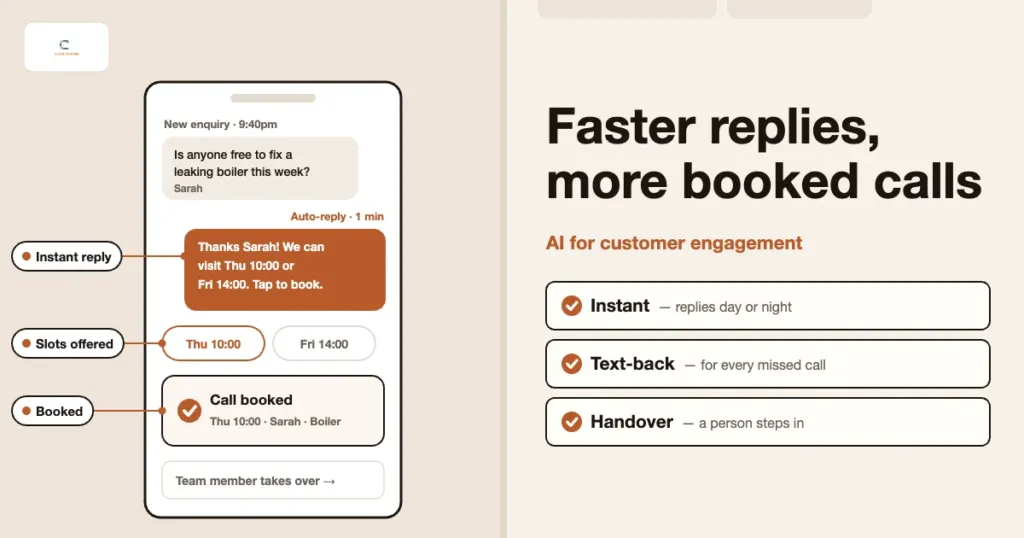
When a form comes in, a reply should go out within a minute or two. Not a bland “thanks, we’ll be in touch”, but a short message that confirms what they asked about, sets an honest expectation for when a person will call and asks one or two useful questions, such as their area and a good time to talk.
AI reads the free-text part of the form and tailors the reply. Someone who wrote “boiler leaking, baby at home” should get a different reply from someone asking for an annual service quote. It should choose from approved wording, not improvise. If the enquiry came from an ad, the reply should match the promise made on the page, which is one reason landing pages built for booked calls matter.
2. Missed-call text-back
For many trades and clinics, missed calls are the biggest leak of all. The owner is up a ladder or the receptionist is with a patient, and the caller tries the next number. A missed-call text-back sends a short message within seconds: sorry we missed you, here’s how to book, or reply with what you need and we’ll call you back.
AI can handle the replies and pass a summary to the team. Only text people who have just called you, make it obvious the message is from your business, make it easy to opt out, and check the rules on business texting where you operate, because they differ between countries. If calls drive most of your work, also make your Google Business Profile work for calls.
3. A website chat assistant that answers FAQs and offers booking slots
A chat assistant earns its place when it does two things well: answers the questions people ask before they commit, and offers a real time to talk. Do you cover my area? Do I need a referral? These are answerable from content you already have.
Restrict it to your approved content: service pages, FAQs, policies and areas covered. If a question falls outside that, it should say so and offer a callback, not guess. For booking, connect it to your live calendar so the slots it offers are real. A promised slot you can’t honour does more damage than no chat at all.
4. Call transcription and summaries for follow-up and quality checks
Many phone systems and CRMs can now transcribe calls and produce a short summary: what the caller needed, what was promised and what happens next. Fewer details get lost between the person who took the call and the person following up.
Summaries are also a practical quality check. Reading ten a week shows whether prices are explained consistently and why some enquiries don’t become bookings. Tell callers they are recorded, check whether your location requires everyone’s consent, limit who sees transcripts and delete them when no longer needed.
5. Drafting follow-ups and review replies (a person approves)
Follow-up is where many service businesses quietly lose bookings. AI is good at first drafts: a follow-up after a quote, a reminder before an appointment, a reply to a new Google review.
The rule is simple: a person approves before anything is sent, at least until you trust the output. Review replies are public and hard to take back, so never let them post automatically. For sequences that run on their own, such as quote reminders, build them as proper automations with approved wording. Our guide to email automation for service businesses covers which sequences to build first.
6. Sorting and scoring enquiries
When enquiries arrive from forms, calls, chat and email, AI can tag each one by service, location, urgency and likely fit, then route it to the right person. An emergency leak goes to the on-call engineer; an obvious sales pitch goes nowhere.
The risk: a good lead marked as low priority may never get a call. Let people override the tags, review a sample of low-scored enquiries every week, and base the rules on what actually became a booked job. Our article on lead quality scoring and spam forms explains how to build scoring that reflects real outcomes.
Guardrails that protect trust and keep you compliant
AI that talks to customers speaks for your business. These guardrails are what make it worth having.
- Human handover. Every automated conversation needs a clear route to a person. The AI should hand over as soon as someone asks for one, sounds upset or raises something outside its brief.
- Never invent prices or availability. If a price depends on a site visit or assessment, the AI says so. If it offers a time, that time comes from your live calendar.
- Say it’s automated where required. Some places require you to tell people when they are dealing with an automated system. In the EU, the AI Act’s rule that chatbots must make clear people are talking to AI has applied since 2 August 2026, and it is good practice everywhere. A simple line such as “I’m the practice’s AI assistant” is enough.
- Consent and data protection. If you serve customers in the UK or EU, GDPR and UK GDPR apply to the personal data these tools handle. In the UK, the Data (Use and Access) Act 2025 has updated UK GDPR and raised the maximum fines for unlawful marketing texts and calls to UK GDPR levels. Have a lawful basis, explain it in your privacy notice and check where your providers store data. Other countries have their own privacy laws, so check local rules or take advice.
- Keep sensitive details out of chat. Clinics should avoid collecting health details by chat or text.
Write the “never” list first. Before you switch anything on, write down what the AI must never do: quote prices, confirm a time without checking the calendar, give clinical or legal advice, promise outcomes. Then test every item yourself.
How to start small: one use, 30 days
Switch everything on at once and you can’t tell what worked. Pick one use and give it 30 days.
Week one. Choose the use that fixes your biggest leak, then write the wording, the “never” list and the handover rule, and note your current numbers.
Weeks two and three. Switch it on, then read every automated conversation. Fix confusing wording and check that handovers actually reach someone.
Week four. Compare against your starting numbers and decide: keep, change or drop. Only then add a second use. It is the same principle behind our 90-day lead engine: one fix at a time, each measured before the next.
How to measure it in booked calls
Messages sent and chats started are activity, not results. Measure three things before and after you switch anything on.
- Response time. The time from enquiry to first useful reply, and to first contact with a person. Your CRM or inbox timestamps will give you this.
- Enquiry-to-booking rate. How many enquiries become a booked call or appointment? This is the number AI should move.
- Booked calls. The total that actually landed in the diary, by source, so you can see whether the gain is real.
To do this properly, your tracking has to count bookings rather than clicks. Our guide to tracking booked calls, not clicks explains the setup, and the GA4, call tracking and Google Ads measurement stack shows how calls, forms and ad data fit together. Once bookings are tracked, compare your cost per booked call before and after.
Common mistakes
- Letting AI answer anything. A chat assistant without limits will eventually make something up.
- Hiding the human. People who want a person and can’t find one leave. Make the handover obvious.
- Quoting prices automatically. Unless prices are fixed and published, leave pricing to people.
- Automating before fixing the basics. If forms are broken or calls route to a voicemail nobody checks, fix that first.
- Not reading the conversations. The first month of transcripts is the best feedback you will get.
- Measuring activity, not bookings. Thousands of automated replies mean nothing if booked calls didn’t move.
- Forgetting how people find you. AI on your site only helps if people reach it. Search is changing, but SEO still matters in the age of AI search, and clear service pages feed both rankings and your chat assistant.
FAQs
Will customers be put off by talking to AI?
Most people mind slow replies and unhelpful answers far more than automation itself. Keep the AI short, accurate and honest about what it is, and make the handover to your team easy.
Is it legal to use AI to reply to customers?
Generally yes, but existing rules still apply. Data protection law such as GDPR and UK GDPR covers the personal data involved, call recording and business texting have their own rules, and some places require you to disclose automation. Rules vary by country and region, so check local requirements or take advice before you launch.
Which AI use should a small service business start with?
Start where you lose the most enquiries. For businesses that miss a lot of calls, missed-call text-back is usually the quickest win. If forms sit overnight or over weekends, start with instant replies to web enquiries.
Do we need new software to do this?
Often not. Many CRMs, phone systems and chat tools already include automated replies, transcription or AI drafting. Check what yours can do before buying anything new.
How can ClickOptimo help?
We find where your enquiries are leaking and fix the biggest gap first, with guardrails and human approval built in. That covers fast replies and follow-up sequences through our email marketing service, and booked-call tracking through our analytics and tracking service. Book via /book/.
Next step: close your biggest response gap
This week, pull your last 30 enquiries and note how long each one waited for a first reply and how many became a booked call. Find the biggest gap, whether that is missed calls, overnight forms or unchased quotes, and pick the one AI use that closes it.
Book a Growth Diagnostic — we’ll review your response times, enquiry handling and tracking, and tell you which automation to start with.
More context: 90-day lead engine, day by day · Attribution and assisted conversions · 10 signs your website is costing you leads
growth@clickoptimo.com · +91-8497982579