Table of Contents
“Leads are up” is the most tired sentence in service marketing — usually spoken while closers are exhausted, the diary is thin, and half the CRM is spam, tyre-kickers or out-of-area tyre-kickers with a new name. Volume dashboards celebrate form fills; the team pays the tax. Lead quality scoring for service businesses is not B2B SaaS jargon. It is a simple way to rate enquiries by fit and likelihood to book, cut spam forms that train Google Ads on junk, and feed better signals back so spend follows diary outcomes.
This blueprint is for appointment-led firms — home services, trades, clinics, professional practices — across the US, UK, AU, CA and NZ. No fake “reduce spam 90%” claims. Soft next steps: a Growth Diagnostic when forms, tracking and Ads disagree on what a conversion is, or the 90-Day Lead Engine when measurement and qualification need a time-boxed rebuild with Analytics & tracking.
Promise: a lightweight scoring model owners can actually run, spam defences that do not kill conversion, and a feedback loop to Ads. Soft proof of method sits on Results; logos do not replace cleaner booked-call rates. Anchor the conversation in cost per lead vs cost per booked call so “cheap leads” stop winning arguments they should lose.
Define qualified enquiry and booked call
Write two definitions on one page and make every vendor use them.
Qualified enquiry: fits your service, area and basic fit rules (and is not obvious spam). Examples: in-area homeowner requesting a service you offer; patient seeking an appointment type you provide; business needing a scoped professional job.
Booked call (or booked appointment): a diary outcome — time held with a real prospect after human confirmation — not a form thank-you page view.
Without those lines, scoring is theatre and Ads optimisation is guesswork. Tie definitions to track booked calls, not clicks so marketing and ops share one scoreboard. Soft next step when definitions still fight CRM stages: Analytics & tracking.
Owners who skip definitions inherit agency wins that evaporate in the diary. Put the two lines in the Ads account notes, the CRM pipeline labels and the weekly report header. If a partner cannot repeat them, they are optimising a different business. Put both definitions in the weekly report header so every chart is forced to answer them. If an agency cannot map their conversion actions to those two lines, pause optimisation theatre until they can. Reception scripts should use the same language: “qualified” is not a compliment — it is a routing rule. Soft proof stays on Results; never invent quality-rate percentages for pitch decks.
Why volume dashboards hide pain
Form submit counts rise when spam rises, when fields get easier, or when you buy broader match without negatives. Closers feel the pain first: dialling empty numbers, arguing with bots, chasing DIY queries. CPL looks “healthy” while cost per booked call climbs. Volume dashboards hide that inversion. Score quality weekly or Ads will keep buying the spam you accidentally rewarded. Volume dashboards also hide channel mix problems: a spam-heavy Display experiment can “save” Search CPL in the roll-up while burning closers. Segment quality by campaign and by form vs call before you celebrate. When seasonal demand rises, junk rises with it — scoring is peak-season infrastructure, not a nice-to-have. Owners who only audit quality after a bad quarter pay in lost diary slots they cannot recover.
A lightweight scoring model owners can run
Keep the model on one screen. Score each enquiry on five axes (0–2 or 1–5 — pick one scale and stick to it):
- Fit — do they need a job you actually sell?
- Urgency — emergency / this week / research-only?
- Area — in coverage, edge, or clearly out?
- Budget signal — vague “cheap quote” vs scoped need (without interrogating every field)?
- Spam likelihood — disposable email, nonsense name, timing anomalies, known bot patterns?
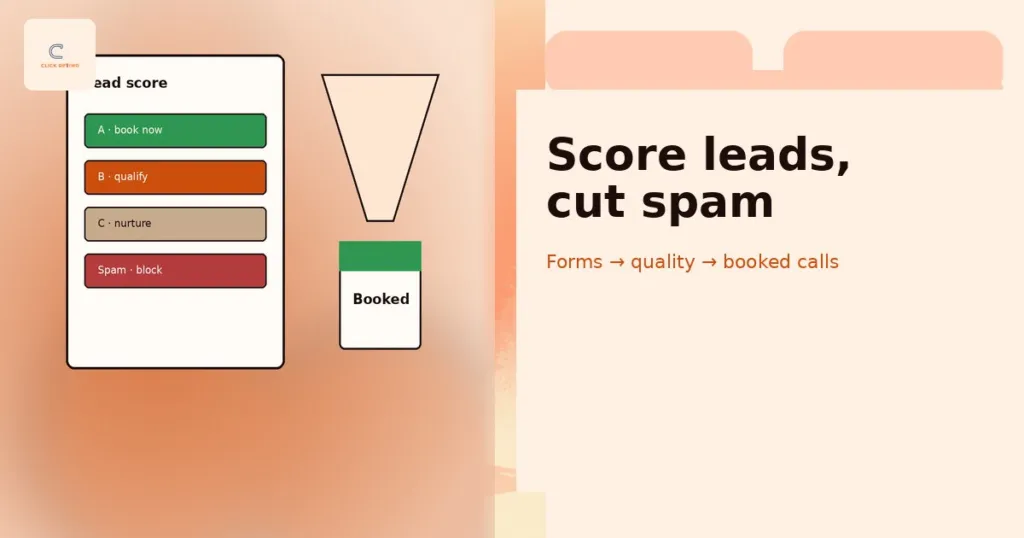
Total or tier the score (A / B / C). A gets immediate human follow-up; C gets automated triage or discard after a quick human glance if volume is high. The goal is prioritisation and reporting honesty — not a PhD model. Feed A/B outcomes into CRM stages that sales trusts. Soft method proof can point to Results; never invent conversion-rate lifts.
When seasonal peaks hit, scoring protects capacity — see seasonal demand planning for trades and clinics. Pair with the wasted Google Ads spend checklist so junk themes and junk forms tell one story. The services hub connects Ads and measurement when silos invent conflicting “wins.” Start scoring in a spreadsheet if the CRM is messy — perfection is not required on day one. Export last week’s enquiries, score them in thirty minutes with whoever answers the phone, and you will already see patterns Ads should negate. Automate later once humans agree on edge cases. Avoid ten-point academic models nobody updates; a three-tier system that is used beats a twenty-factor model that is ignored.
Illustrative rubric (not a universal standard)
Illustrative only — adapt to your vertical:
| Signal | Higher score | Lower score |
|---|---|---|
| Service match | Named job you sell | DIY, wholesale, employment |
| Geography | Core service area | Far out / wrong city |
| Contact quality | Real phone + coherent note | gibberish, fake domains |
| Timing | Human pace | millisecond fills, repeat floods |
| History | Prior booked patient/customer | known spam fingerprint |
Do not treat this table as law. A clinic’s “urgency” differs from an emergency plumber’s. Review the rubric quarterly with whoever answers the phone — they know which fields predict no-shows. Soft next step when the rebuild needs structure: the 90-Day Lead Engine.
Scoring rule: Optimise to booked calls; demote spam and misfit before celebrating CPL.
Spam and bot defences that don’t kill conversion
Defences should raise the cost of junk without burying real bookers. High-level levers: thoughtful field design (ask what you need for routing, not a novel), server-side timing checks, honeypots where appropriate, and CAPTCHA / reCAPTCHA trade-offs used carefully — too aggressive and mobile conversion dies. Prefer progressive qualification on thank-you or callback flows when first-step friction is already high. Test changes against booked-call rate, not only submit rate. If you use Google reCAPTCHA, check it still works: keys now sit in a Google Cloud project, and the free tier covers 10,000 checks a month. Detail for landings that convert sits in landing pages that book calls; measurement hygiene in the GA4 + call tracking + Ads stack.
Money pages that attract the wrong intent also inflate spam-adjacent noise — strengthen SEO money pages and SEO for service businesses so organic visitors self-select. Negatives and query hygiene remain Ads’ first spam filter upstream: negative keywords for services.
Never claim a silver bullet. Spam evolves; defences need review. When tracking and forms still disagree with the diary, book a Growth Diagnostic. Field design tip: ask for service type and postcode or suburb early when those fields route work; postpone essay-length “tell us everything” boxes until after intent is clear. Invisible honeypots help; visible puzzles that punish older customers do not. Revisit filters after every theme or landing change — spam shifts when you open new doors. Log false positives weekly so real bookers are not trapped in quarantine during peak weeks.
Call spam and fake click patterns (awareness)
Call spam is not the same as form spam. Patterns include robocalls, number spoofing, short abandoned rings, and click-to-call abuse. Form filters do not protect the phone channel. Track call outcomes separately; use vendor tools and CRM dispositions carefully. Fake click patterns on ads can also inflate engagement metrics without bookable intent — awareness first, then specialist review. Do not assume one CAPTCHA fixes the phone. Soft proof stays method-only on Results.
Closing the loop to Google Ads
Quality without a feedback loop still trains bidding on junk. Mindset: when CRM quality is reliable, enhanced conversions and offline import workflows can send better signals — start with clean definitions before complex imports. Google is moving offline conversion uploads to its Data Manager API (the old Google Ads API route closed to accounts not already using it from 15 June 2026), so check any CRM connector you rely on is up to date. Mark spam and misfit so they stop counting as success; mark booked outcomes so smart bidding has something true to chase. Share a monthly quality pack with the Ads owner: top junk themes, negatives to add, landing mismatches, and score distribution. Use Google Ads for service businesses as the optimisation home; pair with briefing or firing a Google Ads agency standards if partners only report CPL.
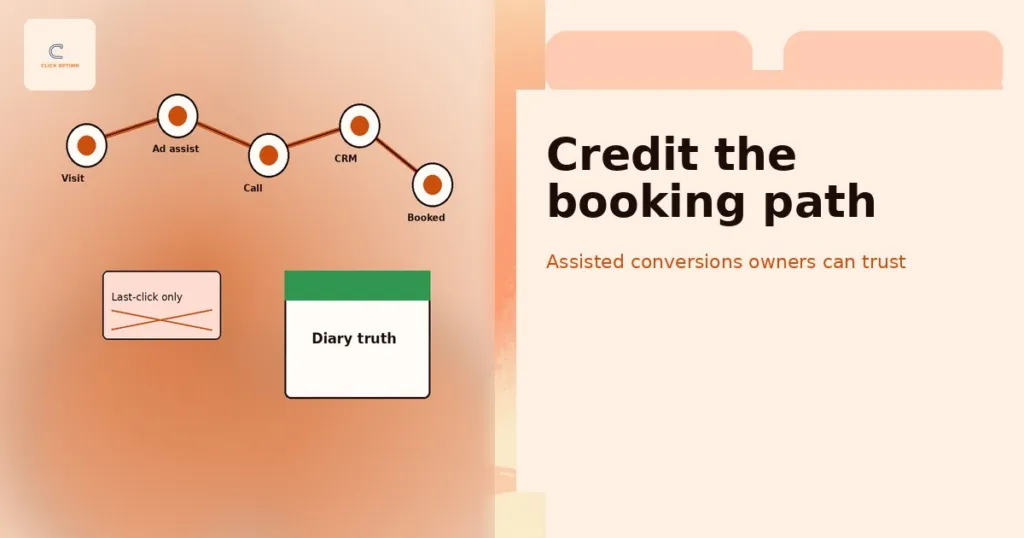
Attribution nuance belongs after quality is honest — attribution for assisted conversions — because junk “conversions” poison every model. Closing the loop also means agreeing what never counts as a conversion: bot submits, known spam fingerprints, out-of-area auto-rejects, and employment or DIY queries. Until those are excluded, smart bidding will keep buying them. Share the exclusion list with SEO so money-page FAQs discourage the same waste organically. If offline imports are not ready, at least stop optimising to raw form fills in the UI.
Team workflow: who touches which score
Assign ownership: marketing owns spam filters and Ads feedback; ops/reception owns first disposition; sales owns A-lead follow-up SLA. One person should own the weekly quality scoreboard. Do not let every closer invent private scoring in chat apps. Document who can discard C-leads and who must call A-leads within the agreed minutes — especially in peak weeks. Soft next step for a time-boxed rebuild of tracking plus qualification: Analytics & tracking and the 90-Day Lead Engine. Ethical remarketing lists also depend on clean events — see ethical remarketing for services. Train new reception staff on the score meanings in the first week — tribal knowledge is how C-leads clog A queues. Review score drift monthly: if everything becomes an A, the rubric collapsed. Keep marketing and ops in one short huddle when spam spikes after a campaign change; do not wait for the monthly deck. Soft next step when workflow and tracking both need rebuild: the 90-Day Lead Engine.
FAQs
What is lead quality scoring for service businesses?
A simple way to rate enquiries by fit and likelihood to book—so reporting and follow-up prioritise diary outcomes over raw form counts.
How do spam forms hurt Google Ads performance?
They inflate conversions, train smart bidding on junk, and waste sales time—making CPL look fine while booked calls stall.
Should I add more form fields to improve quality?
Sometimes a few qualification fields help; too many kill conversion. Test carefully and watch booked-call rate, not only submit rate.
Can I send quality signals back to Google Ads?
Yes in principle via enhanced/offline workflows when CRM quality is reliable. Start with clean definitions before complex imports.
Is call spam different from form spam?
Yes—patterns and defences differ. Track both; don’t assume form filters protect the phone channel.
How can ClickOptimo help?
Diagnostics align tracking, forms and Ads optimisation to qualified enquiries. Book via /book/.
Next step: stop celebrating junk volume
Do not award next week’s bid strategy to a form-count spike while closers drown in spam. Define qualified enquiry and booked call, run a lightweight score, harden spam defences without killing conversion, close the loop to Ads, and assign clear workflow owners. When you want a guided pass across tracking, forms and Ads signals, book a short diagnostic.
Book a Growth Diagnostic — twenty minutes, gaps ranked by diary impact.
More context: Growth Diagnostic · services · Analytics & tracking · Google Ads for service businesses
growth@clickoptimo.com · +91-8497982579