Table of Contents
You are paying for nearly every click while a competitor owns the Map pack, the review strip, and the branded searches that should have been cheaper. That is not “SEO vs Ads.” It is a discovery mix problem: local SEO and Google Ads work better together when Maps visibility, Google Business Profile (GBP), and shared money pages reduce wasted paid intent and support lower CPA on real enquiries.
This post is for owners and growth leads of service businesses — home services, trades, clinics, professional firms — across the US, UK, AU, CA and NZ. You will get mechanisms (not ranking guarantees), shared assets, a joint operating rhythm, and a decision frame for when local SEO investment beats another bid increase. No fake “CPA down X%” claims. Illustrative patterns only. Soft next steps: a Growth Diagnostic or the 90-Day Lead Engine when channels need one system.
The service-business discovery mix
Local service demand rarely arrives through one box. Prospects see the Map pack, organic local results, paid search ads, and branded queries after a van, referral or review. Some ring from GBP. Some click an ad, bounce, then return via Maps. Some search the business name after a neighbour’s recommendation. Treating SEO and Ads as unrelated vendors means each channel optimises a slice while the diary sees one messy pipeline.
A healthy mix for SEO for service businesses and Google Ads for service businesses usually includes: accurate GBP and Maps presence for high-intent “near me” and category+location demand; organic money pages that match jobs you actually sell; paid search for coverage gaps, defence, and themes SEO has not yet won; and branded demand that should not be left entirely to competitors’ ads. Measurement still owns the scoreboard — see the minimum viable measurement stack and Analytics & tracking so CPA means booked calls, not vanity clicks.
Illustrative pattern only — not a promised mix: a residential trade might earn weekday Map-pack calls for category+suburb queries, use Ads for evening emergency coverage and themes not yet ranking, and protect brand when competitors bid on the business name. A clinic might lean form-and-call on service pages while GBP drives navigational rings. The point is role clarity, not a fixed percentage split that ignores capacity and seasonality.
Why siloed SEO and Ads teams leak money
Silos produce duplicate content briefs and opposite negatives, money pages that Ads cannot land on, GBP categories that do not match ad themes, and weekly meetings where “SEO rankings” and “Ads CPA” never meet the diary. Query waste found in search terms never becomes an SEO brief or GBP service update. SEO wins a Map pack impression while Ads keeps bidding on the same DIY theme. Leak pattern: two budgets, one ignored customer journey. The wasted Google Ads spend checklist is more useful when SEO owns the same theme list.
How Maps visibility can lower paid CPA (mechanisms)
Maps visibility does not magically cut CPC overnight. It can indirectly support lower paid CPA when more people recognise the brand before they click, when branded and navigational demand rises, when trust signals (reviews, photos, hours) reduce wrong-intent clicks, and when shared landing and GBP consistency cut bounce on paid sessions. Quality Score and ad experience signals are influenced by landing relevance and expected click behaviour — treat those carefully and without guarantees. Measure booked-call CPA, not “we moved up a pack slot.”
Stronger local presence also changes mix: some high-intent queries convert via call from GBP instead of a paid click; some paid clicks arrive warmer because the prospect already saw stars and photos. That can improve enquiry quality even when raw CPC stays stubborn. Competitors who only buy ads fund discovery that a balanced operator partly earns. Soft proof of integrated method sits on Results — cases are illustrative of approach, not promised CPA deltas.
Mechanisms to watch in your own data (without over-claiming): branded search volume and branded CPA; share of calls from GBP vs site; bounce and time-to-call on paid landings that match GBP services; and whether DIY or wrong-geo themes still burn budget after SEO and negatives share one list. If branded demand rises while non-brand CPA stays flat, you may still be ahead on blended booked-call cost — report both, not only the Ads column in isolation.
What we mean by CPA here (enquiry / booked call — define)
In this article, CPA means cost per meaningful enquiry or, preferably, cost per booked call (or sales-accepted appointment) — not cost per click, not cost per “lead” that never reaches the diary. If your Ads column celebrates cheap form fills that sales rejects, you are not measuring the CPA that matters. Align definitions with cost per lead vs cost per booked call and track booked calls, not clicks. Maps-assisted branded demand should show up in the same reconcile: Spend | Enquiries | Booked.
Careful language: Maps visibility can support efficiency. It does not guarantee lower CPA, pack rankings, or lead volume. Always reconcile to booked calls in your market and capacity.
Shared assets that make both channels efficient
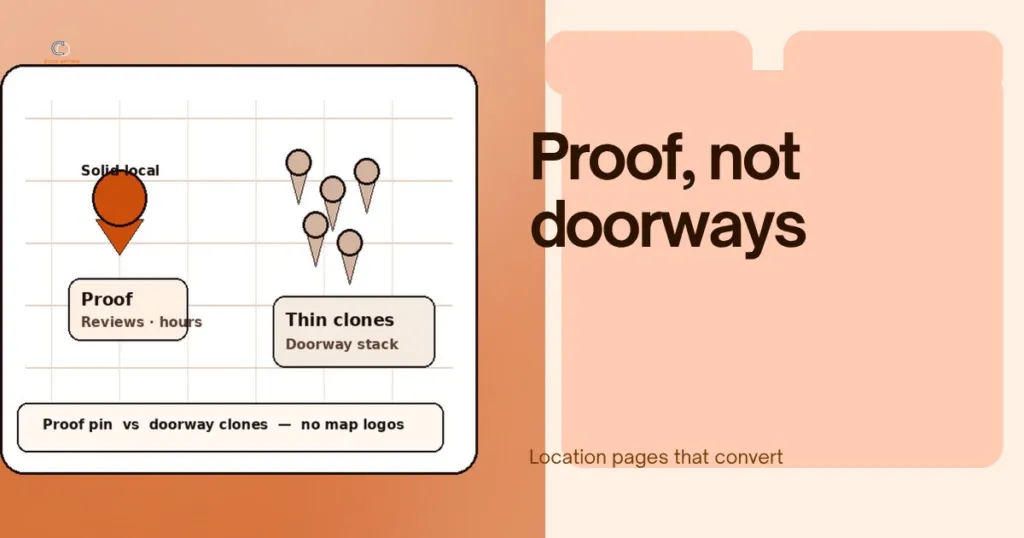
The assets that make local SEO and Google Ads efficient are mostly shared. Conversion-focused money pages (service and service+location where genuine) give Ads a message-matched landing and SEO a durable URL. Non-doorway location pages: real coverage, unique proof, clear offer — not spun city copies. GBP services, posts and photos should echo the jobs you sell and the themes Ads buys. Call and form paths must work on mobile from both organic and paid entry. One services hub mindset: same offer truth everywhere.
When paid lands on a generic homepage while Maps shows a specific service, trust breaks and CPA suffers. When GBP says “emergency” and the landing says “book next week,” expectation mismatch wastes both channels. Build once; point both channels at the same truth.
Practical shared-asset checklist for a working session: list top five paid themes by spend; confirm each has a matching money-page H1 and offer; confirm GBP primary/secondary categories and services echo those jobs; confirm NAP and phone paths; confirm reviews mention the services you sell. Gaps on that list are usually cheaper to fix than another week of broad match experiments.
NAP, categories, reviews as conversion trust
Name, address, phone (NAP) consistency across site, GBP and directories reduces confusion and failed calls. Categories should match the jobs you want — not every adjacent trade you once considered. Reviews are conversion trust for Maps and for paid visitors who check you before ringing. Respond; ask ethically after good jobs; never buy fake reviews (they breach Google’s policies and are now banned under the UK DMCC Act and the US FTC rule). Trust assets do not replace tracking, but they change whether the right people complete the enquiry.
Location assets and call paths in Ads
Location assets, call assets and, where relevant, Local Services Ads need the same footprint and phone truths as GBP. Tracked numbers should not silently fight NAP consistency without a plan. Click-to-call on mobile money pages must work after ad click. If call tracking is in play, preserve campaign context without wrecking the local number people expect from Maps — configure deliberately. Broken call paths inflate apparent CPA because spend continues while diary stays empty.
Operating rhythm: one query theme list
Run one shared list of query themes: Keep / Negative / Content / GBP. Export search terms from Ads; tag DIY, wrong geo, wrong job type, jobs/careers, and winners. Negatives protect paid budget. The same losers inform what not to chase as thin SEO pages. Winners and near-winners become content and GBP category or service updates. Branded and competitor themes get an explicit defence rule so you do not invent strategy weekly.
Meet fortnightly (or weekly in busy seasons) with Ads + SEO + whoever owns the diary. Agenda: theme list changes, money-page gaps, review velocity, reconcile of booked-call CPA, and capacity. Do not run separate “SEO report” and “Ads report” that never share a page. When measurement cannot support that rhythm, fix the stack before blaming Maps or bids.
Owner-runnable tip: keep the theme list in one sheet with columns for Ads action, SEO action, GBP action, and owner. Colour only what changed since last meeting. Speed beats a 40-slide deck. If the front desk reports “wrong job type” calls, that feedback belongs on the same sheet as negatives and category edits — not in a forgotten chat thread.
When local SEO investment beats more bid
Raising bids on non-brand themes gets expensive fast when Map pack and organic local are weak, when brand defence is leaking to competitors, or when seasonality spikes CPC for jobs you already earn via reputation. Invest in local SEO when: capacity can take more organic and GBP calls; money pages and NAP/reviews are the bottleneck; you are over-reliant on paid for branded or category terms you should partly own; or siloed vendors cannot ship a joint theme list. Bid more when: coverage gaps are real, SEO lead time is too slow for a seasonal window, or you need defence while Maps presence is still building.
Rarely pause Ads entirely because you “rank in the pack.” Pack coverage fluctuates; Ads cover gaps and protect brand. Soft rebuild path when SEO, Ads and tracking need one operating system: the 90-Day Lead Engine. Method tone on Results — not promised pack slots.
Capacity matters: winning more Map-pack calls you cannot answer still wastes reputation and future reviews. Seasonality matters: a summer spike may need paid coverage while autumn is the window to deepen location pages and review velocity. Brand defence matters: if competitors bid on your name while your GBP is thin, fixing presence and a modest brand campaign often beats only raising non-brand bids.
FAQs
Do local SEO and Google Ads work better together?
Yes for most service businesses. Shared query insights, consistent money pages and stronger Maps/brand presence usually improve enquiry quality and can reduce reliance on ever-costlier non-brand clicks.
Can Maps visibility lower Google Ads CPA?
Indirectly—through more branded demand, higher trust before the click, and better-aligned landing experiences. Treat CPA claims carefully; measure booked calls, not vanity rankings.
Should I pause Ads if I rank in the Map pack?
Rarely. Map pack coverage fluctuates. Use Ads for defence, coverage gaps, and high-intent themes while SEO builds durable presence.
What shared assets matter most?
Accurate GBP, conversion-focused service/location pages, clear call/form paths, and a joint list of query themes and negatives.
Is this only for home services?
No—clinics and professional services with local intent benefit too, though query patterns and call vs form mix differ.
How does a Growth Diagnostic help?
It reviews Ads, local SEO and tracking as one system aimed at booked calls. Book via /book/.
Next step: one system, one scoreboard
Stop funding discovery only through clicks while Maps and money pages lag. Align shared assets, run one query theme list, and define CPA as booked-call cost. When you want Ads, local SEO and tracking reviewed as one system, book a short diagnostic.
Book a Growth Diagnostic — twenty minutes, channels ranked by diary impact.
More context: Growth Diagnostic · services
growth@clickoptimo.com · +91-8497982579