Table of Contents
Every few months someone declares that SEO is dead. In 2026 the reason given is AI: Google shows AI Overviews above many results, AI Mode answers questions in a chat, and more people ask ChatGPT, Claude or Perplexity before they search at all. If an AI tool answers the question, why would anyone visit your website?
For a service business, the honest answer is that the way people find you is changing, but the reason they need to find you is not. Nobody hires a plumber, a physiotherapist or an accountant from a chat window. They still check who is local, who is trusted and who can help this week — and search, in all its forms, is still where that happens.
This guide is for owners and marketing leads of service businesses — trades, clinics, home services and professional firms — across the US, UK, AU, CA and NZ. It covers what has changed in search, six reasons SEO still pays, how to adapt your SEO for AI answers, and how to measure it in booked calls rather than rankings.
AI changes where people read the answer. It does not change who they call. The businesses that show up as a trusted, local, clearly described option still win the booking.
What has changed in search — and what has not
Since Google started showing AI Overviews in 2024 and added AI Mode in 2025, many searches end with a summary at the top of the page. Independent research, including a 2025 Pew Research Center study, found that people click fewer links when an AI summary appears. At the same time, AI assistants have started sending visitors to websites from their own answers.
Here is how the picture looks for a typical service business:
| Area | What has changed | What still works |
|---|---|---|
| Information searches | Simple questions (“how often should a boiler be serviced?”) are often answered on the results page | Detailed, trustworthy answers still get cited — and clicked by people who want more |
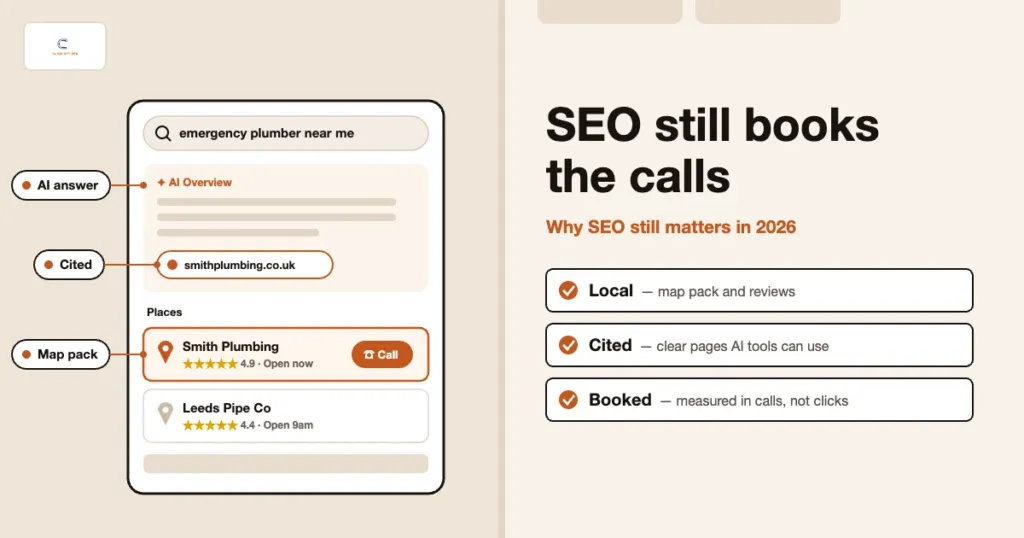
| Local “near me” searches | AI summaries and Maps results sit side by side | Google Business Profile, reviews and local relevance still decide who appears |
| Service searches | Buyers compare more options before they contact anyone | Clear service pages with prices, proof and an easy next step |
| AI assistants | ChatGPT, Claude, Perplexity and others recommend businesses and link to sources | Being described clearly and consistently across your site, profiles and reviews |
| Measurement | Fewer clicks for some informational searches | Booked calls from organic search and Maps remain measurable |
The pattern is clear: search is shifting from ten blue links towards answers, but the answers still come from somewhere. They are built from websites, business profiles and reviews — the same things good SEO has always looked after.
Six reasons SEO still pays for service businesses
These are the reasons we still recommend SEO to most service businesses in 2026, alongside paid search where it makes sense.
1. People with urgent problems still search
A burst pipe, a bad back or a tax deadline does not start with a long chat. It starts with a search such as “emergency plumber near me” or “physio open Saturday”. These searches carry high intent and often lead to a call within minutes. Ranking in the Maps results and the organic results for them is still one of the most valuable positions a local business can hold. Our guide to local SEO strategies for Google Maps covers how to compete for them.
2. AI answers are built from pages that explain things well
AI Overviews and AI assistants draw on web pages to write their answers, and often link to them. Pages that are easy to crawl, clearly structured and genuinely useful are the ones most likely to be used. In other words, the groundwork that helps you rank — clear service pages, good answers to real questions and a technically sound site — also makes you more likely to be cited.
3. Trust signals matter more, not less
When a buyer reads a short AI answer, they still check the business behind it. Reviews, a complete Google Business Profile, accreditations and real case results reassure them. SEO for a service business has always included these signals. In 2026 they carry even more weight, because they are what both people and AI tools use to judge whether you are a safe choice. See our guide to Google Business Profile for calls.
4. Organic visits keep working when the budget stops
Paid ads stop the moment you stop paying. A service page that ranks for a valuable search keeps bringing enquiries month after month, with no cost per click. That does not make SEO free — it takes time and skill — but it builds an asset that lowers your blended cost per booked call over time. Our guide to splitting budget between ads and SEO in year one shows how the two work together.
5. SEO makes every other channel work harder
The pages that rank also receive your Google Ads traffic, your referrals and your social visitors. Faster, clearer service pages convert better whichever way people arrive. Local SEO supports paid search too — our guide on how local SEO and Google Ads lower your CPA together explains why.
6. Your competitors are not standing still
In most towns, a handful of businesses take most of the calls from search. If you step back from SEO because “AI is taking over”, the competitors who keep improving their pages, reviews and profiles will take your share of the enquiries that are still out there — and they are also the businesses AI tools learn to recommend.
See AI visitors in GA4. In Google Analytics 4, open Reports → Acquisition → Traffic acquisition and change the main dimension to Session source. Look for sources such as chatgpt.com, perplexity.ai, claude.ai and gemini.google.com. The numbers may be small today, but they show whether AI tools are already sending you potential customers. Since May 2026, GA4 also groups many of these visits into an “AI Assistant” channel in the same report.
How to adapt your SEO for AI search
You do not need a separate “AI SEO” strategy. You need the fundamentals done properly, plus a few habits that make your content easy for both people and AI tools to use:
- Answer the question first. Start each section with a clear, direct answer in a sentence or two, then add the detail. AI tools and busy readers both look for it.
- Write FAQs from real customer questions. Use the questions your team hears on the phone, each as its own heading with a short answer below, so search engines and AI tools can match each question to its answer. FAQ schema is now optional: Google stopped showing FAQ rich results in May 2026.
- Be specific about who, what and where. State your services, towns, opening hours and price ranges plainly, and keep them consistent across your website, Google Business Profile and directory listings.
- Show real experience. Case examples, photos of your own work, named authors and qualifications help both Google and AI tools judge whether to trust you.
- Keep one page per service. Separate, well-structured service pages are easier to rank, and easier to cite, than one long page that lists everything. Our guide to keyword research for service businesses shows how to plan them.
- Fix the technical basics. Fast pages, mobile-friendly layouts and nothing blocking search engines from your key pages. Check them in Google Search Console.
What this means for your SEO budget
For most service businesses, the shift to AI search is a reason to spend SEO budget more carefully, not to stop. Put the money where enquiries come from: your Google Business Profile and reviews, your main service and location pages, and the technical health of the site. Spend less on generic blog posts that chase broad informational searches, because those are the clicks AI answers are most likely to absorb.
A useful rule of thumb is to ask, for every SEO task, whether it helps a buyer choose you or helps a search engine or AI tool understand who you are, what you do and where. If it does neither, it can wait. If you are weighing up whether to run SEO in-house, with specialists or alongside paid search, our guide to integrated ads and SEO vs specialists sets out the trade-offs.
How to measure SEO in 2026
Rankings and traffic still matter as signs of progress, but they are not the result. As AI answers take some informational clicks, judge SEO by the enquiries it brings:
- Booked calls from organic search and Maps: calls, forms and bookings where the source was Google organic or your Business Profile.
- Search Console clicks and impressions for money pages: your service and location pages, not blog traffic in general.
- Business Profile actions: calls, website clicks and direction requests.
- AI referrals: visits from AI assistants, found in GA4 as shown above.
- Cost per booked call across channels: to see how organic results lower your blended cost.
If you are not tracking booked calls yet, start with our guide to tracking booked calls, not clicks.
Common mistakes when SEO meets AI
- Stopping SEO because of AI headlines. Local, high-intent searches are still where many service enquiries start.
- Publishing lots of thin AI-written pages. Generic content adds little for readers and can drag down how search engines see the whole site.
- Chasing traffic instead of enquiries. A blog post with thousands of visits and no calls is worth less than a service page with a few hundred visits that book.
- Inconsistent business details. Different names, phone numbers or service areas across your site and profiles confuse search engines and AI tools alike.
- Ignoring reviews. A steady flow of genuine reviews is one of the strongest trust signals for people and AI tools.
For more pitfalls, see our list of SEO mistakes that hurt rankings.
FAQs
Is SEO dead because of AI?
No. AI has changed how some search results look and reduced clicks for simple informational questions, but people still search for local services, compare options and contact businesses they trust. AI tools also rely on web pages and business profiles for their answers, so good SEO helps you appear there too.
Do AI Overviews reduce clicks to my website?
For some informational searches, yes — people get a short answer on the results page. For urgent or local service searches, people usually still need to call or book, so they click through to a business. Focus your SEO effort on the service and location pages that lead to enquiries.
How do I get my business mentioned by ChatGPT or Google’s AI?
There is no guaranteed method. What helps is a clear, crawlable website with a page for each service, direct answers to common questions, consistent business details across the web and plenty of genuine reviews. The same work that improves your SEO improves your chances.
How long does SEO take for a service business?
Fixes to your Google Business Profile and existing service pages can show results within weeks. Ranking new pages for competitive services usually takes several months. Paid search can cover the gap while SEO builds.
How can ClickOptimo help?
A Growth Diagnostic reviews your rankings, Google Business Profile, service pages and tracking, then ranks the fixes by their effect on booked calls. Book via /book/.
Next step: check where your enquiries come from
This week, open Google Search Console and list the ten pages that get the most clicks. Then check GA4 for booked calls by source over the last three months. If your service pages are not among the top pages, or organic search brings few booked calls, that is where to start.
Book a Growth Diagnostic — we will review your search visibility and tracking, and show you where SEO can bring more booked calls.
More context: Growth Diagnostic · SEO services · Analytics and tracking services
growth@clickoptimo.com · +91-8497982579