Table of Contents
Remarketing gets a bad name for a reason: the ad that follows someone across the web after one quiet visit feels like stalking, not service. Appointment-led businesses live on trust — licences, reviews, “will they show up?” — so creepy retargeting burns the brand faster than it fills the diary. Remarketing for service businesses can still help when it reminds, does not hound, and sits on solid search and measurement foundations. This guide is Google-centric (Search, RLSA, careful Display), not a social-as-core playbook.
This blueprint is for appointment-led firms — home services, trades, clinics, professional practices — across the US, UK, AU, CA and NZ. Not legal advice; point compliance questions to qualified counsel. Soft next steps: a Growth Diagnostic when tags, lists and tracking maturity are unclear, or the 90-Day Lead Engine when paid systems need a time-boxed rebuild with Google Ads for service businesses.
Owners often bolt remarketing onto a leaky account: weak search intent, messy conversion definitions, no exclusions. That order is backwards. Soft proof of method sits on Results; logos do not replace diary outcomes. Fix foundations first, then re-engage with restraint.
Practically, remarketing sits in the same scoreboard as search: Spend | Enquiries | Booked. If remarketing spend rises while booked calls stay flat, you bought reminders without a path — fix creatives, landing message match or exclusions before raising budgets. Owners should ask for list sizes, frequency distributions and exclusion coverage in every monthly Ads review, not only CTR on Display placements.
Where remarketing fits in a booked-call system
Remarketing belongs after measurement basics exist: clear enquiry and booked-call definitions, working tags with consent where required, and search campaigns that already capture high-intent demand. It can re-engage visitors who need a nudge — people who viewed a money page, started a form, or clicked to call and bounced — not invent demand from cold Display alone. Treat it as a layer on a booked-call system, not the system itself. Tie outcomes to booked calls, not clicks and the GA4 + call tracking + Ads stack so “remarketing wins” are diary events, not vanity reach.
If search waste is still high, fix that before buying more impressions of your logo. The wasted Google Ads spend checklist and negative keyword hygiene usually return more booked-call impact than an early Display blast. Soft next step when foundations and remarketing need one rebuild: the 90-Day Lead Engine.
Remarketing is not a substitute for search intent
Search captures people who asked for the job. Remarketing reminds people who already showed interest. Do not use broad Display remarketing as a cheap substitute for keyword coverage, message match or landing pages that book calls. When lists are small — common for service SMEs — prefer high-intent overlays (RLSA, brand defence) over volume for its own sake. Cold audiences with weak creatives teach the market that you are noisy, not trustworthy.
Lists that make sense for services
Build lists around commercial behaviour, not every page view:
- Money-page visitors — service, location and high-intent hubs (align with Search Console money-page priorities).
- Form abandoners — started but did not submit, where tagging allows.
- Call-click abandoners — clicked to call or showed call intent without a booked outcome, where available.
- Key content with care — only pages that support the offer; not every blog URL forever.
Membership duration should cover a typical consideration cycle for your service — days for emergency trades, longer for consultative professional work — then expire. Over-long lists create fatigue and brand irritation. Review list sizes monthly; tiny lists cannot support aggressive Display ambitions without scraping the barrel.
Pair lists with Analytics & tracking so membership rules match consent and event quality. Soft method proof can point to Results; never invent ROAS from remarketing alone.
Segment lists by recency when volume allows: last seven days often deserves a clearer call path than day sixty. Mixing brand-new money-page visitors with half-forgotten blog readers in one always-on list is how frequency caps fail in practice. Name lists after behaviour (“service-page-7d”, “form-start-30d”), not vanity labels (“everyone-warm”). Clear names make exclusions and creative matching easier for whoever inherits the account.
Exclusions: customers, staff, converters
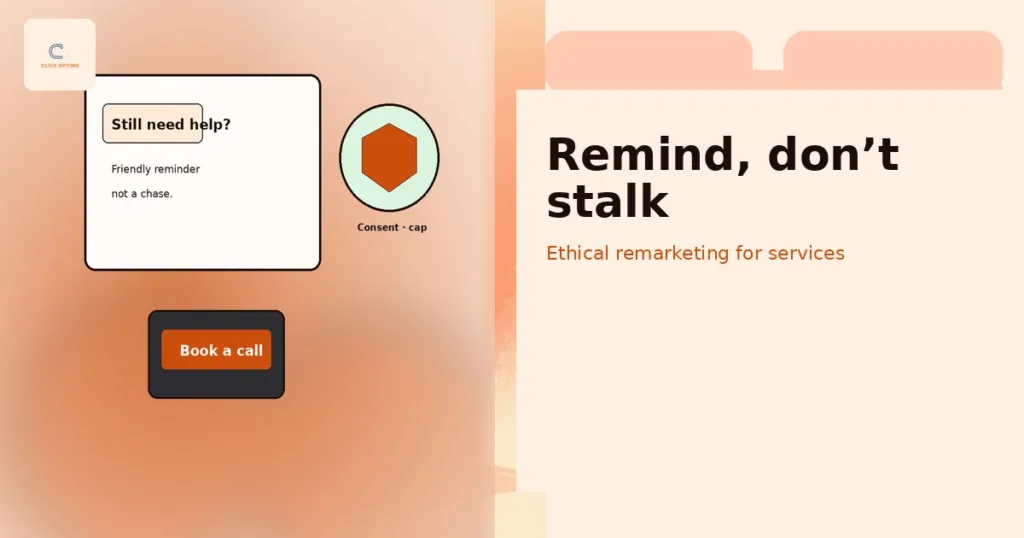
Exclusions protect trust and budget. Exclude recent converters (booked call, form thank-you, CRM “won”) for a sensible window so you do not chase people who already hired you. Exclude staff and known internal traffic where possible. Exclude sensitive path visitors when your vertical or policy requires it. Keep a living exclusion set the same way you keep negatives — owned, reviewed, not set-and-forgotten. Remarketing without exclusions is how “helpful reminder” becomes “why are they still following me?”
Do / Don’t: Do remessage money-page visitors with a clear call path. Don’t retarget converters and staff for weeks with the same urgent creative.
Creative that helps (not hounds)
Creative should clarify the offer, proof and easy next step: call, book, or short form. Lead with the job and area when honest; show a review excerpt or licence line; put the phone or book path in the ad experience where formats allow. Avoid fear-mongering, fake countdown timers and “we saw you looking at…” copy that sounds surveillance-heavy. Sensitive categories (health, legal distress, debt-adjacent themes) need extra caution — softer value, stronger consent hygiene, and often less Display aggression. Google’s personalised advertising policy also blocks remarketing lists and Customer Match for ads promoting many health, debt and personal-hardship services, so check eligibility before building lists.
Match creative to list intent: money-page viewers get service clarity; form abandoners get friction removal (“two fields, we call within X”); brand search defenders get trust and NAP consistency with local SEO and Ads. Rotate enough to avoid fatigue; do not rotate into gimmicks. The services hub is for browsers; remarketing creatives are for people who already raised a hand once.
Test one creative variable at a time: offer line, proof line or CTA — not a full redesign weekly. Service buyers notice repetition; they also notice bait. If a vertical forbids certain claims, put that rule in the ad account notes so freelancers cannot “improve” performance with risky copy. Helpful creative is constrained creative.
Frequency caps and duration norms (principles, not hard legal advice)
Cap frequency so the same person is not hammered daily across placements. Shorter, helpful bursts beat months of identical Display. Align duration with how long a typical buyer considers your service; emergency trades need shorter windows than complex professional engagements. Review caps when complaints, brand lift (or damage) anecdotes, or rising frequency with flat booked calls appear. These are operating principles for owners — not jurisdiction-specific legal advice. When in doubt, lower frequency and tighten lists.
Do/don’t cards for the team: Do remessage money-page visitors with hours, area and a single call path. Do exclude won customers for a cooling-off window. Don’t use medical or legal scare creatives for a traffic bump. Don’t keep someone in a list for six months because “audience size.” Ethical remarketing is operational discipline expressed as lists, caps and copy — not a slogan on a slide.
Consent, privacy and brand safety (high level)
Remarketing depends on tags, cookies or similar identifiers and — in many regions — consent. Owners should treat consent mode, CMP behaviour and tag firing as part of measurement maturity, not an afterthought bolted on after lists are live. For EEA and UK visitors, Google requires consent for personalised ads; people whose consent mode signal denies ad personalisation are not added to remarketing lists. Brand safety means avoiding placements and creatives that embarrass the firm next to junk inventory; prefer controlled high-intent surfaces when volume is limited. This section is high level and not legal advice — engage counsel or a qualified privacy specialist for your markets (US state rules, UK GDPR, PECR and the Data (Use and Access) Act 2025, AU/CA/NZ as applicable).
Owner checklist mindset: know what you collect, why, how long lists retain members, how to honour opt-outs, and who owns tag changes after a site redesign. Document exclusions and sensitive-category rules. If consent or tagging is unclear, pause expansion and fix foundations via Analytics & tracking before buying more remarketing reach.
Brand-safety reviews should include placement reports and a quick sample of where ads actually showed. If inventory quality is poor, tighten to managed placements or Search/RLSA-heavy mixes rather than “fixing” with louder creatives. Privacy and brand safety are operating disciplines; treat them like call-tracking hygiene — boring, documented, owned.
RLSA and brand defence vs broad Display
When lists are small — often the case for service SMEs — prefer RLSA (remarketing lists for search ads) and brand defence over forcing low-quality Display volume. RLSA lets you adjust bids or tailor search ads for people who already visited, while still requiring a search. Brand defence protects your name from competitors when prior visitors search again. Broad Display remarketing can work carefully with tight lists, strong creatives and caps — but it is where creepy frequency and junk placements appear first. Do not treat Display reach as proof of a healthy funnel.
ClickOptimo’s wedge prioritises Google Ads + SEO + tracking for measurable enquiries. Social retargeting may exist elsewhere in a business; it is not the core system here. Soft next step for paid structure: Google Ads for service businesses. Money pages that feed lists should stay sharp via SEO for service businesses and GBP for calls where local matters. When partners push “always-on everywhere” without exclusions or diary joins, use the same standards as briefing or firing a Google Ads agency.
When list size finally grows, resist the urge to unlock every Display network feature on day one. Expand with the same ethics: caps, exclusions, honest creatives, diary joins. Remarketing maturity is restraint under more data, not permission to stalk harder. Keep SEO money pages and Ads lists in sync so you remessage pages that still convert.
FAQs
Is remarketing useful for service businesses?
Yes when search foundations and tracking are solid. It can re-engage visitors who need a nudge—not invent demand from cold Display alone.
What is ethical remarketing?
Consent-aware tagging, respectful frequency, clear value in ads, sensible exclusions, and avoiding sensitive or misleading creatives.
Should service brands rely on social retargeting first?
ClickOptimo’s wedge prioritises Google Ads + SEO + tracking for measurable enquiries. Social may exist elsewhere; it is not the core system here.
How long should someone stay in a remarketing list?
Long enough to cover a typical consideration cycle, short enough to avoid fatigue—review by service type and cap frequency.
Do small sites have enough list size?
Often lists stay small. Focus on RLSA and brand defence; don’t force low-quality Display volume.
How can ClickOptimo help?
A Diagnostic checks whether remarketing is appropriate given tracking maturity. Book via /book/.
Next step: earn the reminder
If a Diagnostic finds tags firing before consent or lists built from every URL, pause remarketing expansion. Foundations beat clever audiences. Soft next step remains /book/ when Ads, consent and diary joins disagree.
Do not launch remarketing to paper over weak search, messy tags or landing pages that fail the call path. Build lists from money-page behaviour, exclude converters and staff, write helpful creatives, cap frequency, and prefer RLSA and brand defence when lists are small. Stay helpful; stay ethical. When you want a guided pass across Ads, tracking and whether remarketing belongs yet, book a short diagnostic.
Book a Growth Diagnostic — twenty minutes, gaps ranked by diary impact.
More context: Growth Diagnostic · services · Google Ads for service businesses
growth@clickoptimo.com · +91-8497982579