Table of Contents
- Brand is a decision shortcut, not a design project
- Where buyers check you before they call
- Why a stronger brand lowers your cost per booked call
- Seven trust signals that win the call
- How to measure whether your brand is working
- Common mistakes that undermine trust
- FAQs
- Next step: run a trust audit this week
When someone needs a boiler fixed, a tooth looked at or a contract reviewed, they rarely call the first business they see. They skim the results, open a couple of Google Business Profiles, glance at a website, and pick the one that feels safest. That moment of choosing is where your brand does its real work.
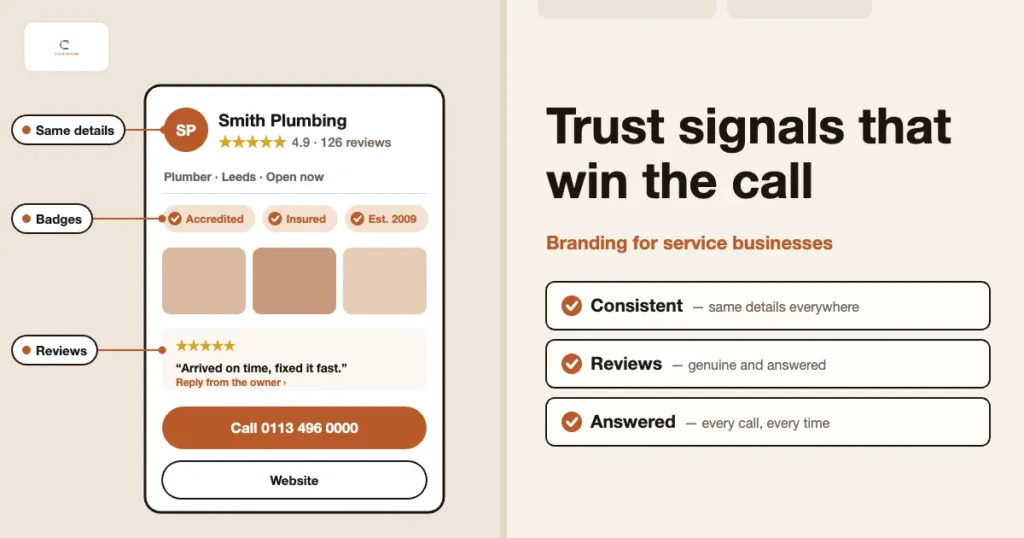
For a service business, brand is not the logo. It’s whether the buyer recognises you and trusts you enough to pick up the phone. Buyers check far more than a logo. Do your reviews look real? Does the number on your van match the one on Google? Does someone friendly answer? Each is a trust signal, and together they decide whether you win the call.
This guide is for owners and marketing leads of service businesses — trades, clinics, home services and professional firms — across the US, UK, AU, CA and NZ. It covers where buyers check you before they call, the seven trust signals that matter most, why a stronger brand lowers your cost per booked call, how to measure it, and the mistakes that quietly undo the work.
Your brand is not what your logo says. It’s what the buyer sees in the few seconds before they decide who to call.
Brand is a decision shortcut, not a design project
Most service purchases are made under some pressure. The buyer can’t judge a plumber’s work or a solicitor’s advice in advance, so they look for proxies: other people’s opinions, signs of professionalism, and evidence that you’re real and established.
That’s what brand means here: the sum of those proxies, seen where the buyer compares you with two or three alternatives. A brand that helps makes the choice feel low-risk. A small doubt is enough to send them to the next listing.
Where buyers check you before they call
Buyers don’t meet your brand in one place. They piece it together across several touchpoints, often within minutes. The table maps the main ones.
| Touchpoint | What the buyer checks | Trust signal that helps |
|---|---|---|
| Search results | Is this a real, local business that does what I need? | A clear business name, accurate services and locations in page titles, review stars where shown |
| Google Business Profile | Rating, recent reviews, photos, opening hours | A steady flow of genuine reviews with replies, real photos, correct hours and categories |
| Website | Do they look professional? Who are they? Roughly what will it cost? | Real team and job photos, accreditations near the enquiry form, pricing guidance, a visible phone number |
| Phone call | Is someone helpful and competent? | Answered quickly, business name stated, a clear next step offered |
| Van, uniform or site visit | Do they match what I saw online? | The same name, logo and colours as online; tidy, identifiable staff |
| Follow-up | Do they keep their promises? | Confirmation messages, on-time arrival, a polite review request after the job |
Notice how little of this is about design. Most trust is earned by details being accurate, consistent and human, which is cheap to fix.
Why a stronger brand lowers your cost per booked call
Brand is often treated as a “nice to have” apart from performance marketing. In practice it feeds straight into the numbers. If you judge marketing by cost per booked call rather than cost per lead, brand is one of the biggest levers you have. Three mechanisms explain why.
- More branded searches. When people remember your name from a van, a referral or a past job, they search for you directly. Those searches are usually cheaper to capture and more likely to become calls.
- Higher conversion rates. A visitor who sees real reviews, real photos and clear pricing has fewer reasons to hesitate. The same traffic produces more enquiries, so each booked call costs less.
- Better ad click-through. In paid search, a recognisable name and a strong review profile can make your ad the one people pick from several similar ones. More clicks from the same impressions means your budget works harder.
If more of the people who see you choose you, every channel you pay for becomes more efficient. That’s also why brand work and local SEO for Google Maps reinforce each other: the map results are where many buyers build their shortlist.
Seven trust signals that win the call
These are the signals that make the biggest difference for most service businesses. Work through them in order; the early ones are cheapest to fix.
1. Consistent name, phone number and details everywhere
Your business name, address, phone number, hours and service area should match exactly across your website, Google Business Profile, directories, social profiles, quotes, invoices and vehicles. Small differences, like an old mobile number on a directory, make you look less established and can confuse search engines.
Pick one version of each detail, write it down, and update every place it appears. Then roll out any future change everywhere in the same week.
2. A steady flow of genuine reviews, with replies
Buyers read recency as much as rating. Forty reviews from three years ago look weaker than twenty from the last six months. The aim is a steady flow, not a one-off burst.
Build the request into your process: a text or email after each completed job, with a direct link to your review page. Reply to every review, good and bad. A calm, specific reply to a complaint often does more for trust than another five-star rating. Our guide to getting more calls from your Google Business Profile covers the profile side in more detail.
3. Real photos of your team and your work
Buyers spot stock photos and discount them straight away. Real photos of your technicians, clinicians or advisers, premises and finished jobs prove you exist and show what working with you looks like.
Phone photos are fine if they’re well lit and in focus. Use them on your key pages and your Google Business Profile, and add new ones regularly. Ask permission before photographing customers’ homes, and never show anything that identifies a patient or client.
4. Accreditations and memberships where the decision is made
Licences, insurance, trade body memberships, professional registrations and manufacturer approvals are powerful because someone other than you has checked them. But they only help if the buyer sees them at the moment of choosing.
Many sites bury accreditations in the footer. Move them next to the enquiry form, the phone number and the booking button. On service pages and landing pages built to turn ad clicks into booked calls, a short row of relevant badges near the call to action is usually worth more than a long paragraph about your history. Only show memberships you currently hold.
Try the stranger test. Ask someone who doesn’t know your business to search for your service in your area on their phone, find you, and decide whether they’d call. Watch without helping. Every moment they hesitate is a trust gap, and most are small, fixable details.
5. Clear pricing guidance
Many service businesses avoid publishing prices because every job is different. That’s understandable, but silence on price makes buyers nervous. They fear a shock quote or a wasted call.
You don’t need a full price list. “From” prices, typical ranges, call-out fees, what’s included in a first consultation, or a short explanation of how quotes work all reduce that anxiety. Clear pricing guidance also filters out enquiries that were never going to book, which keeps your team’s time free for qualified calls.
6. A recognisable, consistent look and tone
This is where the logo comes in, along with colours, typefaces and tone. The goal is recognition: a buyer who saw your van last month should feel a flicker of familiarity when your listing appears.
Consistency matters more than sophistication. Use the same logo files, colours and tone across your website, profiles, vehicles, uniforms, quotes and emails. If your site feels dated or out of step with how you present in person, check the signs your website is costing you leads before spending on anything new. When you do redesign, build it around conversion-focused website design rather than looks alone.
7. How calls are answered
Every other signal leads here. If the phone rings out or is answered by someone rushed and unclear, the work done elsewhere is wasted.
Agree a standard greeting that includes your business name. Make sure calls are answered during your advertised hours, or routed to someone who can help. Give whoever answers a short guide for the common questions: availability, rough pricing and next steps. And track missed calls, because a missed call from a ready buyer is one of the most expensive leads you can lose.
How to measure whether your brand is working
Brand is measurable if you track the right things over months rather than days. Track these five.
- Branded search in Search Console. In the Performance report, use the Branded queries filter where it’s available, or filter by queries containing your business name. Rising clicks and impressions on those queries suggest more people remember you. Our guide to using Search Console for your money pages shows how to set up useful filters.
- Google Business Profile actions. Your profile’s performance view shows calls, website clicks and direction requests. Watch these alongside your review count.
- Website conversion rate. The share of visitors who call, submit a form or book. If your trust improvements are working, this should rise for the same kind of traffic.
- Review count and rating trend. Count new reviews per month and watch the average rating over time, not just the headline number.
- Cost per booked call. The number that ties everything together: total marketing spend divided by booked calls, not raw enquiries. You’ll need tracking that records booked calls, not just clicks, to get this right.
Review these monthly and log each trust change you make. Over a quarter, you’ll see which changes moved the numbers.
Common mistakes that undermine trust
- Stock photos everywhere. Generic smiling models suggest you have nothing real to show. Replace them with genuine photos of your team and work, even simple ones.
- Fake or incentivised reviews. Google’s policies prohibit fake reviews and offering incentives in exchange for reviews. Breaking them risks removed reviews and profile restrictions, such as a pause on new reviews or a public warning that fake reviews were removed. Fake reviews are now also banned under consumer law in the UK and US. Ask every customer, and let the reviews be honest.
- Rebrands that break consistency. A new name or logo rolled out on the website but not on Google, directories, vans or invoices creates exactly the mismatch buyers distrust. Plan the full rollout before launch day.
- Spending on the logo first. A new logo won’t fix unanswered calls, thin reviews or missing prices. Fix the signals buyers actually check, then refresh the look if it still needs it.
- Hiding accreditations and contact details. A phone number buried in the footer, or badges tucked away on an About page, won’t help anyone decide. Put them where the decision happens, including on location pages that convert.
FAQs
Is branding worth it for a small service business?
Yes, as long as you treat branding as trust signals rather than a design project. Consistent details, genuine reviews, real photos and well-answered calls cost little and affect every enquiry you get. A visual rebrand can usually wait.
Do we need a new logo?
Usually not straight away. If your current logo is legible and used consistently, it’s doing its job. Consider a refresh only when it looks out of date next to competitors or doesn’t work at small sizes, and plan the rollout across every touchpoint before you launch it.
How many reviews do we need?
There’s no magic number. What matters is that your reviews are recent, genuine and at least comparable to the businesses you appear next to in the map results. Aim for a steady monthly flow from a consistent post-job request rather than chasing a single target.
How long before brand improvements show up in our numbers?
Some changes, like better call handling or pricing guidance on key pages, can affect conversion rates within weeks. Branded search and review growth build more slowly, so judge them over a quarter or longer. Keep a note of what you changed and when, so you can link cause and effect.
How can ClickOptimo help?
We audit the trust signals buyers check across search, your Google Business Profile, your website and your phone handling, then fix the gaps that cost you booked calls. That can include website design built around trust and conversion, a simple review process, and the tracking to measure the impact. Book via /book/.
Next step: run a trust audit this week
This week, search for your service and location on your phone, as a buyer would. Open your profile, your website and two competitors’ profiles. Note where your details differ, where you rely on stock photos, where accreditations and pricing are missing, and whether your phone is answered with your business name. Pick the three cheapest fixes and finish them before Friday.
Book a Growth Diagnostic — we’ll map your trust signals against your competitors and show which gaps are costing you the most booked calls.
More context: Local SEO and Google Ads for a lower CPA · Ethical remarketing for service businesses · Mobile-friendly websites that win booked calls
growth@clickoptimo.com · +91-8497982579