Table of Contents
Pretty reports. Empty diary. That pattern is how service owners end up funding opaque Google Ads retainers for months — clicks up, booked calls flat, and nobody able to define a conversion sales would recognise. This guide helps you brief an agency properly or exit a bad fit with clarity: questions to ask, red flags in the first 60–90 days, and how to fire without burning your data.
Written for service businesses — home services, trades, clinics, professional firms — across the US, UK, AU, CA and NZ. No competitor smears. No invented “clients left X” stories. Soft second opinion when you want measurement-first eyes on the account: a Growth Diagnostic via /book/. When the rebuild needs Ads, SEO and tracking in one system: the 90-Day Lead Engine.
Hiring and firing are both briefing problems. A weak brief attracts vanity reporting; a clear brief either gets a serious partner or surfaces a mismatch before you burn a quarter. Use this post as a working checklist you can paste into an email or RFP — then insist the answers appear in the scope of work, not only in the sales call.
What a good agency brief must include
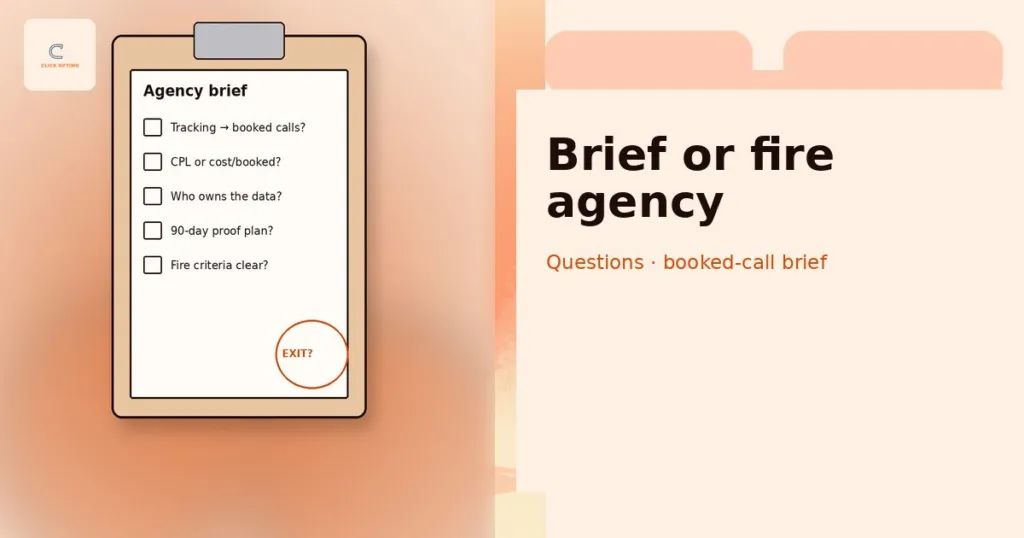
A brief is not a logo pack and a vague “get more leads.” For Google Ads for service businesses, include at least:
- Offer and exclusions — what you sell, what you refuse, ticket expectations.
- Service areas — geo rules the phone team will enforce.
- Capacity and lead-handling SLA — answer times, who books, after-hours rules.
- North-star metric — booked call / sales-accepted appointment, not soft micro-conversions. Align language with cost per lead vs cost per booked call.
- Reporting cadence — weekly or fortnightly reconcile to the diary, not only Ads columns.
- Brand and compliance — claims you can make; regulated categories noted.
Without those, agencies invent proxies. You then argue about CTR while the diary stays quiet. Soft proof of serious method — illustrative, not promises — sits on Results. Browse the services hub when you want Ads, SEO and tracking scoped as one system rather than three silos.
Add commercial boundaries: monthly media budget bands, industries or claims you will not run, and whether remarketing is in or out for your category. Ambiguity here becomes “we thought you wanted volume” later. Put the north-star metric in the first page of the SOW in plain English a sales lead would accept.
Access and tracking non-negotiables
You keep admin ownership of Google Ads. Agencies manage; they do not hostage the account. Require GA4/GTM (or equivalent) visibility, call-tracking configuration rights where used, and CRM/calendar access enough to verify booked stages. Broken or vanity tracking is not a “phase two” nicety — see Analytics & tracking, track booked calls, not clicks, and the minimum viable measurement stack. If a partner resists access, that is the brief failing early.
Twenty questions before you hire
Use these in discovery calls or RFPs. Grouped so you can score answers, not vibes.
Measurement (1–5)
- How do you define a conversion for a service business like ours?
- Will primary conversions be sales-verifiable (enquiry, meaningful call, booked stage)?
- How do you handle call tracking without breaking Ads attribution?
- How often do you reconcile Ads conversions to CRM/diary booked calls?
- Who owns GA4/GTM changes, and how are duplicates prevented?
Waste control (6–10)
- How often do you mine search terms, and who approves negatives?
- What is your process for DIY, jobs-we-don’t-do, and wrong-geo themes?
- How do you separate brand and non-brand in reporting?
- What would you pause in the first two weeks if waste is obvious?
- Can you walk a recent anonymised waste-cleanup example (no fake metrics)?
Local / SEO interplay (11–14)
- How do GBP and local SEO insights inform Ads themes?
- Do money pages and ad groups share one job list?
- Who owns landing relevance when Quality or bounce looks wrong?
- How do you avoid SEO and Ads teams contradicting negatives or geos? (See local SEO + Ads and SEO for service businesses.)
Reporting and incentives (15–20)
- What does the weekly report include beyond spend, clicks and CTR?
- How are you incentivised — retainer, % of spend, performance — and where are conflicts?
- Will we retain admin ownership and exportable history?
- What happens if tracking is broken for a full week?
- What decisions require owner approval vs agency discretion?
- How do you define success at day 60 and day 90 in diary terms?
Patterns from the wasted Google Ads spend checklist make questions 6–10 concrete. Prefer partners who answer in booked-call language, not product loyalty.
Score answers 0–2 (evasive / partial / clear and diary-tied). A partner who aces measurement but fails waste control will still burn budget. A partner who mines search terms brilliantly but cannot explain incentives may scale spend against your interest. Holistic scores beat one shiny case study.
Bring your own baseline if you have it: last month’s Spend | Enquiries | Booked. Ask them what they would change in the first fourteen days. Vague “full account audit” without examples of decisions is a stall. Specificity — even if they disagree with your current setup — is a good sign.
Answers that should worry you
Worry when you hear: “We optimise to all conversions” with no sales definition; “Call tracking comes later”; “Search terms are fine on autopilot”; “SEO is a different team, we don’t touch it”; “We need MCC ownership you can’t access”; “Success is impression share / Quality Score alone”; or guarantees of lead volume without knowing capacity. Price alone is not the signal — ultra-low retainers often mean thin senior time — but measurement discipline is.
Brief test: Ask them to write one sentence: “We will optimise Google Ads toward ___ that sales can verify.” If they cannot fill the blank, do not sign.
Red flags in the first 60–90 days
After hire, watch behaviour — not slide design.
- No regular search-term hygiene; junk themes keep spending.
- Vanity KPIs dominate after you asked for booked-call reporting.
- Landing and money-page neglect while bids rise.
- “Blame the algorithm” loops with no conversion or offer diagnosis.
- Tracking still broken, duplicated or undefined past the agreed window.
- Resistance to CRM/diary reconcile or owner admin access.
- Creative and assets that ignore exclusions you briefed.
Sixty to ninety days is enough to see a plan, not enough to excuse permanent fog. If nothing in the account reflects your brief, you do not have a ramp — you have inertia.
Also watch meeting quality. If every call is a tour of the Ads UI with no diary numbers, interrupt and ask for booked-call reconcile. If the agency cannot produce search-term samples when asked, assume hygiene is not happening. Document requests and non-answers; that paper trail makes a professional exit easier and fairer.
Documentation you should already have
By the end of month one you should hold: account access map, conversion list with primary vs secondary, negative/theme log, money-page list, and a sample weekly scorecard (Spend | Enquiries | Booked). If none of that exists, document the gap in writing before you escalate or exit.
Keep copies of the original brief and any agreed KPIs. When you fire, you can state the gap without personal attacks: “We asked for weekly booked-call reconcile and search-term hygiene; after ninety days neither exists.” That framing protects relationships and keeps the focus on commercial reality.
How to fire professionally (without burning data)
Exit calmly. Protect assets first.
- Export — campaigns, ads, audiences, negatives, change history notes you need; download reports you may not see later.
- Confirm ownership — your admin on Ads, Analytics, call tracking, domain/DNS, and landing CMS.
- Conversion ownership — know which tags and actions are yours; do not let a departing partner delete the only clean conversion without a handoff.
- Revoke access in order — billing and sensitive tools after exports; remove agency users once you have backups.
- Notify — short professional note stating end date and access removal; skip public drama.
- Stabilize — pause reckless automations if needed; keep phones answered while you re-brief.
A measurement-first second opinion helps you see whether the account needs a new partner or a system rebuild. Book via /book/.
Do not delete conversion tags in anger on day one of the exit. Replace access and verify the next partner or internal owner can see history first. Burning the scoreboard because you are frustrated with the coach leaves you blind for the rebuild. Professional exits preserve learning.
If billing is on the agency’s MCC with you as a shadowed user only, fix ownership before or during exit — that is a structural risk, not a paperwork nicety. Future you will thank present you.
Briefing an integrated Ads + SEO partner instead
Service demand mixes Map pack, organic, paid and branded search. Siloed PPC and SEO vendors often maintain opposite negatives, duplicate geos and money pages Ads cannot use. Briefing an integrated partner means one job list, shared definitions of booked calls, and weekly reconcile across channels — not three decks that never meet the diary.
When the gap is structural, a time-boxed rebuild beats another thin retainer. Soft path: the 90-Day Lead Engine aligns Google Ads, SEO and tracking for service owners who want clarity, not mystery invoices.
Integrated briefing also surfaces capacity and SEO/Ads role clarity: what paid must cover while Maps and organic mature, and what paid should stop buying once local presence earns the click. That conversation belongs in the SOW. Without it, you hire a PPC vendor to rent discovery forever.
FAQs
What should I include in a Google Ads agency brief?
Service offer and exclusions, service areas, capacity, how leads are handled, the definition of a booked call, tracking access, and reporting cadence tied to diary outcomes.
What questions should I ask a Google Ads agency?
Ask how they define conversions, how often they mine search terms, how they handle call tracking, whether SEO/local insights inform Ads, and how they are incentivised beyond spend volume.
When should I fire a Google Ads agency?
When reporting stays vanity-heavy after clear requests, waste persists without a plan, tracking remains broken, or they cannot connect activity to booked calls within an agreed window.
Who owns the Google Ads account?
You should. Agencies manage; owners retain admin ownership and exportable history.
Is a cheaper retainer always worse?
Not always—but ultra-low retainers often mean thin senior time. Judge by measurement discipline and booked-call focus, not price alone.
How can ClickOptimo help if I’m unsure?
Book a Growth Diagnostic for a measurement-first second opinion: /book/.
Next step: brief for the diary, or exit cleanly
Do not renew another quarter of unread reports. Write the north star into the brief, ask the twenty questions, and watch the first 60–90 days for search-term hygiene and diary reconcile. If the partner cannot define a booked call, choose a cleaner exit and a measurement-first reset.
Book a Growth Diagnostic — twenty minutes, gaps ranked by diary impact.
More context: Growth Diagnostic · 90-Day Lead Engine · services
growth@clickoptimo.com · +91-8497982579